

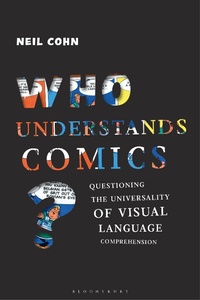
Who Understands Comics?
Questioning the Universality of Visual Language Comprehension
1st Edition
Published on 12. November 2020
256 pages
978-1-350-15606-7 (ISBN)
Description

**Nominated for the 2021 Eisner Award for Best Academic/Scholarly Work**
Drawings and sequential images are so pervasive in contemporary society that we may take their understanding for granted. But how transparent are they really, and how universally are they understood?
Combining recent advances from linguistics, cognitive science, and clinical psychology, this book argues that visual narratives involve greater complexity and require a lot more decoding than widely thought. Although increasingly used beyond the sphere of entertainment as materials in humanitarian, educational, and experimental contexts, Neil Cohn demonstrates that their universal comprehension cannot be assumed. Instead, understanding a visual language requires a fluency that is contingent on exposure and practice with a graphic system. Bringing together a rich but scattered literature on how people comprehend, and learn to comprehend, a sequence of images, this book coalesces research from a diverse range of fields into a broader interdisciplinary view of visual narrative to ask: Who Understands Comics?
Drawings and sequential images are so pervasive in contemporary society that we may take their understanding for granted. But how transparent are they really, and how universally are they understood?
Combining recent advances from linguistics, cognitive science, and clinical psychology, this book argues that visual narratives involve greater complexity and require a lot more decoding than widely thought. Although increasingly used beyond the sphere of entertainment as materials in humanitarian, educational, and experimental contexts, Neil Cohn demonstrates that their universal comprehension cannot be assumed. Instead, understanding a visual language requires a fluency that is contingent on exposure and practice with a graphic system. Bringing together a rich but scattered literature on how people comprehend, and learn to comprehend, a sequence of images, this book coalesces research from a diverse range of fields into a broader interdisciplinary view of visual narrative to ask: Who Understands Comics?
More details
Edition
1. Auflage
Language
English
Place of publication
London
United Kingdom
Publishing group
Bloomsbury Publishing PLC
Illustrations
40 bw illus
File size
2,63 MB
ISBN-13
978-1-350-15606-7 (9781350156067)
Copyright in bibliographic data and cover images is held by Nielsen Book Services Limited or by the publishers or by their respective licensors: all rights reserved.
Schweitzer Classification
Other editions
Additional editions
Book
11/2020
Bloomsbury Academic
€35.00
Shipment within 15-20 days
Person
Neil Cohn is Associate Professor of Communication and Cognition at Tilburg University, the Netherlands. He is the author of The Visual Language of Comics (2013) and editor of The Visual Narrative Reader (2016).
Content
1. An Assumption of Universality
2. Comprehending Visual Narratives
3. Cross-cultural Diversity of Visual Languages
4. Cross-cultural Comprehension of Visual Languages
5. Development of Visual Narrative Comprehension
6. Variation Between Fluent Comprehenders
7. Visual Narrative Comprehension in Clinical Populations
8. Graphic Narratives and Filmed Narratives
9. Visual Language Fluency
References
Index
2. Comprehending Visual Narratives
3. Cross-cultural Diversity of Visual Languages
4. Cross-cultural Comprehension of Visual Languages
5. Development of Visual Narrative Comprehension
6. Variation Between Fluent Comprehenders
7. Visual Narrative Comprehension in Clinical Populations
8. Graphic Narratives and Filmed Narratives
9. Visual Language Fluency
References
Index
