

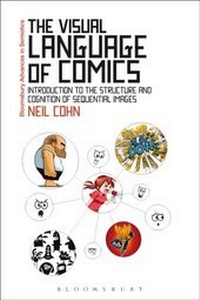
The Visual Language of Comics
Introduction to the Structure and Cognition of Sequential Images.
1st Edition
Published on 5. December 2013
256 pages
978-1-4411-8324-8 (ISBN)
Description

Drawings and sequential images are an integral part of human expression dating back at least as far as cave paintings, and in contemporary society appear most prominently in comics. Despite this fundamental part of human identity, little work has explored the comprehension and cognitive underpinnings of visual narratives-until now.
This work presents a provocative theory: that drawings and sequential images are structured the same as language. Building on contemporary theories from linguistics and cognitive psychology, it argues that comics are written in a visual language of sequential images that combines with text. Like spoken and signed languages, visual narratives use a lexicon of systematic patterns stored in memory, strategies for combining these patterns into meaningful units, and a hierarchic grammar governing the combination of sequential images into coherent expressions. Filled with examples and illustrations, this book details each of these levels of structure, explains how cross-cultural differences arise in diverse visual languages of the world, and describes what the newest neuroscience research reveals about the brain's comprehension of visual narratives. From this emerges the foundation for a new line of research within the linguistic and cognitive sciences, raising intriguing questions about the connections between language and the diversity of humans' expressive behaviours in the mind and brain.
This work presents a provocative theory: that drawings and sequential images are structured the same as language. Building on contemporary theories from linguistics and cognitive psychology, it argues that comics are written in a visual language of sequential images that combines with text. Like spoken and signed languages, visual narratives use a lexicon of systematic patterns stored in memory, strategies for combining these patterns into meaningful units, and a hierarchic grammar governing the combination of sequential images into coherent expressions. Filled with examples and illustrations, this book details each of these levels of structure, explains how cross-cultural differences arise in diverse visual languages of the world, and describes what the newest neuroscience research reveals about the brain's comprehension of visual narratives. From this emerges the foundation for a new line of research within the linguistic and cognitive sciences, raising intriguing questions about the connections between language and the diversity of humans' expressive behaviours in the mind and brain.
Reviews / Votes
[Neil Cohn's] theory, presented in The Visual Language of Comics, is provocative ... If he is right, the hidden logic of cartoon panels could provide new vistas on art, language and creative development. * The Observer * [Cohn's] work exhibits a dogged quest for rigour that gives this book an authoritative tone. [ . . . ] Perhaps the biggest question the book asks is one that demands consideration by any current or future researcher: 'why should the brain create several unique and diverse ways to handle different behaviours when it can efficiently make use of various general underlying structures'? Those with the desire to answer . . . will find this book a thoughtful and useful companion to their studies. * The Comics Grid * The most unified and accessible explanation of the theory [of visual "language"] this far. * Scandinavian Journal of Comic Art * Cohn's book represents a major break away from previous discussions of linguistic structures in other media ... He manages to combine a sophisticated theory model with much needed empirical experiments ... This is an innovative approach for comic book research, connecting systematic linguistics and cognitive studies in new ways that are a valuable extension of previous discussions. * Closure (Bloomsbury Translation) * Cohn writes succinctly, using language familiar to discourse analysts ... [and] draws on the work of others as well as his own original research. * Discourse Studies * Neil Cohn thinks about the comics medium and visual literacy on very deep and enlightening levels. In The Visual Language of Comics, Cohn shares his research and insights on how the mind works when processing sequential visuals. It's fascinating reading for anyone interested in visual communication. Neil Cohn is diving deeper into comics and the brain than anyone I know now. Neil Cohn's The Visual Language of Comics is a smart, carefully organized, and exceptionally well-argued work of comics scholarship. I suspect it will become one of a very small number of truly crucial texts in the burgeoning field of comics studies. The book provides an original yet persuasive account of the relationship of comics and language and introduces key terms and conceptual distinctions that are likely to become part of the common sense of comics analysis and criticism. It also explores the ways in which comics have been used as tools of communication and self-expression across a variety of cultural contexts. Over the past decade Neil Cohn has published a number of important research articles on comics that make use of his training in linguistics, psychology, and neuroscience. The Visual Language of Comics builds on this interdisciplinary scholarship but it also offers new insights and opens up new avenues of inquiry. Recommended for anyone with an interest in comics, language, and what Richard Gregory calls "the eye-brain system." Being able to tell stories with images is an important and perhaps unique human ability. Neil Cohn has done us all a favor, by analyzing how we can use a visual language theory to analyze comics and other forms of graphic communication; to think deeply about language and the mind. His years of deep thinking, and research, show in this new and provocative book In this pioneering book, Neil Cohn opens up a whole new domain of cognitive science: the study of how we derive meaning from sequential images.While borrowing much of his approach from theoretical linguistics and psycholinguistics, Cohn is careful to let the character of the phenomena speak for themselves, appealing to a rich and fascinating selection of examples from a wide range of graphic traditions.His results illuminate the parallels and sharpen the differences among different human cognitive systems. This book offers more than the title implies, transcending The Visual Language of Comics to reveal the structural, rule governed system that constitutes the visual language used in many forms of contemporary communication. One of the most interesting aspects of Cohn's work is his exploration of the lexicon and grammar of visual language as employed in "dialects" that vary across cultures. Cohn's arguments are rigorous, but clearly, even entertainingly, supported with scores of visual examples and explanations. After reading this book you'll never look at comics the same way, and your view of language will be broadened as well. Neil Cohn is a linguist, a cognitive psychologist, and a graphic artist. In this pathbreaking book he brings his diverse skills together to explore and reveal underlying structures of visual language. Careful study of visual narrative in several cultures shows that comics are beautifully patterned and generative, comparable to language and music. Cohn elaborates what he calls the "visual-graphic modality of language," pointing to a wealth of research possibilities in cognitive neurology, psycholinguistics, and cultural anthropology. Neil Cohn introduces a new and rigorous set of tools for discussing comics and visual narrative that will influence practitioners as well as academics. His arguments confirm many intuitions of cartoonists about the way comics work while at the same time deflating numerous others. I believe it will significantly enrich the discourse in this still-developing area of study. Combining expertise in psychology and linguistics with skills in draftsmanship, Cohn explores the analogies between comics and verbal language with exciting results. By unveiling patterns in all stylistic dimensions of comics' visuals, this book is not just indispensable reading for comics scholars, but also constitutes a major contribution to the discipline of visual studies more generally. Very useful to introduce students to the core elements of comics and to show them how meaning is conveyed by pictorial elements. * Jutta Rymarczyk, Heidelberg University of Education, Germany * Very coherent good level of theory and terminology. * Patricia Kennon, Maynooth University *More details
Series
Edition
1. Auflage
Language
English
Place of publication
New York
United States
Publishing group
Bloomsbury Publishing PLC (Digital)
Illustrations
81
ISBN-13
978-1-4411-8324-8 (9781441183248)
Copyright in bibliographic data and cover images is held by Nielsen Book Services Limited or by the publishers or by their respective licensors: all rights reserved.
Schweitzer Classification
Other editions
Additional editions
Neil Cohn
The Visual Language of Comics
Introduction to the Structure and Cognition of Sequential Images.
Book
12/2013
Bloomsbury Academic
€45.00
Shipment within 15-20 days
Neil Cohn
The Visual Language of Comics
Introduction to the Structure and Cognition of Sequential Images.
Book
12/2013
Bloomsbury Academic USA
€113.00
Article exhausted; check different version
Person
Neil Cohn is an internationally recognized scholar for his research on the overlap of sequential images and language in cognition. He is the author of Early Writings on Visual Language and Meditations.
Content
Chapter 1. Introducing Visual Language
SECTION 1: STRUCTURE OF VISUAL LANGUAGE
Chapter 2. The Visual Lexicon, Part 1: Visual morphology
Chapter 3. The Visual Lexicon, Part 2: Panels and Constructions
Chapter 4. Visual Language Grammar: Narrative Structure
Chapter 5. Navigation of External Compositional Structure
Chapter 6. Cognition of Visual Language
SECTION 2: VISUAL LANGUAGE ACROSS THE WORLD
Chapter 7. American Visual Language
Chapter 8. Japanese Visual Language
Chapter 9. Central Australian Visual Language
Chapter 10. The Principle of Equivalence
SECTION 1: STRUCTURE OF VISUAL LANGUAGE
Chapter 2. The Visual Lexicon, Part 1: Visual morphology
Chapter 3. The Visual Lexicon, Part 2: Panels and Constructions
Chapter 4. Visual Language Grammar: Narrative Structure
Chapter 5. Navigation of External Compositional Structure
Chapter 6. Cognition of Visual Language
SECTION 2: VISUAL LANGUAGE ACROSS THE WORLD
Chapter 7. American Visual Language
Chapter 8. Japanese Visual Language
Chapter 9. Central Australian Visual Language
Chapter 10. The Principle of Equivalence
