

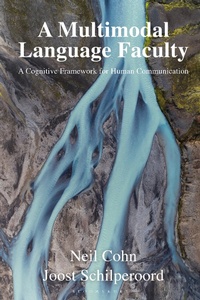
A Multimodal Language Faculty
A Cognitive Framework for Human Communication
1st Edition
Published on 16. May 2024
352 pages
978-1-350-40243-0 (ISBN)
Description

Natural human communication is multimodal. We pair speech with gestures, and combine writing with pictures from online messaging to comics to advertising. This richness of human communication remains unaddressed in linguistic and cognitive theories which maintain traditional amodal assumptions about language. What is needed is a new, multimodal paradigm.
This book posits a bold reorganization of the structures of language, and heralds a reconsideration of its guiding assumptions. Human expressive behaviors like speaking, signing, and drawing may seem distinct, but they decompose into similar cognitive building blocks which coalesce in emergent states from a singular multimodal communicative architecture. This cognitive model accounts for unimodal and multimodal expression across all of our modalities, providing a "grand unified theory" that incorporates insights from formal linguistics, cognitive semantics, metaphor theory, Peircean semiotics, sign language, gesture, visual language, psycholinguistics, and cognitive neuroscience. Such a perspective reconfigures how we understand linguistic structure, diversity, universals, innateness, relativity, and evolution. A Multimodal Language Faculty directly confronts centuries-old notions of language and offers a compelling reimagination of what language is and how it works.
This book posits a bold reorganization of the structures of language, and heralds a reconsideration of its guiding assumptions. Human expressive behaviors like speaking, signing, and drawing may seem distinct, but they decompose into similar cognitive building blocks which coalesce in emergent states from a singular multimodal communicative architecture. This cognitive model accounts for unimodal and multimodal expression across all of our modalities, providing a "grand unified theory" that incorporates insights from formal linguistics, cognitive semantics, metaphor theory, Peircean semiotics, sign language, gesture, visual language, psycholinguistics, and cognitive neuroscience. Such a perspective reconfigures how we understand linguistic structure, diversity, universals, innateness, relativity, and evolution. A Multimodal Language Faculty directly confronts centuries-old notions of language and offers a compelling reimagination of what language is and how it works.
More details
Edition
1. Auflage
Language
English
Place of publication
London
United Kingdom
Publishing group
Bloomsbury Publishing PLC
Target group
Professional and scholarly
Illustrations
83 bw illus
ISBN-13
978-1-350-40243-0 (9781350402430)
Copyright in bibliographic data and cover images is held by Nielsen Book Services Limited or by the publishers or by their respective licensors: all rights reserved.
Schweitzer Classification
Other editions
Additional editions
Neil Cohn | Joost Schilperoord
A Multimodal Language Faculty
A Cognitive Framework for Human Communication
Book
approx. 12/2025
Bloomsbury Academic
€45.00
Not yet published
Neil Cohn | Joost Schilperoord
A Multimodal Language Faculty
A Cognitive Framework for Human Communication
Book
06/2024
Bloomsbury Academic
€148.80
Shipment within 15-20 days
Persons
Neil Cohn is Associate Professor of Cognition and Communication at Tilburg University, Netherlands. Cohn's books include The Visual Language of Comics (Bloomsbury, 2013) and the 2021 Eisner-nominated Who Understands Comics? (Bloomsbury, 2020), which establish the linguistic and cognitive study of graphic communication.
Joost Schilperoord is Assistant Professor of Cognition and Communication at Tilburg University, the Netherlands. He is best known for his research on language, graphics, multimodality, and cognition.
Joost Schilperoord is Assistant Professor of Cognition and Communication at Tilburg University, the Netherlands. He is best known for his research on language, graphics, multimodality, and cognition.
Content
List of Figures
List of Tables
Part I: Foundations
1. Reimagining Language
Part II. Modalities
2. What is a Modality?
3. Interfacing Between Modalities
Part III: Meaning
4. Conceptual Structures for Multiple Modalities
5. Multimodal Semantic Interactions
Part IV: Grammar
6. The Complexity Hierarchy
7. Interactions Between Combinatorial Schemas
Part V: Multimodality
8. Unimodal Expressions in a Multimodal Model
9. Independent Multimodal Interactions
10. Substitutive Multimodal Interactions
Part VI: A Multimodal Language Faculty
11. Consequences of a Multimodal Language Faculty
12. Evolution of a Multimodal Language Faculty
13. Towards a Multimodal Linguistics
References
Index
List of Tables
Part I: Foundations
1. Reimagining Language
Part II. Modalities
2. What is a Modality?
3. Interfacing Between Modalities
Part III: Meaning
4. Conceptual Structures for Multiple Modalities
5. Multimodal Semantic Interactions
Part IV: Grammar
6. The Complexity Hierarchy
7. Interactions Between Combinatorial Schemas
Part V: Multimodality
8. Unimodal Expressions in a Multimodal Model
9. Independent Multimodal Interactions
10. Substitutive Multimodal Interactions
Part VI: A Multimodal Language Faculty
11. Consequences of a Multimodal Language Faculty
12. Evolution of a Multimodal Language Faculty
13. Towards a Multimodal Linguistics
References
Index
