

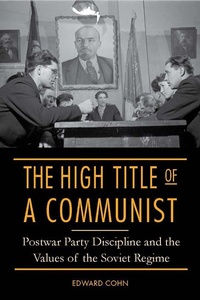
The High Title of a Communist
Postwar Party Discipline and the Values of the Soviet Regime
Published on 19. June 2015
260 pages
978-1-60909-179-8 (ISBN)
Description

Between 1945 and 1964, six to seven million members of the Communist Party of the Soviet Union were investigated for misconduct by local party organizations and then reprimanded, demoted from full party membership, or expelled. Party leaders viewed these investigations as a form of moral education and used humiliating public hearings to discipline wrongdoers and send all Soviet citizens a message about how Communists should behave. The High Title of a Communist is the first study of the Communist Party's internal disciplinary system in the decades following World War II.
Edward Cohn uses the practices of expulsion and censure as a window into how the postwar regime defined the ideal Communist and the ideal Soviet citizen. As the regime grappled with a postwar economic crisis and evolved from a revolutionary prewar government into a more bureaucratic postwar state, the Communist Party revised its informal behavioral code, shifting from a more limited and literal set of rules about a party member's role in the economy to a more activist vision that encompassed all spheres of life. The postwar Soviet regime became less concerned with the ideological orthodoxy and political loyalty of party members, and more interested in how Communists treated their wives, raised their children, and handled their liquor. Soviet power, in other words, became less repressive and more intrusive. Cohn uses previously untapped archival sources and avoids a narrow focus on life in Moscow and Leningrad, combining rich local materials from several Russian provinces with materials from throughout the USSR. The High Title of a Communist paints a vivid portrait of the USSR's postwar era that will help scholars and students understand both the history of the Soviet Union's postwar elite and the changing values of the Soviet regime. In the end, it shows, the regime failed in its efforts to enforce a clear set of behavioral standards for its Communists-a failure that would threaten the party's legitimacy in the USSR's final days.
Edward Cohn uses the practices of expulsion and censure as a window into how the postwar regime defined the ideal Communist and the ideal Soviet citizen. As the regime grappled with a postwar economic crisis and evolved from a revolutionary prewar government into a more bureaucratic postwar state, the Communist Party revised its informal behavioral code, shifting from a more limited and literal set of rules about a party member's role in the economy to a more activist vision that encompassed all spheres of life. The postwar Soviet regime became less concerned with the ideological orthodoxy and political loyalty of party members, and more interested in how Communists treated their wives, raised their children, and handled their liquor. Soviet power, in other words, became less repressive and more intrusive. Cohn uses previously untapped archival sources and avoids a narrow focus on life in Moscow and Leningrad, combining rich local materials from several Russian provinces with materials from throughout the USSR. The High Title of a Communist paints a vivid portrait of the USSR's postwar era that will help scholars and students understand both the history of the Soviet Union's postwar elite and the changing values of the Soviet regime. In the end, it shows, the regime failed in its efforts to enforce a clear set of behavioral standards for its Communists-a failure that would threaten the party's legitimacy in the USSR's final days.
Reviews / Votes
Edward Cohn's The High Title of a Communist makes an important contribution... by turning our attention to the Communist Party itself and specifically to how it handled wayward comrades between 1945 and 1964.(H-Net Reviews) Cohn's work contributes much to knowledge of the changing lives of Communist Party members in the immediate postwar years in the USSR. Recommended.
(Choice) Cohn's work is an important addition to the political and social history of the postwar Soviet Union and a further demonstration that the seeming divisions between the Stalin and Khrushchev periods are not as clear as we once thought.
(The Russian Review) This is an important book. It has a good mixture of political and social history, which will be of interest to historians of the USSR working in both fields. Its comparative elements would also appeal to scholars seeking a broader understanding of the contemporary history of Europe.
(The Soviet and Post-Soviet Review) Edward Cohn of Grinnell College has written a solidly researched and cogently argued book.
(Canadian Slavonic Papers)
More details
Language
English
Place of publication
Ithaca
United States
Publishing group
Cornell University Press
Target group
College/higher education
Product notice
Reflowable
ISBN-13
978-1-60909-179-8 (9781609091798)
Copyright in bibliographic data and cover images is held by Nielsen Book Services Limited or by the publishers or by their respective licensors: all rights reserved.
Schweitzer Classification
Other editions
Additional editions
Edward Cohn
The High Title of a Communist
Postwar Party Discipline and the Values of the Soviet Regime
Book
06/2015
Northern Illinois University Press
€78.19
Shipment within 3-4 weeks
Person
Edward Cohn is assistant professor of history at Grinnell College.
Content
- Cover
- THE HIGH TITLE OF A COMMUNIST
- Title
- Copyright
- Dedication
- Table of Contents
- List of Illustrations
- List of Abbreviations and Russian-Language Terms
- Acknowledgments
- Note on Pseudonyms
- Introduction
- Chapter One The Communist Party and Its System of Internal Discipline in the Postwar Years
- The Party's Role in Soviet Society
- Unofficial Roles of the Communist Party: Career Advancement and Networking
- The Individual Communist's Role in Soviet Society
- The Hierarchy of Party Punishments
- The Road to Expulsion and Censure
- Party Discipline and the Organizational Responsibilities of Communists
- Criminal Law and Party Discipline
- Chapter Two The Last Purge: The Expulsion of POWs and Communists Who lived on Occupied Territory
- Retribution and the Civic Purge in Europe (and Beyond)
- The Extent and Nature of the Purge
- Defining "Unworthy Conduct" and Passivity under the Occupation
- Gender and the Politics of Occupation
- Former POWs in the Postwar Communist Party
- Chapter Three De-Stalinizing Party Discipline: Purging and Politics in Postwar Expulsion Cases
- Political Transgressions in the Postwar Stalin Years
- De-Stalinization, Rehabilitation, and Political Misconduct under Khrushchev
- The Restoration and Rehabilitation of Purge Victims in the Khrushchev Era
- The Limits of Rehabilitation
- Ending the Postwar Purge
- Punishing the Perpetrators
- Chapter Four Policing the Party: Corruption, Administrative Misconduct, and Control from Above in Postwar Party Discipline
- Corruption and Administrative Misconduct in the Party: The Statistics
- Corruption, Administrative Misconduct, and the Theft of State Property under Stalin
- Obstacles to the Struggle with Corruption: Passive Communists and Interference in Court
- The Struggle with Corruption and Administrative Crime under Khrushchev
- Chapter Five Sex and the Married Communist: Family Troubles and Marital Infidelity in the Postwar Communist Party
- Communism and Morality under Late Stalinism
- Family and Party under Khrushchev: The Theory
- The Practice of Khrushchev-Era Party Discipline in the Family
- Party Discipline and Family Life after World War II
- Chapter Six "We Talk a lot, but Take Very Few Measures": The Party's Struggle with Drunkenness among Its Members
- Drinking and Drunkenness in the USSR and the Communist Party
- Drunkenness, Labor Discipline, and Work under Stalin
- Drunkenness as a Social Problem: The Khrushchev-Era."School of Communism''
- Drunkenness, Party Discipline, and Public Opinion
- Conclusion
- Notes
- Bibliography
- Index
