

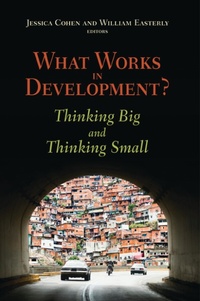
What Works in Development?
Thinking Big and Thinking Small
1st Edition
Published on 1. February 2010
245 pages
978-0-8157-0419-5 (ISBN)
Description

What Works in Development? brings together leading experts to address one of the most basic yet vexing issues in development: what do we really know about what works¿ and what doesn't¿in fighting global poverty?
The contributors, including many of the world's most respected economic development analysts, focus on the ongoing debate over which paths to development truly maximize results. Should we emphasize a big-picture approach¿focusing on the role of institutions, macroeconomic policies, growth strategies, and other country-level factors? Or is a more grassroots approach the way to go, with the focus on particular microeconomic interventions such as conditional cash transfers, bed nets, and other microlevel improvements in service delivery on the ground? The book attempts to find a consensus on which approach is likely to be more effective.
Contributors include Nana Ashraf (Harvard Business School), Abhijit Banerjee (MIT), Nancy Birdsall (Center for Global Development), Anne Case (Princeton University), Jessica Cohen (Brookings),William Easterly (NYU and Brookings),Alaka Halla (Innovations for Poverty Action), Ricardo Hausman (Harvard University), Simon Johnson (MIT), Peter Klenow (Stanford University), Michael Kremer (Harvard), Ross Levine (Brown University), Sendhil Mullainathan (Harvard), Ben Olken (MIT), Lant Pritchett (Harvard), Martin Ravallion (World Bank), Dani Rodrik (Harvard), Paul Romer (Stanford University), and DavidWeil (Brown).
The contributors, including many of the world's most respected economic development analysts, focus on the ongoing debate over which paths to development truly maximize results. Should we emphasize a big-picture approach¿focusing on the role of institutions, macroeconomic policies, growth strategies, and other country-level factors? Or is a more grassroots approach the way to go, with the focus on particular microeconomic interventions such as conditional cash transfers, bed nets, and other microlevel improvements in service delivery on the ground? The book attempts to find a consensus on which approach is likely to be more effective.
Contributors include Nana Ashraf (Harvard Business School), Abhijit Banerjee (MIT), Nancy Birdsall (Center for Global Development), Anne Case (Princeton University), Jessica Cohen (Brookings),William Easterly (NYU and Brookings),Alaka Halla (Innovations for Poverty Action), Ricardo Hausman (Harvard University), Simon Johnson (MIT), Peter Klenow (Stanford University), Michael Kremer (Harvard), Ross Levine (Brown University), Sendhil Mullainathan (Harvard), Ben Olken (MIT), Lant Pritchett (Harvard), Martin Ravallion (World Bank), Dani Rodrik (Harvard), Paul Romer (Stanford University), and DavidWeil (Brown).
More details
Edition
1. Auflage
Language
English
Place of publication
DC
United States
ISBN-13
978-0-8157-0419-5 (9780815704195)
Copyright in bibliographic data and cover images is held by Nielsen Book Services Limited or by the publishers or by their respective licensors: all rights reserved.
Schweitzer Classification
Other editions
Additional editions
Book
11/2009
Brookings Institution
€40.10
Shipment within 10-20 days
Persons
Jessica Cohen is a development economic research fellow with the Global Economy and Development program at the Brookings Institution. William Easterly, professor of economics at New York University and a nonresident senior fellow at the Brookings Institution, is the author of The White Man's Burden:Why theWest's Efforts to Aid the Rest Have Done So Much Ill and So Little Good (Penguin, 2006).
Content
- Front Cover
- Copyright Information
- Table of Contents
- Introduction: Thinking Big versus Thinking Small
- The New Development Economics: We Shall Experiment, but How Shall We Learn?
- Breaking Out of the Pocket: Do Health Interventions Work? Which Ones and in What Sense?
- Pricing and Access: Lessons from Randomized Evaluations in Education and Health
- The Policy Irrelevance of the Economics of Education: Is "Normative as Positive" Just Useless, or Worse?
- The Other Invisible Hand: High Bandwidth Development Policy
- Big Answers for Big Questions: The Presumption of Growth Policy
- Contributors
- Index
- Back Cover
