Alles über E-Books | Antworten auf Fragen rund um E-Books, Kopierschutz und Dateiformate finden Sie in unserem Info- & Hilfebereich.
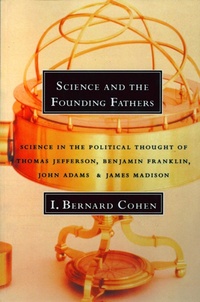
General readers, students of American history, and professional historians alike will profit from reading this engaging presentation of an aspect of American history conspicuously absent from the usual textbooks and popular presentations of the political thought of early America.
Thomas Jefferson was the only president who could read and understand Newton's Principia. Benjamin Franklin is credited with establishing the science of electricity. John Adams had the finest education in science that the new country could provide, including "Pnewmaticks, Hydrostaticks, Mechanicks, Staticks, Opticks." James Madison, chief architect of the Constitution, peppered his Federalist Papers with references to physics, chemistry, and the life sciences.
For these men science was an integral part of life—including political life. This is the story of their scientific education and of how they employed that knowledge in shaping the political issues of the day, incorporating scientific reasoning into the Constitution.
Language
Place of publication
ISBN-13
978-0-393-24715-2 (9780393247152)
Schweitzer Classification
I. Bernard Cohen (1914?2003) was Victor S. Thomas Professor, Emeritus, of the History of Science at Harvard University, where he taught from 1942 to 1984. He was the first American to receive the degree of Ph.D. in the History of Science. He was the author of many books, including Science and the Founding Fathers: Science in the Political Thought of Thomas Jefferson, Benjamin Franklin, John Adams, and James Madison; The Science of Benjamin Franklin; Revolution in Science; The Newtonian Revolution; The Birth of a New Physics; and, with Anne Whitman, Isaac Newtonís Principia: A New Translation of Newtonís Mathematical Principles of Natural Philosophy. He edited several series of works, including Harvard Monographs in the History of Science, Three Centuries of Science in America, and the ongoing Studies & Texts in the History of Computing. He was a Fellow of the American Academy of Arts and Sciences, the American Association for the Advancement of Science, the Royal Astronomical Society, the British Academy, and the Accademia Nazionale dei Lincei.