

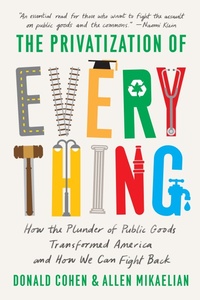
The Privatization of Everything
Description

As people reach for social justice and better lives, they create public goods-free education, public health, open parks, clean water, and many others-that must be kept out of the market. When private interests take over, they strip public goods of their power to lift people up, creating instead a tool to diminish democracy, further inequality, and separate us from each other.
The Privatization of Everything, by the founder of In the Public Interest, an organization dedicated to shared prosperity and the common good, chronicles the efforts to turn our public goods into private profit centers. Ever since Ronald Reagan labeled government a dangerous threat, privatization has touched every aspect of our lives, from water and trash collection to the justice system and the military.
However, citizens can, and are, wresting back what is ours. A Montana city took back its water infrastructure after finding that they could do it better and cheaper. Colorado towns fought back well-funded campaigns to preserve telecom monopolies and hamstring public broadband. A motivated lawyer fought all the way to the Supreme Court after the State of Georgia erected privatized paywalls around its legal code.
The Privatization of Everything connects the dots across a broad spectrum of issues and raises larger questions about who controls the public things we all rely on, exposing the hidden crisis of privatization that has been slowly unfolding over the last fifty years and giving us a road map for taking our country back.
More details
Other editions
Additional editions
Persons
Donald Cohen is the founder and executive director of the research and policy center In the Public Interest and the co-author (with Allen Mikaelian) of The Privatization of Everything and (with Nick Hanauer and Joan Walsh) of Corporate Bullsh*t (both from The New Press). He lives in Los Angeles.
Allen Mikaelian is a New York Times bestselling author. The co-author (with Donald Cohen) of The Privatization of Everything (The New Press), he lives in Washington, DC.
Content
- Intro
- Part I UNDERSTANDING PRIVATIZATION
- 1 Public Goods for the Common Good
- 2 The Roots and Reasons of Privatization
- Part II PUBLIC GOODS FOR LIFE
- 3 Privatizing Public Health Makes Us Sick
- 4 "They Just Have to Pay"
- 5 The Stuff of Life
- Part III THE PUBLIC GETS US THERE
- 6 Economic Destiny and the Pitfalls of the Public-Private Partnership
- 7 Toll Roads at America's Crossroads
- 8 Who Owns the Journey? Recentering the Public
- Part IV PRIVATIZATION'S SLOW COUP
- 9 When the Contract Is King
- 10 Democracy in Darkness
- 11 Skin in the Game
- 12 Freedom Has a Price
- Part V EVERY LAST DIME
- 13 Teaching Them a Lesson
- 14 Privatized Medicaid and the Business of Denying Care
- 15 What's in It for Wall Street
- 16 Privatizing Pays Us Less
- Part VI THINGS IN COMMON
- 17 Public Places
- 18 School Choice and Resegregation
- 19 Public Libraries and Apple Pie
- 20 Communities Take Care
- Part VII PRIVATIZATION DOESN'T WANT YOU TO KNOW
- 21 School Choice and Competition
- 22 Higher Education
- Part VIII "THE CASH JUST POURS OUT"
- 23 Academic Publishing
- 24 They Even Want to Own the Weather
- 25 Drug Prices and the Pirates of the Patent System
- Part IX BECOMING PRO-PUBLIC
- Acknowledgments
- Notes
- Index
