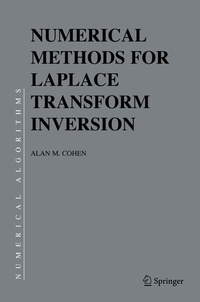
Numerical Methods for Laplace Transform Inversion
Description

Operational methods have been used for over a century to solve problems such as ordinary and partial differential equations. When solving such problems, in many cases it is fairly easy to obtain the Laplace transform, while it is very demanding to determine the inverse Laplace transform that is the solution of a given problem. Sometimes, after some difficult contour integration, we may find that a series solution results, but this may be quite difficult to evaluate in order to get an answer at a particular time value.
The advent of computers has given an impetus to developing numerical methods for the determination of the inverse Laplace transform. This book gives background material on the theory of Laplace transforms, together with a fairly comprehensive list of methods that are available at the current time. Computer programs are included for those methods that perform consistently well on a wide range of Laplace transforms.
Reviews / Votes
From the reviews:
"This book gives background material on the theory of Laplace transforms together with a comprehensive list of numerical methods for determination of the inverse Laplace transform. Computer programs are included for those methods that perform consistently well on a wide range of Laplace transforms. It provides a balanced course of Laplace transforms consisting of theory, numerical techniques and applications. . This book may be a useful tool for all those who use Laplace transforms in their work whether they are mathematicians, engineers or financial planners." (Som Prakash Goyal, Zentralblatt MATH, Vol. 1127 (4), 2008)
"In this book, Alan M. Cohen summarizes known results related to numerical methods. The book starts with basic analytic theory of the Laplace transform. . The book provides a large amount of carefully selected and clearly explained examples, and seems to be ideal for self-study or preparing students' courses for different levels. By gathering various information on the Laplace transform in one place, the author has created a standard reference source." (Alexander Denisjuk, Mathematical Reviews, Issue 2009 c)
More details
Other editions
Additional editions