

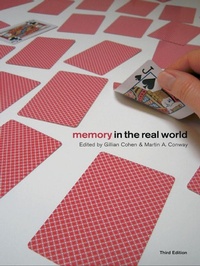
Memory in the Real World
3rd Edition
Published on 3. December 2007
424 pages
978-1-135-41988-2 (ISBN)
Description

This fully revised and updated third edition of the highly acclaimed Memory in the Real World includes recent research in all areas of everyday memory. Distinguished researchers have contributed new and updated material in their own areas of expertise. The controversy about the value of naturalistic research, as opposed to traditional laboratory methods, is outlined, and the two approaches are seen to have converged and become complementary rather than antagonistic.
The editors bring together studies on many different topics, such as memory for plans and actions, for names and faces, for routes and maps, life experiences and flashbulb memory, and eyewitness memory. Emphasis is also given to the role of memory in consciousness and metacognition. New topics covered in this edition include life span development of memory, collaborative remembering, deja-vu and memory dysfunction in the real world.
Memory in the Real World will be of continuing appeal to students and researchers in the area.
The editors bring together studies on many different topics, such as memory for plans and actions, for names and faces, for routes and maps, life experiences and flashbulb memory, and eyewitness memory. Emphasis is also given to the role of memory in consciousness and metacognition. New topics covered in this edition include life span development of memory, collaborative remembering, deja-vu and memory dysfunction in the real world.
Memory in the Real World will be of continuing appeal to students and researchers in the area.
Reviews / Votes
"This book is a very welcome addition to the memory literature, providing thorough and detailed reviews of the growing body of research concerned with taking memory out of the laboratory. The authors are a combination of established scientists and younger investigators, who have in common a broad approach to the topic that accepts the importance of both theory and its application. This book should prove a valuable resource." - Alan Baddeley, University of York, UK"This book offers a comprehensive account of what is known about memory in real life. The list of authors is highly impressive, and in many cases the author of the chapter you are reading is also the leading researcher in that particular field. The overall result is a book of impressive range and detail, which makes it a key reference source for any student in this field." - David Groome, University of Westminster, UK
"Before reading this book I listed the questions that people often ask me about memory. Most of these questions were answered even more thoroughly than I was hoping for. The breadth of research covered is impressive." - Jackie Andrade, University of Plymouth, UK
"The collaboration of Gillian Cohen with a group of experts in a number of fields has resulted in an amazing new book that I can highly recommend to anyone interested in the operation of memory in everyday contexts, as well as in cognitive psychology of memory in general." - Lia Kvavilashvili, University of Hertfordshire, UK "This book is a very welcome addition to the memory literature, providing thorough and detailed reviews of the growing body of research concerned with taking memory out of the laboratory. The authors are a combination of established scientists and younger investigators, who have in common a broad approach to the topic that accepts the importance of both theory and its application. This book should prove a valuable resource." - Alan Baddeley, University of York, UK
"This book offers a comprehensive account of what is known about memory in real life. The list of authors is highly impressive, and in many cases the author of the chapter you are reading is also the leading researcher in that particular field. The overall result is a book of impressive range and detail, which makes it a key reference source for any student in this field." - David Groome, University of Westminster, UK
"Before reading this book I listed the questions that people often ask me about memory. Most of these questions were answered even more thoroughly than I was hoping for. The breadth of research covered is impressive." - Jackie Andrade, University of Plymouth, UK
"The collaboration of Gillian Cohen with a group of experts in a number of fields has resulted in an amazing new book that I can highly recommend to anyone interested in the operation of memory in everyday contexts, as well as in cognitive psychology of memory in general." - Lia Kvavilashvili, University of Hertfordshire, UK
More details
Edition
3rd edition
Language
English
Place of publication
London
United Kingdom
Publishing group
Taylor & Francis Ltd
Target group
College/higher education
Professional and scholarly
Edition type
Revised edition
Illustrations
7 s/w Tabellen
7 Tables, black and white
File size
5,06 MB
ISBN-13
978-1-135-41988-2 (9781135419882)
Copyright in bibliographic data and cover images is held by Nielsen Book Services Limited or by the publishers or by their respective licensors: all rights reserved.
Schweitzer Classification
Other editions
Additional editions
Book
12/2007
3rd Edition
Psychology Press Ltd
€205.20
Shipment within 3-4 weeks
Book
12/2007
3rd Edition
Psychology Press Ltd
€79.70
Shipment within 3-4 weeks
Persons
Gillian Cohen is a Cognitive Psychologist who held research posts in the Department of Experimental Psychology at the University of Oxford and more recently was Professor of Psychology at the Open University. She has had visiting appointments at Oxford, Buckingham and Louvian. Her research has focused on memory, especially memory for names and the effects of normal ageing on memory.
Martin Conway is Director of the Institute of Psychological Sciences at the University of Leeds and an ESRC Professorial fellow. He is a world-leading researcher of human memory. His main research interest at present is the relationship between memory and the self, and the breakdown of this relationship in brain damage and psychological interest.
Martin Conway is Director of the Institute of Psychological Sciences at the University of Leeds and an ESRC Professorial fellow. He is a world-leading researcher of human memory. His main research interest at present is the relationship between memory and the self, and the breakdown of this relationship in brain damage and psychological interest.
Content
G. Cohen, Introduction: The Study of Everyday Memory. J. Ellis, Memory for Intentions, Actions and Plans. A. Smith, Memory for Places: Routes, Maps and Locations. D. Wright, E. Loftus, Memory for Events: Eyewitness Testimony. R. Hanley, Memory for People: Faces, Voices and Names. H. Williams, M. Conway, Memory for Personal Experiences: Autobiographical and Flashbulb Memory. G. Cohen, Memory for Knowledge: General Knowledge and Expertise. G. Radvansky, Situational Models in Memory: Texts and Stories. R. Thompson, Collaborative and Social Remembering. C. Horton, M. Conway, Memory for Thoughts and Dreams. S. Gathercole, C. Moulin, Life Span Development of Memory: Childhood and Old Age. A. O'Connor, C. Moulin, Memory, Consciousness and Metacognition. C. Souchay, C. Moulin, The Psychopathology of Everyday Memory. G. Cohen, Overview: Speculations and Conclusions.
