

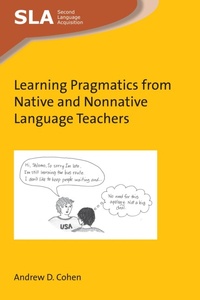
Learning Pragmatics from Native and Nonnative Language Teachers
Published on 25. May 2018
312 pages
978-1-78309-994-8 (ISBN)
Description

This book deals with intercultural pragmatics and how both nonnative teachers (NNTs) and native teachers (NTs) may enhance their classroom instruction regarding target language (TL) pragmatics. It focuses primarily on the experiences of instructors as they teach their learners about the pragmatics of the TL, both in second and foreign language learning settings. It makes clear that there are aspects of teaching pragmatics where it may help to be an NT and other areas where it may help to be an NNT and proposes creative ideas that both sets of teachers may draw on to compensate for gaps in their knowledge. Further themes in the book include ideas for motivating students who want to learn about pragmatics, the role of technology in teaching and learning pragmatics, the role of learning strategies, the assessment of pragmatics and ways to research pragmatics. The book will be of interest to teachers, teacher educators and students interested in researching and improving the teaching of pragmatics.
Reviews / Votes
This book is a timely addition to the field, helping us move from the native-nonnative distinction to native-nonnative collaboration when teaching pragmatics in a language classroom. A variety of personal experiences and episodes used to illustrate theories, research, and practice make the content of pragmatics fully accessible to teachers and students. This book is the ideal companion for practitioners and researchers who wish to gain a thorough understanding of issues related to pragmatics learning in a global context. * Naoko Taguchi, Carnegie Mellon University, USA * This book is a significant and timely contribution to the area of teaching pragmatics. Being aware that it is difficult to define what native and nonnative speaker means, Cohen's book takes a close look at teaching and learning pragmatics, providing material in a number of different languages and cultures. It will be read with interest by any teacher educator and researcher. * Eva Alcon Soler, Universitat Jaume I, Spain * This innovative book takes a fresh perspective on learning, teaching and assessing pragmatics. It manages to be both scholarly and highly practical, and its coverage of pragmatics instruction by non-native speaker teachers makes a unique and much needed contribution to the field. * Carsten Roever, University of Melbourne, Australia * This book is a full-fledged guidance to assist both NNTs and NTs to improve classroom instruction on pragmatics and make pragmatics accessible to learners [...] it is truly a powerful guide for the motivated front runners of foreign language and second language teaching in environments, like Japan, where the pragmatic instruction is still underestimated. -- Mai Oyama, UCL Institute of Education, UK and Kyoko Oyama, Waseda University, Japan * System 81 (2019) * The discussion of the findings of the current theoretical and empirical research on teaching and learning pragmatics and the impressive reference list make the book attractive for researchers interested in pragmatics and for teacher educators who are...critically aware of the NS-NNS dichotomy used in the book. -- Iryna Lenchuk, Dhofar University, Oman * Journal of Pragmatics 143 (2019) *More details
Series
Language
English
Place of publication
Bristol
United Kingdom
Publishing group
Channel View Publications Ltd
Target group
College/higher education
Product notice
Reflowable
ISBN-13
978-1-78309-994-8 (9781783099948)
Copyright in bibliographic data and cover images is held by Nielsen Book Services Limited or by the publishers or by their respective licensors: all rights reserved.
Schweitzer Classification
Other editions
Additional editions
Andrew D. Cohen
Learning Pragmatics from Native and Nonnative Language Teachers
Book
05/2018
Multilingual Matters
€56.50
Shipment within 10-20 days
Person
Andrew D. Cohen is Professor Emeritus, University of Minnesota, USA. He has published extensively in the areas of pragmatics, language assessment, and language learner strategies, and frequently presents his research at international conferences. He was the recipient of the 2006 Distinguished Scholarship and Service Award from the American Association for Applied Linguistics (AAAL). He is also a hyperpolyglot, currently learning his 13th language, Mandarin.
Content
Chapter 1: An Introduction to Pragmatics for Learners and Teachers
Chapter 2: The Development of Pragmatic Ability (with Lauren Wyner)
Chapter 3: The Handling of Pragmatics by Native and Nonnative Teachers
Chapter 4: What Native and Nonnative Teachers Know About Pragmatics and What They Report Doing
Chapter 5: Basic Issues in the Teaching of Pragmatics (with Lauren Wyner)
Chapter 6: Ideas for Teaching Pragmatics and for Motivating Learners
Chapter 7: The Role of Technology in Teaching and Learning Pragmatics
Chapter 8: The Learning of Pragmatics
Chapter 9: The Assessment of Pragmatics
Chapter 10: Researching Pragmatics
Chapter 11: Conclusions
References
Acronyms Used in the Book
Chapter 2: The Development of Pragmatic Ability (with Lauren Wyner)
Chapter 3: The Handling of Pragmatics by Native and Nonnative Teachers
Chapter 4: What Native and Nonnative Teachers Know About Pragmatics and What They Report Doing
Chapter 5: Basic Issues in the Teaching of Pragmatics (with Lauren Wyner)
Chapter 6: Ideas for Teaching Pragmatics and for Motivating Learners
Chapter 7: The Role of Technology in Teaching and Learning Pragmatics
Chapter 8: The Learning of Pragmatics
Chapter 9: The Assessment of Pragmatics
Chapter 10: Researching Pragmatics
Chapter 11: Conclusions
References
Acronyms Used in the Book
