

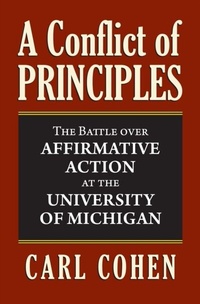
A Conflict of Principles
Description

?No state . . . shall deny to any person within its jurisdiction the equal protection of the laws.? So says the Equal Protection Clause of the U.S. Constitution, a document held dear by Carl Cohen, a professor of philosophy and longtime champion of civil liberties who has devoted most of his adult life to the University of Michigan. So when Cohen discovered, after encountering some resistance, how his school, in its admirable wish to increase minority enrollment, was actually practicing a form of racial discrimination?calling it ?affirmative action??he found himself at odds with his longtime allies and colleagues in an effort to defend the equal treatment of the races at his university. In A Conflict of Principles Cohen tells the story of what happened at Michigan, how racial preferences were devised and implemented there, and what was at stake in the heated and divisive controversy that ensued. He gives voice to the judicious and seldom heard liberal argument against affirmative action in college admission policies.
In the early 1970s, as a member of the Board of Directors of the American Civil Liberties Union, Cohen vigorously supported programs devised to encourage the recruitment of minorities in colleges, and in private employment. But some of these efforts gave deliberate preference to blacks and Hispanics seeking university admission, and this Cohen recognized as a form of racism, however well-meaning. In his book he recounts the fortunes of contested affirmative action programs as they made their way through the legal system to the Supreme Court, beginning with DeFunis v. Odegaard (1974) at the University of Washington Law School, then Bakke v. Regents of the University of California (1978) at the Medical School on the UC Davis campus, and culminating at the University of Michigan in the landmark cases of Grutter v. Bollinger and Gratz v. Bollinger (2003). He recounts his role in the initiation of the Michigan cases, explaining the many arguments against racial preferences in college admissions. He presents a principled case for the resultant amendment to the Michigan constitution, of which he was a prominent advocate, which prohibited preference by race in public employment and public contracting, as well as in public education.
An eminently readable personal, consistently fair-minded account of the principles and politics that come into play in the struggles over affirmative action, A Conflict of Principles is a deeply thoughtful and thought-provoking contribution to our national conversation about race.
All prices
More details
Other editions
Additional editions
Person
Content
Prologue
1. How It All Began
2. Bakke and the Rise of Diversity
3. From The Nation to Commentary
4. From Washington to Berlin and Beyond
5. Naked Racial Preference
6. The University of Michigan Comes into Focus
7. Confrontation
8. Pulling Teeth
9. Revelation
10. Further Revelations
11. What Was I to Do?
12. Point of No Return
13. On t the Federal Courts
14. The Climate of Opinion at Michigan
15. The Reading Room
16. Moving Targets
17. Intervenors
18. The Thin Line between Permissible and Impermissible
19. 128 Honorary Degrees and a Coat Check
20. The Heart of the Trial: 257 to 1,000
21. Vindication
22. Petitions Don't Decide Lawsuits
23. Why It Smelled Funny
24. Back on the Home Front
25. Some Personal Questions
26. Preparing for the Big Event
27. The Big Event
28. The End of Litigation
29. From Legal Battles to to Political Battles: The Michigan Civil Rights Initiative
30. Defending the Michigan Civil Rights Initiative
31. The Michigan Constitution Amended
32. Race Preference at the University of Texas
33. Race Preference in Michigan Is Permanently Ended
Appendix A: Freedom of Information Act Requests
Appendix B: The Cohen Report, 20 March 1996
Appendix C: The Michigan Civil Rights Initiative (MCRI)
Notes
Index

