

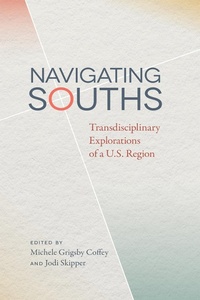
Navigating Souths
Description

The work of considering, imagining, and theorizing the U.S. South in regional, national, and global contexts is an intellectual project that has been going on for some time. Scholars in history, literature, and other disciplines have developed an advanced understanding of the historical, social, and cultural forces that have helped to shape the U.S. South. However, most of the debates on these subjects have taken place within specific academic disciplines, with few attempts to cross-engage.
Navigating Souths broadens these exchanges by facilitating transdisciplinary conversations about southern studies scholarship. The fourteen original essays in Navigating Souths articulate questions about the significances of the South as a theoretical and literal "home" base for social science and humanities researchers. They also examine challenges faced by researchers who identify as southern studies scholars, as well as by those who live and work in the regional South, and show how researchers have responded to these challenges. In doing so, this book project seeks to reframe the field of southern studies as it is currently being practiced by social science and humanities scholars and thus reshape historical and cultural conceptualizations of the region.
More details
Other editions
Additional editions
Persons
MICHELE GRIGSBY COFFEY is an instructor of history at the University of Memphis. Her work has been published in the edited collection South Carolina Women: Their Lives and Times (Georgia), Louisiana History, and in the Encyclopedia of U.S. Political History.
Jodi Skipper (Editor)
JODI SKIPPER is an assistant professor of anthropology and southern studies at the University of Mississippi. Her work has been published in the Journal of Community Archaeology and Heritage, the Southern Quarterly, the Black Scholar, Community Development, and Sociology of Race and Ethnicity.
Content
- Cover
- Title
- Copyright
- CONTENTS
- ACKNOWLEDGMENTS
- Introduction
- PART 1. Laying the Groundwork
- Reimagining Southern Studies Time and Space, Bodies and Spirits
- PART 2. Reframing Norms
- Deconstructing the Bible Belt
- Katrina Babies Reproducing Deviance in the Future Unknown
- PART 3. Engaging Politics
- Southern Inhospitality Latino Immigrant Attrition and Resistance in the South
- Public History, Diversity, and Higher Education Three Case Studies on the African American Past
- Where Do We Go from Here? The Implications of Black Intellectual History in the Modern South
- South Unbound A Case Study in Ron Rash's Appalachian Fiction
- PART 4. Southern Studies in Practice
- Interlocality and Interdisciplinarity Learning from Existing Models of the Global South
- Finding Strength in Southern Studies Pedagogy Cultivating Individual Resilience through a Representative Narrative
- Southern Transformations Three Documentary Films by Anne Lewis
- Surviving the Economic Apocalypse Capitalism, Consumption, and the Indian Imaginary in Karen Russell's Swamplandia!
- Last (Un)Fair Deal Going Down Blues Tourism and Racial Politics in Clarksdale, Mississippi
- The Politics of Hillbilly Horror
- PART 5. Drives and Desires
- For They Know Not What They Do Southern Studies Centers, Normativity, and Fantasies of White Redemption
- BIBLIOGRAPHY
- CONTRIBUTORS
- INDEX
- A
- B
- C
- D
- E
- F
- G
- H
- I
- J
- K
- L
- M
- N
- O
- P
- Q
- R
- S
- T
- U
- V
- W
- Y
- Z
