

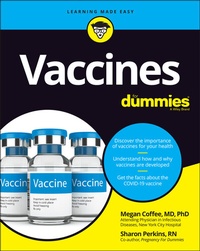
Vaccines For Dummies
Description

Measles, mumps, and rubella--oh my! Why are we vaccinating our children--and ourselves--against these diseases, and what goes on in our bodies after the needle comes out? Vaccines For Dummies will inform and entertain you about all things vax, including how the first vaccines were discovered, what's in modern vaccines, how they are tested and approved for use, and why the CDC's vaccine schedule is what it is. Inside, you'll also find a complete guide to vaccine benefits, potential side effects, and contraindications, so you'll be ready when shot time comes.
From the very first inoculations hundreds of years ago to the brand new COVID-19 shot, creating immunity to diseases has become a human specialty. If you're wondering how safe and how necessary it all is, you aren't alone. In Vaccines For Dummies, we'll explore the issue from every angle, empowering you to take charge of your wellbeing. With this book, you will:
* Discover the ABCs of vaccines, including what they're made of and how they work
* Learn about each recommended childhood and adult immunization, plus the seasonal flu shot, all with this evidence-based guide
* Take a journey through vaccine history, meeting the major players of yesterday and today
* Decide what's right for your family, with the help of the most recent vaccine science
Parents, parents-to-be, adults of any age, and anyone who wants to delve into the microscopic world of pathogens and their arch nemeses (antigens and antibodies) will get a double dose of knowledge from Vaccines For Dummies.
More details
Other editions
Additional editions
Persons
Sharon Perkins, RN, is the co-author of more than 10 For Dummies titles including Pregnancy For Dummies, Healthy Aging For Dummies, Dad's Guide to Baby's First Year For Dummies, and most recently, Getting Pregnant For Dummies.
Content
Chapter 1
Focusing on Vaccine Fundamentals
IN THIS CHAPTER
Looking at the importance of vaccines
Getting a handle on how vaccines work
Surveying the COVID-19 vaccine
Checking out schedules and side effects
Boosting your immune system's response
Infections that once haunted childhood are now seen only in textbooks. These were the true bogeymen of childhood, the real monsters under the bed. They were common and potentially life-threatening. We now have vaccines for these infections that were so tricky to treat and easy to spread. Most children around the world are vaccinated against these bogeymen, including, among others, measles, polio, diphtheria, tetanus, and smallpox. Vaccines have helped send these diseases packing, even though we still don't always have good treatments for the diseases themselves.
There's a lot of information - and misinformation - out there about vaccines. When large groups lose trust in the benefits of vaccination, many people, not just those who don't want to be vaccinated, can suffer. Diseases like COVID-19 can continue to spread. Those who have weakened immune systems that don't respond well to vaccines can be infected by others. It's important that we keep our eyes on the common enemy - infectious diseases.
Realizing the Crucial Role of Vaccines
Vaccinations provide a valuable tool. You can give your immune system a heads-up about infections before you ever see them. You can stop diseases before you ever get sick by giving your immune system a cheat sheet on what to look for. Unlike medications that reduce the symptoms once the illness has begun, vaccines can stop infections before they ever happen. Childhood - and adulthood - have become a lot safer in the process.
Vaccines give your immune system a superpower. Through vaccines, your immune system learns how to stop bad guys it's never seen before. These bad guys cause infectious diseases. They're the pathogens, also called germs, which are so tiny that we can see them only with a microscope. These pathogens include bacteria, viruses, fungi, and parasites. Chapter 2 describes different viruses and the vaccines that combat them, while bacteria and their vaccines are discussed in Chapter 4.
Vaccines provide you with personal protection against these pathogens and the diseases they cause, but what works even better is if everyone is vaccinated. The superpower of a vaccine increases as more people jump on the bandwagon. With infectious diseases, we're all in this together. If everyone is vaccinated, a pathogen spreading person to person is stymied.
Vaccines may not provide 100 percent protection. Some people may not be able to take or benefit from a vaccine; they may be too young or have a weakened immune system. But if enough of us are vaccinated, odds are the pathogen just can't spread. It can't jump from person to person. It may infect one person and maybe another, but if most people are vaccinated, it won't keep finding new people to spread to and will fade away.
This is what herd immunity is all about - when enough people are vaccinated, we can push back the spread of some terrible and deadly diseases. Chapter 11 details the benefits of herd immunity and debunks the myths often perpetuated about vaccines. Diseases can bounce back if fewer people are vaccinated.
We can save many lives if we had more vaccines. Scientific challenges and the lack of funding and motivation have kept some vaccines from being developed. (See Chapter 13 for more information.) New diseases yet to emerge will need vaccines, as we have seen as COVID-19 has spread around the world. (See Chapter 3 for info on COVID-19 and the vaccine.)
It may not seem so exciting now, but we have had reliable and effective vaccines only since the end of the 1700s. At that time, it was found that one mild virus, cowpox, can train our immune system to protect us from a terrible virus, smallpox. (If vaccine history interests you, check out Chapter 12, which discusses the people instrumental in creating a number of vaccines. Chapter 14 describes major pandemics throughout history.)
Many vaccines work on the same principle as this first vaccine did: Show the immune system something harmless but similar to what causes the disease, and the immune system will learn to protect us against the dangerous one too. However, scientists continue working on vaccines to develop new, possibly more effective approaches to train our immune system. Different pathogens require different sorts of vaccines, and for some diseases, vaccines still elude us.
We do have vaccines for a wide range of infections, though. Vaccines can prevent some types of liver disease (hepatitis A and B) and some types of cancer (human papillomavirus). We also have vaccines for adults, such as for pneumonias and shingles, diseases we're more prone to as we get older. But we still don't have vaccines for the infections that year after year take the most lives. We don't have an HIV vaccine, and we need better vaccines for tuberculosis and malaria. We also don't have a vaccine for the common cold, which would be hard to make. Chapter 6 provides information on all current vaccines, while Chapter 13 looks at diseases that still aren't preventable.
As is often said about vaccines, it's not vaccines that save lives; it's vaccinations. For communities to be protected, vaccines need to be given. The tough part is often ensuring that vaccines are accessible for all and vaccination rates are high enough to protect the entire community.
Explaining How a Vaccine Works
Vaccines hold up a "Wanted" photo of the bad guy - the pathogen or germ. Each vaccine is a little different, but they all show our immune system something super recognizable about the pathogen. That way, if we are ever exposed to this pathogen, our immune systems will respond to it.
The "Wanted" photo can be some bit from the outside of the pathogen, like a specific protein or sugar. These bits act as a way to identify the pathogen, similar to the way a tattoo or birthmark helps you identify a person. The vaccine version may attach this "Wanted" photo to a warning, like a blinking red light, such as a protein that will create a stronger immune response.
Other vaccines may be the equivalent of a head-to-foot photo; some vaccines use the whole pathogen (in a killed vaccine, explained more in Chapter 5) or in a live, but safe, similar version. Chapter 7 discusses the ingredients that typically make up vaccines.
Vaccines let you bypass the delay it would take to develop natural immunity if you were first exposed to the pathogen without this head start. Normally, it can take a couple of weeks for your immune system to figure out how to fight a new disease; with a vaccine, your body is ready and able to fight from the first time you see the actual pathogen.
Find out more about the basics of how a vaccine works in the following sections.
Distinguishing between antigens and antibodies
Antigens are what is memorable in the "Wanted" photo. An antigen is something very specific - like that birthmark or tattoo - that can't be missed. Your immune system uses that very specific marking to create an immune response and memory. This marking is usually a protein or sometimes a sugar on the outside of the pathogen.
Antibodies are what your body makes in response to antigens. After your body has been shown the antigen or "Wanted" photo, you keep a supply of memory immune cells that can make a whole lot more antibodies if the pathogen ever arrives. Specific antibodies go after just one specific antigen. Once that antigen is found again, your body floods it with copies of this antibody from those memory immune cells. The antibodies then attach themselves to their antigens, which are on the outside of the pathogen. The antibodies then stop this specific pathogen, like a virus particle or bacterium cell, from causing any more problems.
It typically takes a few weeks after exposure for the body to produce this response. Vaccination gives you a head start so you already have the ability to make all these antibodies if you need to. With a natural infection, you can get quite sick before you were able to scramble and create an effective immune response.
Breaking down other vaccine ingredients
Vaccines contain more than just the "Wanted" photos, called antigens, that help your immune system identify pathogens (see the preceding section). Other ingredients are needed to make sure the vaccine works as it should:
- Some of these "Wanted" photos don't create much of an immune response. The immune system needs to be alerted to the fact that this "Wanted" photo is important to remember. Vaccines may include an alert, which acts like a red blinking light, saying "pay attention here." This ingredient may even be directly attached to the "Wanted" photo. Such alerts when added to the vaccine mix are called adjuvants. A common adjuvant includes aluminum, also found in drinking water, antacids, and antiperspirants. We discuss the ingredients that go into vaccines more in Chapter 7.
- Vaccines also may contain stabilizers, much like some of...
