

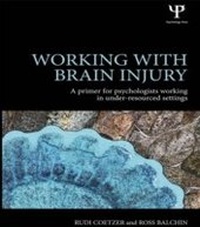
Working with Brain Injury
A primer for psychologists working in under-resourced settings
1st Edition
Published on 12. May 2014
222 pages
978-1-317-81062-9 (ISBN)
Description

This book provides a hands-on resource for the development of essential skills and competencies in clinical neuropsychology. On a very practical level it addresses a question frequently asked by students, trainees, interns, and newly qualified psychologists: what do I need to know in order to perform the everyday tasks involved in clinical neuropsychology? The authors distil, from a vast knowledge base, the practical skills and knowledge needed to lay the foundations for working with brain-injured patients, especially within the developed and developing world where time and resources are limited.
The book is divided into three main sections: Basic Foundations, Clinical Practice, and Professional Issues. Together these sections cover 18 fundamental topics, each representing a key part of the life of a practitioner. Each chapter contains practical tips, points for reflective practice, and suggested further reading, with a particular emphasis on issues pertaining to working in under-resourced clinical environments. The book draws upon landmark academic papers and textbooks, and also the authors' experiences of working in state hospitals in both South Africa and the National Health Service in the United Kingdom.
Working with Brain Injury will be essential reading for clinical psychology trainees and their supervisors, for newly qualified psychologists in clinical settings, and for students and practitioners in other clinical professions seeking an introduction to clinical neuropsychology.
The book is divided into three main sections: Basic Foundations, Clinical Practice, and Professional Issues. Together these sections cover 18 fundamental topics, each representing a key part of the life of a practitioner. Each chapter contains practical tips, points for reflective practice, and suggested further reading, with a particular emphasis on issues pertaining to working in under-resourced clinical environments. The book draws upon landmark academic papers and textbooks, and also the authors' experiences of working in state hospitals in both South Africa and the National Health Service in the United Kingdom.
Working with Brain Injury will be essential reading for clinical psychology trainees and their supervisors, for newly qualified psychologists in clinical settings, and for students and practitioners in other clinical professions seeking an introduction to clinical neuropsychology.
Reviews / Votes
"This is the ideal introduction for students and professionals new to the field of neuropsychology. The authors have successfully taken a large and complex subject and made it accessible by presenting a clear, succinct and comprehensive compendium. The book is easy to read, it offers practical advice, opportunity for reflective practice and readers in both resourced and under-resourced settings will find the sage counsel valuable." - Debbie Alexander, Psychiatry Department, Faculty of Medicine and Health Sciences, Stellenbosch University, South Africa"If you work in rehabilitating individuals with acquired brain injury, you are probably working in a setting with limited physical resources or limited expertise. How to face such universal problems - and deliver the basic care that patients need and deserve - is the question at the heart of Coetzer and Balchin's work. In a field overflowing with intimidating handbooks and manuals, this book brings hand-picked clinical knowledge and warm advice." - Christian E Salas, Clinical Neuropsychologist and Psychoanalytic Psychotherapist, Head Forward Centre, Manchester, UK "The book's 200 pages offer a compact, yet comprehensive and pleasant reading experience, which prepares the reader for the task of working with patients who suffer from brain lesions...Encompassing almost all aspects of clinical neuropsychology within these two broad categories of (neuro) science and (clinical) art in one short book is no small accomplishment." - Kobi Tiberg, Neuropsychoanalysis
"Working with Brain Injury will not only help to improve clinical practice (and contain the anxiety) of a generation of psychologists new to the field of neuropsychology, it is also an invaluable resource for the experienced neuropsychologist...[it] is a fantastic practical resource that I thoroughly enjoyed reading. I would recommend it to all psychologists that have an interest in neuropsychology. It has the potential to improve your clinical and professional practice whilst also saving you a great deal of time!" - Janet Hodgson, Consultant Clinical Neuropsychologist at The Encephalitis Society, for Brain Injury
"Coetzer and Balchin confront the limitations and seem aware that, in those contexts, less may be more. They know that learning a basic set of skills, which can be put then systematically into practice, can make a huge difference. Their book is a materialisation of this idea. I highly recommend this book to anyone interested in using clinical neuropsychology to help individuals with acquired brain injury." - Christian E Salas Riquelme, PhD, Head Forward Centre, Manchester, for Advances in Clinical Neuroscience and Rehabilitation (ACNR)
"This is the ideal introduction for students and professionals new to the field of neuropsychology. The authors have successfully taken a large and complex subject and made it accessible by presenting a clear, succinct and comprehensive compendium. The book is easy to read, it offers practical advice, opportunity for reflective practice and readers in both resourced and under-resourced settings will find the sage counsel valuable." - Debbie Alexander, Psychiatry Department, Faculty of Medicine and Health Sciences, Stellenbosch University, South Africa
"If you work in rehabilitating individuals with acquired brain injury, you are probably working in a setting with limited physical resources or limited expertise. How to face such universal problems - and deliver the basic care that patients need and deserve - is the question at the heart of Coetzer and Balchin's work. In a field overflowing with intimidating handbooks and manuals, this book brings hand-picked clinical knowledge and warm advice." - Christian E Salas, Clinical Neuropsychologist and Psychoanalytic Psychotherapist, Head Forward Centre, Manchester, UK
More details
Language
English
Place of publication
London
United Kingdom
Publishing group
Taylor & Francis Ltd
Target group
Professional and scholarly
Illustrations
4 s/w Tabellen
4 Tables, black and white
File size
3,68 MB
ISBN-13
978-1-317-81062-9 (9781317810629)
Copyright in bibliographic data and cover images is held by Nielsen Book Services Limited or by the publishers or by their respective licensors: all rights reserved.
Schweitzer Classification
Other editions
Additional editions
Rudi Coetzer | Ross Balchin
Working with Brain Injury
A primer for psychologists working in under-resourced settings
Book
05/2014
1st Edition
Psychology Press Ltd
€231.50
Shipment within 3-4 weeks
Rudi Coetzer | Ross Balchin
Working with Brain Injury
A primer for psychologists working in under-resourced settings
Book
05/2014
1st Edition
Psychology Press Ltd
€60.10
Shipment within 3-4 weeks
Persons
Rudi Coetzer is a Consultant Neuropsychologist and Head of Service with the North Wales Brain Injury Service, National Health Service (NHS) Wales, United Kingdom.
Ross Balchin is a Neuropsychologist and Postdoctoral Fellow in Neuropsychology at the University of Cape Town, South Africa.
Ross Balchin is a Neuropsychologist and Postdoctoral Fellow in Neuropsychology at the University of Cape Town, South Africa.
Content
Section 1: Basic Foundations 1. Identifying a knowledge base 2. Neuroanatomy 3. Neuropathology 4. Psychopathology 5. Psychopharmacology 6. Neuropsychological Theory 7. Special Investigations Section 2: Clinical Practice 8. Clinical Assessment in Neuropsychology 9. Neuropsychological Testing 10. Formulation 11. Neuropsychological Rehabilitation 12. Psychotherapy Approaches 13. Record Keeping Section 3: Professional Issues 14. Ethics 15. Professional Practice 16. Supervision 17. Research and Audit 18. Management
