

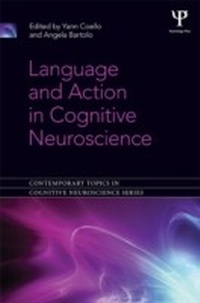
Language and Action in Cognitive Neuroscience
1st Edition
Published on 7. December 2012
376 pages
978-1-136-21418-9 (ISBN)
Description

This book collates the most up to date evidence from behavioural, brain imagery and stroke-patient studies, to discuss the ways in which cognitive and neural processes are responsible for language processing.
Divided into six sections, the edited volume presents arguments from evolutionist, developmental, behavioural and neurobiological perspectives, all of which point to a strong relationship between action and language. It provides a scientific basis for a new theoretical approach to language evolution, acquisition and use in humans, whilst at the same time assessing current debates on motor system's contribution to the emergence of language acquisition, perception and production.
The chapters have been written by internationally acknowledged researchers from a variety of disciplines, and as such this book will be of great interest to academics, students and professionals in the areas of cognitive psychology, neuropsychology, neuroscience, psycholinguistics and philosophy.
Divided into six sections, the edited volume presents arguments from evolutionist, developmental, behavioural and neurobiological perspectives, all of which point to a strong relationship between action and language. It provides a scientific basis for a new theoretical approach to language evolution, acquisition and use in humans, whilst at the same time assessing current debates on motor system's contribution to the emergence of language acquisition, perception and production.
The chapters have been written by internationally acknowledged researchers from a variety of disciplines, and as such this book will be of great interest to academics, students and professionals in the areas of cognitive psychology, neuropsychology, neuroscience, psycholinguistics and philosophy.
Reviews / Votes
This book will be of interest to professional researchers and graduate students in linguistics, psychology, and cognitive neuroscience, especially those who are interested in the rapidly evolving field of "embodied cognition". In recent years this field has been drawing a tremendous amount of attention, and the contributors in this book are major players in the field. Together, the chapters offer a review of the existing literature, an exploration of theoretical issues, and present new data. Researchers and graduate students in the field of embodied cognition will find this collection of cutting-edge perspectives on key issues to be useful reading. - David Kemmerer, Professor of Psychology, Purdue University, USAWritten by some of the leaders in the field, this cutting edge compilation will be invaluable to scientists and students interested in the expanding field of embodied and situated cognition. The book provides an in-depth treatment of the latest thinking and controversies in not only the embodiment of action semantics, but also the evolution of language, relationship between gestures and language, and representation of spatial, temporal, and numerical concepts. Everyone - from seasoned researchers to sceptics to students - will find something new and valuable here. - Rutvik H. Desai, Assistant Professor of Neurology, Medical College of Wisconsin, USA
This unique and ground-breaking volume, written by some of the leading specialists in the field, will be of great interest to academic researchers and students in cognitive neuroscience, psychology and language science who are interested in the rapidly expanding field of language which is grounded in embodied action. The whole range of theoretical issues, spanning from the motor origins of language, to action and language "in the brain", through to language processing, acquisition and semantics, is comprehensively covered, and debated within a unified and illuminating framework. Readers will find in this cutting-edge review a renewed, up-to-date understanding of key issues. - Didier Bottineau, Charge de Recherche, CNRS, MoDyCo, Universite Paris Ouest, France This book will be of interest to professional researchers and graduate students in linguistics, psychology, and cognitive neuroscience, especially those who are interested in the rapidly evolving field of "embodied cognition". In recent years this field has been drawing a tremendous amount of attention, and the contributors in this book are major players in the field. Together, the chapters offer a review of the existing literature, an exploration of theoretical issues, and present new data. Researchers and graduate students in the field of embodied cognition will find this collection of cutting-edge perspectives on key issues to be useful reading. - David Kemmerer, Professor of Psychology, Purdue University, USA
Written by some of the leaders in the field, this cutting edge compilation will be invaluable to scientists and students interested in the expanding field of embodied and situated cognition. The book provides an in-depth treatment of the latest thinking and controversies in not only the embodiment of action semantics, but also the evolution of language, relationship between gestures and language, and representation of spatial, temporal, and numerical concepts. Everyone - from seasoned researchers to sceptics to students - will find something new and valuable here. - Rutvik H. Desai, Assistant Professor of Neurology, Medical College of Wisconsin, USA
This unique and ground-breaking volume, written by some of the leading specialists in the field, will be of great interest to academic researchers and students in cognitive neuroscience, psychology and language science who are interested in the rapidly expanding field of language which is grounded in embodied action. The whole range of theoretical issues, spanning from the motor origins of language, to action and language "in the brain", through to language processing, acquisition and semantics, is comprehensively covered, and debated within a unified and illuminating framework. Readers will find in this cutting-edge review a renewed, up-to-date understanding of key issues. - Didier Bottineau, Charge de Recherche, CNRS, MoDyCo, Universite Paris Ouest, France
More details
Series
Language
English
Place of publication
London
United Kingdom
Publishing group
Taylor & Francis Ltd
Target group
College/higher education
Illustrations
1 Tables, black and white; 29 Line drawings, black and white; 10 Halftones, black and white; 39 Illustrations, black and white
File size
5,06 MB
ISBN-13
978-1-136-21418-9 (9781136214189)
Copyright in bibliographic data and cover images is held by Nielsen Book Services Limited or by the publishers or by their respective licensors: all rights reserved.
Schweitzer Classification
Other editions
Additional editions
Yann Coello | Angela Bartolo
Language and Action in Cognitive Neuroscience
Book
06/2017
1st Edition
Psychology Press Ltd
€79.90
Shipment within 10-20 days
Yann Coello | Angela Bartolo
Language and Action in Cognitive Neuroscience
Book
11/2012
1st Edition
Psychology Press Ltd
€208.60
Shipment within 3-4 weeks
Persons
Yann Coello is Professor of Cognitive Psychology and Neuropsychology at the University of Lille, France. He is the director of the Research Unit on Cognitive and Affective Sciences and is the leader of the Perception, Action and Communication research team.
Angela Bartolo is Assistant Professor of Cognitive Psychology and Neuropsychology at the University of Lille, France.
Angela Bartolo is Assistant Professor of Cognitive Psychology and Neuropsychology at the University of Lille, France.
Content
M. Jeannerod, Foreword Part 1. Language and Action: Past, Present and Future P. Jacob, Embodied Cognition, Communication and the Language Faculty Part 2. Motor origin of language M. Corballis, Toward a Darwinian Perspective on Language Evolution M. Gentilucci, G. C. Campione, From Action to Speech Part 3. Action in Language Processing Y. Coello, C. Ildei-Bidet, Motor Representation and Language in Space, Object, and Movement Perception S. Rueschemeyer, H. Bekkering, Embodied Lexical Representations: Flexible Tools for Predicting the Future A. Borghi, Action Language Comprehension, Affordances and Goals, L. J. Taylor, R. Zwaan, Fault Tolerant Comprehension Part 4. Action in Language Acquisition J. Velay, M. Longcamp, Motor Skills and Written Language Perception: Contribution of Writing Knowledge to Visual Recognition of Graphic Shapes J. Bullens, N. Lienenkaemper, F. Wijnen, A. Postma, Children's Use of Spatial Reference Frames in Verbal and Non-Verbal Tasks Part 5. Action in Spatial Language and Numbers J. E. Miller, L. A. Carlson, Functional Effects in Spatial Language K. R. Coventry, On the Mapping Between Spatial Language and the Vision and Action Systems M. Fischer, The Spatial Mapping of Numbers: its Origin and Flexibility M. Ishiara, Y. Rossetti, P. E. Keller, W. Prinz, Horizontal Spatial Representations of Number and Time: Continuous Number and Categorical Time Line Part 5. Language and Action Within the Brain L. Aziz-Zadeh, Embodied Semantics for Language Related to Actions: A Review of fMRI and Neuropsychological Research H. Stieglitz-Ham, A. Bartolo, The Relationship Between Gesture and Language in Brain Damaged Patients and Individuals with Autism T. A. Nazir, R. Fargier, P. Aravena, V. Boulenger, When Words Trigger Activity in the Brain's Sensory and Motor Systems: It is not Remembrance of Things Past Part 6. Language and Action in Cognitive Neuroscience: A Final Note Y. Coello, A. Bartolo, Contribution of the Action System to Language Perception and Comprehension: Evidence and Controversies
