

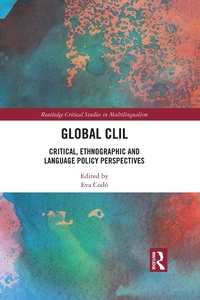
Global CLIL
Critical, Ethnographic and Language Policy Perspectives
1st Edition
Published on 30. December 2022
258 pages
978-1-000-81352-4 (ISBN)
Description

This collection turns a critical lens on Content and Language Integrated Learning (CLIL) research, making the case for a sociolinguistic-informed approach towards investigating social inequalities and making visible issues, processes and actors overlooked in CLIL research.
The volume seeks to expand the borders of existing CLIL scholarship through situated ethnographic perspectives, highlighting the value of a critical sociolinguistic perspective in illuminating the relationship between the emergence of CLIL and specific socio-political and economic conditions in contemporary multilingual education. Drawing on examples from Europe, Latin America, Australia and Asia, the book focuses on exploring inequities in CLIL policy and implementation across different institutional contexts and demonstrates the ways in which CLIL extends beyond the classroom as situated in multiple and changing networks of interest, policy and practice.
This book will be of particular interest to students and scholars in sociolinguistics, multilingual education, language policy and planning, and applied linguistics.
The volume seeks to expand the borders of existing CLIL scholarship through situated ethnographic perspectives, highlighting the value of a critical sociolinguistic perspective in illuminating the relationship between the emergence of CLIL and specific socio-political and economic conditions in contemporary multilingual education. Drawing on examples from Europe, Latin America, Australia and Asia, the book focuses on exploring inequities in CLIL policy and implementation across different institutional contexts and demonstrates the ways in which CLIL extends beyond the classroom as situated in multiple and changing networks of interest, policy and practice.
This book will be of particular interest to students and scholars in sociolinguistics, multilingual education, language policy and planning, and applied linguistics.
Reviews / Votes
This volume brings a much-needed critical perspective on CLIL as aglobal educational phenomenon. It is refreshing and challenging to
those already involved in CLIL research and opens up new lines of
enquiry for researchers who wish to examine critically how CLIL in its
spread around the world may contribute to exacerbating, rather than
ameliorating, social inequality. -
Tom Morton, Universidad Autonoma de Madrid
This first book-length critical account of Content and Language Integrated Learning offers a necessary, groundbreaking, and absolutely fascinating perspective on the various challenges
generated by one of the most popular language education initiatives of the last decades. Incisive, thought-provoking, and brimming with real-life action, this book is a must-read for any scholar interested in the day-to-day affordances and effects of contemporary language education policy.
Juergen Jaspers, Universite Libre de Bruxelles (ULB)
More details
Series
Edition
1. Auflage
Language
English
Place of publication
London
United Kingdom
Publishing group
Taylor & Francis Ltd
Target group
College/higher education
Professional and scholarly
Illustrations
10 Tables, black and white; 8 Line drawings, black and white; 8 Illustrations, black and white
ISBN-13
978-1-000-81352-4 (9781000813524)
Copyright in bibliographic data and cover images is held by Nielsen Book Services Limited or by the publishers or by their respective licensors: all rights reserved.
Schweitzer Classification
Other editions
Additional editions
Book
08/2024
1st Edition
Routledge
€63.40
Shipment within 15-20 days
Book
12/2022
1st Edition
Routledge
€186.20
Shipment within 15-20 days
Person
Eva Codo is Associate Professor of English Linguistics at Universitat Autonoma de Barcelona. Her field of specialisation is the sociolinguistics of multilingualism, with a particular focus on language policy and critical institutional ethnography. Her research has been published widely. She is currently co-Chair of the Association for the Study of Discourse and Society (EDiSo) ad co-editor of Multilingua.
Content
List of contributors
Acknowledgements
1. Introducing Global CLIL: Critical, ethnographic and language policy perspectives
Eva Codo
Part 1: Localisations of CLIL outside Europe
2. Exporting European CLIL to India: Flexible appropriations for complex language debates
Ana M. Relano-Pastor and Jessica McDaid
3. Situated emergence of CLIL: New discourses of bilingual education in Australian government schools
Simone Smala
4. CLIL and the dynamics of policy and sectorization in Colombia
Carl Edlund Anderson, Liliana Cuesta Medina, Rosa Dene David and Jermaine S. McDougald
5. The challenges of integrating linguistic and disciplinary knowledge in public secondary schools in the province of Cordoba, Argentina
Ana Cecilia Peerez and Virginia Unamuno
Part 2: Lived experiences of CLIL: A focus on actors
6. Policy, practice and agency: Making CLIL work? Insights from Austrian upper secondary technical education
Julia Huettner and Ute Smit
7. Bilingual education: English and the life projects of youth in contemporary Spain
Adriana Patino-Santos and David Poveda
8. Languaging teachers: CLIL and the politics of precarisation in Catalonia
Eva Codo
9. Being and becoming a CLIL teacher: Discourses of identities, language and emotional labour in Castilla-La Mancha bilingual schools
Frances Giampapa and Alicia Fernandez Barrera
Afterword - The promise of CLIL: Discourse, practices and selves
Miguel Perez-Milans
Index
Acknowledgements
1. Introducing Global CLIL: Critical, ethnographic and language policy perspectives
Eva Codo
Part 1: Localisations of CLIL outside Europe
2. Exporting European CLIL to India: Flexible appropriations for complex language debates
Ana M. Relano-Pastor and Jessica McDaid
3. Situated emergence of CLIL: New discourses of bilingual education in Australian government schools
Simone Smala
4. CLIL and the dynamics of policy and sectorization in Colombia
Carl Edlund Anderson, Liliana Cuesta Medina, Rosa Dene David and Jermaine S. McDougald
5. The challenges of integrating linguistic and disciplinary knowledge in public secondary schools in the province of Cordoba, Argentina
Ana Cecilia Peerez and Virginia Unamuno
Part 2: Lived experiences of CLIL: A focus on actors
6. Policy, practice and agency: Making CLIL work? Insights from Austrian upper secondary technical education
Julia Huettner and Ute Smit
7. Bilingual education: English and the life projects of youth in contemporary Spain
Adriana Patino-Santos and David Poveda
8. Languaging teachers: CLIL and the politics of precarisation in Catalonia
Eva Codo
9. Being and becoming a CLIL teacher: Discourses of identities, language and emotional labour in Castilla-La Mancha bilingual schools
Frances Giampapa and Alicia Fernandez Barrera
Afterword - The promise of CLIL: Discourse, practices and selves
Miguel Perez-Milans
Index
