

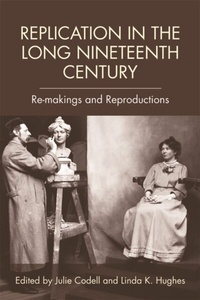
Replication in the Long Nineteenth Century
Description

The first study of nineteenth-century replication across art, literature, science, social science and humanities This landmark study explores replication as a nineteenth-century phenomenon. Replication, defined by Victorian artists as subsequent versions of a first version, similar but changed, occurred in art, literature, the press, merchandising, and historical reproductions in architecture and museums. Replication also shaped scientific concepts in biology and geology and scientific practices in laboratories that repeated experiments as part of the scientific method. Fourteen case studies map a range of nineteenth-century replication practices and associations across art, literature, science, media and material culture. While replication stirred imaginations as well as anxieties over the industrialisation that produced a modern mass culture, Replication in the Long Nineteenth Century suggests, nonetheless, that this phenomenon is a forerunner of our contemporary digital culture.
Key Features
- The first historical study of nineteenth-century replication
- Includes multidisciplinary case studies that rest on archival research as well as theory and analysis
- Establishes a model for studying period concepts across disciplines and practices
- Enhances understanding of the immense impact of digitization by illuminating its pre-history
More details
Other editions
Additional editions
Content
- Intro
- List of Illustrations
- Acknowledgments
- Chapter 1 Introduction: Replication in the Long Nineteenth Century - Re-makings and Reproductions
- Part I Replications and Networks
- Chapter 2 Replication of Things: The Case for Composite Biographical Approaches
- Chapter 3 Transatlantic Autograph Replicas and the Uplifting of American Culture
- Chapter 4 "Petty Larceny" and "Manufactured Science": Nineteenth-Century Parasitology and the Politics of Replication
- Chapter 5 Portraying and Performing the Copy, c. 1900
- Part II Replication and Technology
- Chapter 6 Replicating Tennyson's The Princess, 1847-1853
- Chapter 7 Paisley / Kashmir: Mapping the Imitation-Indian Shawl
- Chapter 8 William Morris and the Form and Politics of Replication
- Chapter 9 Text and Media Replication During the U.S.-Mexican War, 1846-1848
- Part III Replication and Authenticity
- Chapter 10 Literary Replication and the Making of a Scientifi c "Fact": Richard Owen's Discovery of the Dinornis
- Chapter 11 Copying from Nature: Biological Replication and Fraudulent Imposture in Grant Allen's An African Millionaire
- Chapter 12 The Failure of Replication in Nineteenth-Century Literature: Why It All Just Comes Out Wrong
- Part IV Replication and Time
- Chapter 13 "Seeking Nothing and Finding It": Moving On and Staying Put in Mugby Junction
- Chapter 14 The Origins of Replication in Science
- Chapter 15 Fathers, Sons, Beetles, and "a family of hypotheses": Replication, Variation, and Information in Gregory Bateson's Reading of William Bateson's Rule
- Chapter 16 Afterword: The Implications of Nineteenth-Century Replication Culture
- Notes on Contributors
- Index
