

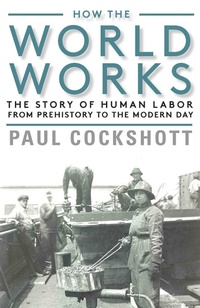
How the World Works
Description

A sweeping history of the full range of human labor Few authors are able to write cogently in both the scientific and the economic spheres. Even fewer possess the intellectual scope needed to address science and economics at a macro as well as a micro level. But Paul Cockshott, using the dual lenses of Marxist economics and technological advance, has managed to pull off a stunningly acute critical perspective of human history, from pre-agricultural societies to the present. In How the World Works, Cockshott connects scientific, economic, and societal strands to produce a sweeping and detailed work of historical analysis. This book will astound readers of all backgrounds and ages; it will also will engage scholars of history, science, and economics for years to come.
More details
Other editions
Additional editions
Person
Content
- Cover
- HOW THE WORLD WORKS
- Title Page
- Copyright Page
- Contents
- Preface
- 1 Introduction
- 2 Pre-Class Economy
- 2.1 Agriculture
- 2.2 Reproduction
- 2.3 Class Formation
- 2.4 War, Patriarchy, Religion, and the Laws of Statistics
- 3 Slave Economy
- 3.1 Technology Complex
- 3.2 Scheme of Reproduction
- 3.3 Contradictions and Development
- 3.4 Human Reproduction
- 3.5 Commodities and Prices
- 3.5.1 Neoclassical Prices
- 3.5.2 The Classical Theory of Prices
- 3.5.3 Evidence for the Theory
- 3.6 Labor and Price under Slavery
- 3.7 Money
- 4 Peasant Economy
- 4.1 Natural and Technical Conditions
- 4.2 Forms of Surplus
- 4.3 Reproduction Structure
- 4.4 Comparison with Capitalism
- 4.5 The Smithian Critique of Feudalism
- 5 Capitalist Economy
- 5.1 The Capitalist Price Mechanism
- 5.2 Recurrence Relations
- 5.3 Capitalist Surplus
- 5.4 Technology and Surplus
- 5.4.1 Vital Energy
- 5.4.2 Hero's Turbine Not Enough
- 5.4.3 Practical Turbines
- 5.4.4 Why Power was Essential
- 5.4.5 An Iron Subjugation
- 5.4.6 Automation or Self-Action
- 5.4.7 Profit of First Use
- 5.4.8 Wage Levels and Innovation
- 5.4.9 Relative Exploitation
- 5.4.10 Summary
- 5.5 Capitalism and Population
- 5.5.1 Population, Food, and Empire
- 5.5.2 Family and Population
- 5.6 Domestic and Capitalist Economy
- 5.6.1 Gender Pay Inequality
- 5.6.2 Narrowing the Wage Gap
- 5.6.3 Division of Domestic Labor
- 5.6.4 Reducing Overall Housework
- 5.6.5 Moving Tasks Out of the Domestic Economy
- 5.7 Distribution of Wage Rates
- 5.8 The Next Generation
- 5.9 Long-Term Trend of Profitability
- 5.10 Productive and Unproductive Activities
- 5.10.1 Violence
- 5.10.2 Vice
- 5.10.3 Finance
- 5.10.4 Modern Rents
- 6 Socialist Economies
- 6.1 What Does Socialism Mean?
- 6.2 Power
- 6.3 Reproduction and Division of Labor
- 6.4 Determination of the Surplus Product
- 6.5 Socialist Economic Growth
- 6.6 Why the Socialist Economies Still Used Money
- 6.7 Socialism or State-Owned Capitalism
- 6.8 Why the Law of Value Really Applies in Socialist Economies
- 6.8.1 Intersectoral Relations
- 6.8.2 Intrasectional Constraints
- 6.9 Crisis of Socialism and Effects of Capitalist Restoration
- 6.9.1 Long Term
- 6.9.2 Medium Term
- 6.9.3 Results
- 7 Future Economics
- 7.1 Technology Complex
- 7.1.1 Materials
- 7.1.2 Transport
- 7.1.3 Information
- 7.2 Population
- 7.3 Politics
- Appendices:
- A Showing which Sectors are Productive
- B Illusions Engendered by Averages
- B.1 Constraints on Reproduction Schemes
- B.2 First Experiment
- B.2.1 Results
- B.3 Discussion
- B.4 Second Experiment
- B.4.1 Results
- B.5 Further Discussion
- B.6 Model and Reality
- Bibliography
- Notes
- Index
