

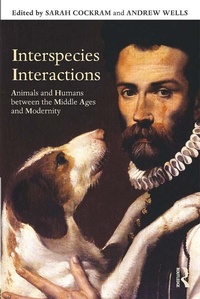
Interspecies Interactions
Animals and Humans between the Middle Ages and Modernity
Published on 14. September 2017
260 pages
978-1-351-61264-7 (ISBN)
Description

Interspecies Interactions surveys the rapidly developing field of human-animal relations from the late medieval and early modern eras through to the mid-Victorian period. By viewing animals as authentic and autonomous historical agents who had a real impact on the world around them, this book concentrates on an under-examined but crucial aspect of the human-animal relationship: interaction.
Each chapter provides scholarly debate on the methods and challenges of the study of interspecies interactions, and together they offer an insight into the part that humans and animals have played in shaping each other's lives, as well as encouraging reflection on the directions that human-animal relations may yet take. Beginning with an exploration of Samuel Pepys' often emotional relationships with the many animals that he knew, the chapters cover a wide range of domestic, working, and wild animals and include case studies on carnival animals, cattle, dogs, horses, apes, snakes, sharks, and invertebrates. These case studies of human-animal interactions are further brought to life through visual representation, by the inclusion of over 20 images within the book.
From 'sleeve cats' to lion fights, Interspecies Interactions encompasses a broad spectrum of relationships between humans and animals. Covering topics such as use, emotion, cognition, empire, status, and performance across several centuries and continents, it is essential reading for all students and scholars of historical animal studies.
Each chapter provides scholarly debate on the methods and challenges of the study of interspecies interactions, and together they offer an insight into the part that humans and animals have played in shaping each other's lives, as well as encouraging reflection on the directions that human-animal relations may yet take. Beginning with an exploration of Samuel Pepys' often emotional relationships with the many animals that he knew, the chapters cover a wide range of domestic, working, and wild animals and include case studies on carnival animals, cattle, dogs, horses, apes, snakes, sharks, and invertebrates. These case studies of human-animal interactions are further brought to life through visual representation, by the inclusion of over 20 images within the book.
From 'sleeve cats' to lion fights, Interspecies Interactions encompasses a broad spectrum of relationships between humans and animals. Covering topics such as use, emotion, cognition, empire, status, and performance across several centuries and continents, it is essential reading for all students and scholars of historical animal studies.
Reviews / Votes
"Interspecies Interactions urges us to mark out new intellectual and methodological territory in historical animal studies. Its chapters span continents, centuries and species in nuanced and revealing ways, celebrating the intertwined becomings of animals, humans and their historical environments. This coherent diversity will be valued by students and scholars across the humanities."Peter Hobbins, The University of Sydney, Australia
"Interspecies Interactions offers original and compelling essays on early modern animals, decentralizing humans and offering new models for considering animal-human relations. Its broad range of places, animals, and approaches represents a new level of sophistication in the historical study of animals."
Anita Guerrini, Oregon State University, USA
"Scholarly and well written, Interspecies Interactions is sensitive to challenges inherent in researching historical animal studies, and will play an exemplary role in expanding the field. The eleven essays here span the period of the middle ages to modernity and are arranged within three helpful themes, 'Empathy, Emotion and Companionship', 'Use and Abuse', and 'Identification and Classification'. In writing history that takes animal experience seriously, the book is a call for respect for the natural world not only in our past but also for our present and future."
Emily Brady, University of Edinburgh, UK
More details
Language
English
Place of publication
London
United Kingdom
Publishing group
Taylor & Francis Ltd
Target group
College/higher education
Illustrations
22 Illustrations, black and white
File size
7,84 MB
ISBN-13
978-1-351-61264-7 (9781351612647)
Copyright in bibliographic data and cover images is held by Nielsen Book Services Limited or by the publishers or by their respective licensors: all rights reserved.
Schweitzer Classification
Other editions
Additional editions
Sarah Cockram | Andrew Wells
Interspecies Interactions
Animals and Humans between the Middle Ages and Modernity
Book
09/2017
1st Edition
Routledge
€63.40
Shipment within 10-20 days
Sarah Cockram | Andrew Wells
Interspecies Interactions
Animals and Humans between the Middle Ages and Modernity
Book
09/2017
1st Edition
Routledge
€206.50
Shipment within 10-20 days
Persons
Sarah Cockram is Lecturer in History, c.1200-1600 at the University of Glasgow. Her publications include Isabella d'Este and Francesco Gonzaga: Power Sharing at the Italian Renaissance Court (2013) and a co-edited special issue of the journal Renaissance Studies on 'The Animal in Renaissance Italy'.
Andrew Wells is a postdoctoral researcher (Wissenschaftlicher Mitarbeiter) in the Graduate School of the Humanities (GSGG) at the Georg-August-Universitaet Goettingen, Germany. He has published essays in History Compass, the Journal of British Studies, and History of European Ideas. His forthcoming book explores the interactions of racial and sexual concepts and identities in eighteenth-century British culture.
Andrew Wells is a postdoctoral researcher (Wissenschaftlicher Mitarbeiter) in the Graduate School of the Humanities (GSGG) at the Georg-August-Universitaet Goettingen, Germany. He has published essays in History Compass, the Journal of British Studies, and History of European Ideas. His forthcoming book explores the interactions of racial and sexual concepts and identities in eighteenth-century British culture.
Content
List of figures; List of Contributors; Acknowledgements; Foreword; Introduction: Action, Reaction, Interaction in Historical Animal Studies; PART 1. EMPATHY, EMOTION AND COMPANIONSHIP; 1. Emotions and the Sixteenth-Century Ottoman Carnival of Animals; 2. Sleeve Cat and Lap Dog: Affection, Aesthetics and Proximity to Companion Animals in Renaissance Mantua; 3. Equine Empathies: Giving Voice to Horses in Early Modern Germany; PART 2. USE AND ABUSE; 4. The Tale of a Horse: The Levinz Colt, 1721-29; 5. Animals at the Table: Performing Meat in Early Modern England and Europe; 6. Blurred Lines: Bestiality and the Human Ape in Enlightenment Scotland; 7. 'A Disgusting Exhibition of Brutality': Animals, the Law, and the Warwick Lion Fight of 1825; PART 3. SELF AND OTHER: IDENTIFICATION AND CLASSIFICATION; 8. Inveterate Travellers and Travelling Invertebrates: Human and Animal in Enlightenment Entomology; 9. Hungarian Grey Cattle: Parallels in Constituting Animal and Human Identities; 10. 'The Monster's Mouth...': Dangerous Animals and the European Settlement of Australia; Afterword; Index
