

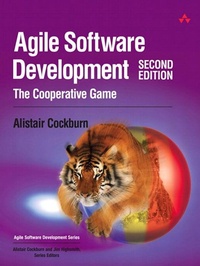
Agile Software Development
The Cooperative Game
2nd Edition
Published on 19. October 2006
504 pages
978-0-321-63007-0 (ISBN)
Description

"Agile Software Development is a highly stimulating and rich book. The author has a deep background and gives us a tour de force of the emerging agile methods."
-Tom Gilb
The agile model of software development has taken the world by storm. Now, in Agile Software Development, Second Edition, one of agile's leading pioneers updates his Jolt Productivity award-winning book to reflect all that's been learned about agile development since its original introduction.
Alistair Cockburn begins by updating his powerful model of software development as a "cooperative game of invention and communication." Among the new ideas he introduces: harnessing competition without damaging collaboration; learning lessons from lean manufacturing; and balancing strategies for communication. Cockburn also explains how the cooperative game is played in business and on engineering projects, not just software development
Next, he systematically illuminates the agile model, shows how it has evolved, and answers the questions developers and project managers ask most often, including
? Where does agile development fit in our organization?
? How do we blend agile ideas with other ideas?
? How do we extend agile ideas more broadly?
Cockburn takes on crucial misconceptions that cause agile projects to fail. For example, you'll learn why encoding project management strategies into fixed processes can lead to ineffective strategy decisions and costly mistakes. You'll also find a thoughtful discussion of the controversial relationship between agile methods and user experience design.
Cockburn turns to the practical challenges of constructing agile methodologies for your own teams. You'll learn how to tune and continuously reinvent your methodologies, and how to manage incomplete communication. This edition contains important new contributions on these and other topics:
? Agile and CMMI
? Introducing agile from the top down
? Revisiting "custom contracts"
? Creating change with "stickers"
In addition, Cockburn updates his discussion of the Crystal methodologies, which utilize his "cooperative game" as their central metaphor.
If you're new to agile development, this book will help you succeed the first time out. If you've used agile methods before, Cockburn's techniques will make you even more effective.
-Tom Gilb
The agile model of software development has taken the world by storm. Now, in Agile Software Development, Second Edition, one of agile's leading pioneers updates his Jolt Productivity award-winning book to reflect all that's been learned about agile development since its original introduction.
Alistair Cockburn begins by updating his powerful model of software development as a "cooperative game of invention and communication." Among the new ideas he introduces: harnessing competition without damaging collaboration; learning lessons from lean manufacturing; and balancing strategies for communication. Cockburn also explains how the cooperative game is played in business and on engineering projects, not just software development
Next, he systematically illuminates the agile model, shows how it has evolved, and answers the questions developers and project managers ask most often, including
? Where does agile development fit in our organization?
? How do we blend agile ideas with other ideas?
? How do we extend agile ideas more broadly?
Cockburn takes on crucial misconceptions that cause agile projects to fail. For example, you'll learn why encoding project management strategies into fixed processes can lead to ineffective strategy decisions and costly mistakes. You'll also find a thoughtful discussion of the controversial relationship between agile methods and user experience design.
Cockburn turns to the practical challenges of constructing agile methodologies for your own teams. You'll learn how to tune and continuously reinvent your methodologies, and how to manage incomplete communication. This edition contains important new contributions on these and other topics:
? Agile and CMMI
? Introducing agile from the top down
? Revisiting "custom contracts"
? Creating change with "stickers"
In addition, Cockburn updates his discussion of the Crystal methodologies, which utilize his "cooperative game" as their central metaphor.
If you're new to agile development, this book will help you succeed the first time out. If you've used agile methods before, Cockburn's techniques will make you even more effective.
More details
Series
Edition
2nd edition
Language
English
Place of publication
Hoboken
United States
Publishing group
Pearson Education (US)
Target group
College/higher education
ISBN-13
978-0-321-63007-0 (9780321630070)
Copyright in bibliographic data and cover images is held by Nielsen Book Services Limited or by the publishers or by their respective licensors: all rights reserved.
Schweitzer Classification
Other editions
Additional editions
Book
11/2006
2nd Edition
Addison Wesley
€54.56
Available immediately
Person
Dr. Alistair Cockburn is an internationally renowned expert on all aspects of software development, from object-oriented modeling and architecture, to methodology design, to project management and organizational alignment. One of the pioneers who coined the term "agile software development," he co-authored the 2001 Agile Software Development Manifesto and the 2005 Declaration of Interdependence. Since 1975, he has led projects and taught in places from Oslo to Cape Town, from Vancouver to Beijing. His work has covered topics from design to management to testing, in research, in government, and in industry. His most recent book is Crystal Clear: A Human-Powered Methodology for Small Teams. His books Writing Effective Use Cases and Agile Software Development won back-to-back Jolt Productivity Awards in 2001 and 2002.
Content
List of Figures xi
List of Stories xvii
Preface xxi
Preface to Second Edition xxxi
0 Unknowable and Incommunicable 1
0.1 Unknowable and Incommunicable: Evolution 21
Chapter 1 A Cooperative Game of Invention and Communication 27
Chapter 1.1 A Cooperative Game of Invention and Communication: Evolution 47
Chapter 2 Individuals 65
Chapter 2.1 Individuals: Evolution 99
Chapter 3 Communication, Cooperating Teams 105
Chapter 3.1 Teams: Evolution 143
Chapter 4 Methodologies 147
Chapter 4.1 Methodologies: Evolution 207
Chapter 5 Agile and Self-Adapting 217
Chapter 5.1 Agile and Self-Adapting: Evolution 241
Chapter 6 The Crystal Methodologies 335
Chapter 6.1 The Crystal Methodologies: Evolution 351
Appendix A The Agile Software Development Manifesto 367
Appendix A.1 The Agile Software Development Manifesto and the Declaration of Interdependence 379
Appendix B Naur, Ehn, Musashi 391
Appendix B.1 Naur, Ehn, Musashi: Evolution 427
Appendix C Afterword 431
Appendix D Books and References 437
Index 453
List of Stories xvii
Preface xxi
Preface to Second Edition xxxi
0 Unknowable and Incommunicable 1
0.1 Unknowable and Incommunicable: Evolution 21
Chapter 1 A Cooperative Game of Invention and Communication 27
Chapter 1.1 A Cooperative Game of Invention and Communication: Evolution 47
Chapter 2 Individuals 65
Chapter 2.1 Individuals: Evolution 99
Chapter 3 Communication, Cooperating Teams 105
Chapter 3.1 Teams: Evolution 143
Chapter 4 Methodologies 147
Chapter 4.1 Methodologies: Evolution 207
Chapter 5 Agile and Self-Adapting 217
Chapter 5.1 Agile and Self-Adapting: Evolution 241
Chapter 6 The Crystal Methodologies 335
Chapter 6.1 The Crystal Methodologies: Evolution 351
Appendix A The Agile Software Development Manifesto 367
Appendix A.1 The Agile Software Development Manifesto and the Declaration of Interdependence 379
Appendix B Naur, Ehn, Musashi 391
Appendix B.1 Naur, Ehn, Musashi: Evolution 427
Appendix C Afterword 431
Appendix D Books and References 437
Index 453
