

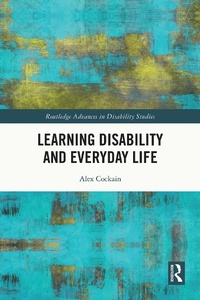
Learning Disability and Everyday Life
1st Edition
Published on 29. March 2024
294 pages
978-1-003-86030-3 (ISBN)
Description

Learning Disability and Everyday Life brings into conversation ideas from social theory with "thick" descriptions of the everyday life of a middle-aged man with learning disabilities and autism.
This book is markedly ethnographic in its orientation to the gritty graininess of everyday life-eating, drinking, walking, cooking, talking, and so on-in, with, and alongside learning disability. However, preoccupation with, the "small" coexists with a gaze intent upon capturing a bigger picture, to the extent that the things constituting everyday life are deployed as prisms through and with which to critically reflect upon the wider worlds of dis/ability and everyday life. Such attention to the small and the big-the micro and the macro-allows this book to explore the ordinary and everyday ways meanings about normalcy and abnormalcy, ability and disability, are put together, enacted, practised, made (up)-in the sense of constituting and fabricating-and, crucially, accomplished through and between people in specific, and invariably contingent, sociocultural, discursive, and material conditions of possibility.
This book will be of specific interest not only to students and scholars of disability but also to persons with lived experiences of disability. This book will also be of interest to students and scholars of anthropology and sociology.
This book is markedly ethnographic in its orientation to the gritty graininess of everyday life-eating, drinking, walking, cooking, talking, and so on-in, with, and alongside learning disability. However, preoccupation with, the "small" coexists with a gaze intent upon capturing a bigger picture, to the extent that the things constituting everyday life are deployed as prisms through and with which to critically reflect upon the wider worlds of dis/ability and everyday life. Such attention to the small and the big-the micro and the macro-allows this book to explore the ordinary and everyday ways meanings about normalcy and abnormalcy, ability and disability, are put together, enacted, practised, made (up)-in the sense of constituting and fabricating-and, crucially, accomplished through and between people in specific, and invariably contingent, sociocultural, discursive, and material conditions of possibility.
This book will be of specific interest not only to students and scholars of disability but also to persons with lived experiences of disability. This book will also be of interest to students and scholars of anthropology and sociology.
Reviews / Votes
"Learning Disability and Everyday Life concerns autism, but the word does not appear in the book title. There is a reason for that, as it becomes clear by reading. Alex Cockain is critical towards pre-given categories; he is aware of the power of language, and he tries to open a narrative space of encounter challenging the assumptions, postures and stereotypes which accompany autistic and disabled persons. Of course, as the Author discusses with much reflexivity, there are limits in his strategy, as with every experiment. Still, it poses a problem, challenges conventions, and allows reconfiguration and renegotiation. So, the title refers to 'learning disability', together with 'everyday life'. On the one hand, focusing on the rhythms and practices of the everyday means paying attention to the scrutiny of the small and the ordinary, including practices like eating, walking or sleeping. But clearly, the small and the ordinary are not meaningless; quite the contrary, the everyday is political and allows access to the broader world of disability."Alberto Vanolo (12 Aug 2024): Learning Disability and Everyday Life, Disability & Society, DOI: 10.1080/09687599.2024.2391612
"Learning Disability and Everyday Life offers an account of Alex Cockain's life with his brother Paul. Paul is a middle-aged man who has labels of autism and learning disability. The account is ethnographic in texture, and Cockain draws on an impressive array of theory relevant to disability studies including anthropology, sociology, linguistics, phenomenology and a good deal more. He also makes liberal use of disability studies literature in advancing his analysis and arguments. The book shows how apparently mundane moments and practices in Alex and Paul's everyday lives are produced by the hegemonic forces which saturate our social world: D/discourses, power relations, normalcy, ableism and disablism, and so on. In other words, all the usual suspects are here, and they are used to illuminate not just Alex and Paul's everyday lives, but the ways in which other people including neighbours, doctors, and Government bureaucrats respond to autism and learning disability, and people who carry such labels, in their everyday lives.
Ultimately, this book offers a uniquely detailed, textured, erudite and theoretically sophisticated ethnographic case study of two people's everyday lives, and how they are shaped bylearning disability and the sociocultural processes and possibilities that attend it."
Dr. Owen Barden, Review of Learning Disability and Everyday Life in the Canadian Journal of Disability Studies 14.1 (April 2025)
More details
Series
Edition
1. Auflage
Language
English
Place of publication
London
United Kingdom
Publishing group
Taylor & Francis Ebooks
Target group
College/higher education
Illustrations
10 Halftones, black and white; 10 Illustrations, black and white
ISBN-13
978-1-003-86030-3 (9781003860303)
Copyright in bibliographic data and cover images is held by Nielsen Book Services Limited or by the publishers or by their respective licensors: all rights reserved.
Schweitzer Classification
Other editions
Additional editions
Alex Cockain
Learning Disability and Everyday Life
Book
07/2025
1st Edition
Routledge
€68.10
Shipment within 10-20 days
Alex Cockain
Learning Disability and Everyday Life
Book
03/2024
1st Edition
Routledge
€206.70
Shipment within 10-20 days
Person
Alex Cockain is a Senior Lecturer in the Faculty of Medicine, Health and Social Care and The Graduate College at Canterbury Christ Church University. Since his first book entitled Young Chinese in Urban China (2012), much of his work has focused upon issues of social inclusion and social exclusion and especially how ability and disability are made through social encounters, discourse, media representations, and everyday practices. His recent work has also explored the tactics disabled people and their families deploy to cope, and make do, with exclusionary places and practices and the ways they attempt to manage disabling social encounters.
Content
Part 1: Dis/orientating directions
1. Encountering, and interpreting, everyday life in-or alongside-significant learning disability, or the world inside-out, and back-to-front
2. Dwelling, outside(r)ness, and (various) other methodological positions
Part 2: Conversations about-and with (or alongside and for)-Paul and other autistic people and things
3. Authorising languages
4. Everyday discourse and everyday power
5. Tu(r)ning (in)to the things themselves
Part 3: Out (of) and about place, let's go outside
6. Becoming quixotic? A discussion on the discursive construction of disability and how this is maintained through social relations
7. Walking small with 'Paul': On (not) passing in purportedly public places
8. Disturbing geographies and in/stability in and around a supermarket
Part 4: Inside, outside, and in/between
9. Accounting for an encounter with a social worker
10. Home, away, and the spaces, places, and persons in/between
11. A room of Paul's own, and the apparent comfort of things
Part 5: To the things themselves
12. Forms of autistic presence and practice
1. Encountering, and interpreting, everyday life in-or alongside-significant learning disability, or the world inside-out, and back-to-front
2. Dwelling, outside(r)ness, and (various) other methodological positions
Part 2: Conversations about-and with (or alongside and for)-Paul and other autistic people and things
3. Authorising languages
4. Everyday discourse and everyday power
5. Tu(r)ning (in)to the things themselves
Part 3: Out (of) and about place, let's go outside
6. Becoming quixotic? A discussion on the discursive construction of disability and how this is maintained through social relations
7. Walking small with 'Paul': On (not) passing in purportedly public places
8. Disturbing geographies and in/stability in and around a supermarket
Part 4: Inside, outside, and in/between
9. Accounting for an encounter with a social worker
10. Home, away, and the spaces, places, and persons in/between
11. A room of Paul's own, and the apparent comfort of things
Part 5: To the things themselves
12. Forms of autistic presence and practice
