

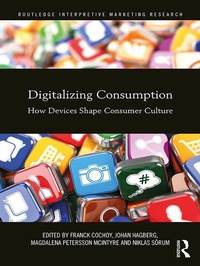
Digitalizing Consumption
How devices shape consumer culture
Published on 14. July 2017
270 pages
978-1-317-29935-6 (ISBN)
Description

Contemporary consumer society is increasingly saturated by digital technology, and the devices that deliver this are increasingly transforming consumption patterns. Social media, smartphones, mobile apps and digital retailing merge with traditional consumption spheres, supported by digital devices which further encourage consumers to communicate and influence other consumers to consume.
Through a wide range of empirical studies which analyse the impact of digital devices, this volume explores the digitization of consumption and shows how consumer culture and consumption practices are fundamentally intertwined and mediated by digital devices. Exploring the development of new consumer cultures, leading international scholars from sociology, marketing and ethnology examine the effects on practices of consumption and marketing, through topics including big data, digital traces, streaming services, wearables, and social media's impact on ethical consumption.
Digitalizing Consumption makes an important contribution to practice-based approaches to consumption, particularly the use of market devices in consumers' everyday consumer life, and will be of interest to scholars of marketing, cultural studies, consumer research, organization and management.
Through a wide range of empirical studies which analyse the impact of digital devices, this volume explores the digitization of consumption and shows how consumer culture and consumption practices are fundamentally intertwined and mediated by digital devices. Exploring the development of new consumer cultures, leading international scholars from sociology, marketing and ethnology examine the effects on practices of consumption and marketing, through topics including big data, digital traces, streaming services, wearables, and social media's impact on ethical consumption.
Digitalizing Consumption makes an important contribution to practice-based approaches to consumption, particularly the use of market devices in consumers' everyday consumer life, and will be of interest to scholars of marketing, cultural studies, consumer research, organization and management.
Reviews / Votes
By following traces, practices and 'devicification', the chapters of this edited collection take us through the profound transformations that characterise contemporary digital consumption. Digital consumers are now not more or less than their devices. Consumers, devices, data, infrastructures and algorithms form composites with consequence.Daniel Neyland, Professor of Sociology, Goldsmiths, UK.
This is a terrific collection that takes the dynamic, material processes of digitalization, rather than 'the digital' as its departure point. As a result, the authors are able to expose the rhythms, traces and consequences of digitalization on consumption, and on social life more broadly. It should be required reading for anyone who wants to move beyond the hype to understand how digitalization is working through infrastructures that artfully combine the enterprises of consumers and professionals to monitor and frame consumption.
Liz McFall, Senior Lecturer in Sociology at the Open University, UK.
The digitalization of consumption is an important field of research that, so far, has not been adequately explored. This book makes a much need contribution by combining in-depth empirical analysis with new theoretical insights. I think it is a must-read for anyone with an interest in this field.
Adam Arvidsson, Associate Professor of Sociology, University of Milan, Italy.
More details
Series
Language
English
Place of publication
London
United Kingdom
Publishing group
Taylor & Francis Ltd
Target group
College/higher education
Illustrations
31 s/w Abbildungen, 7 s/w Tabellen
7 Tables, black and white; 31 Illustrations, black and white
File size
7,38 MB
ISBN-13
978-1-317-29935-6 (9781317299356)
Copyright in bibliographic data and cover images is held by Nielsen Book Services Limited or by the publishers or by their respective licensors: all rights reserved.
Schweitzer Classification
Other editions
Additional editions
Franck Cochoy | Johan Hagberg | Magdalena McIntyre
Digitalizing Consumption
How devices shape consumer culture
Book
12/2019
1st Edition
Routledge
€68.50
Shipment within 15-20 days
Franck Cochoy | Johan Hagberg | Magdalena McIntyre
Digitalizing Consumption
How devices shape consumer culture
Book
06/2017
1st Edition
Routledge
€205.80
Shipment within 10-20 days
Persons
Franck Cochoy is Professor of Sociology at the University of Toulouse Jean Jaures and a member of LISST-CNRS, France. He works in the field of economic sociology, with a focus on the human and technical mediations that frame the relationship between supply and demand. He has published several books in both French and English including On the origins of self-service (Routledge, forthcoming).
Johan Hagberg, PhD, is a Senior Lecturer in Marketing at the School of Business, Economics and Law, University of Gothenburg. His research examines market practices in the field of retailing. His current work investigates consumer logistics, digitalization of consumption and retailing.
Niklas Hansson is PhD in European Ethnology and senior researcher at the Centre for Consumer Science, University of Gothenburg, Sweden. His current work examines digitalization of ethical consumption practices, consumer logistics and marketization of cultural heritage on second hand markets in the Swedish context.
Magdalena Petersson McIntyre is PhD in European Ethnology and Associate Professor at the Centre for Consumer Science, University of Gothenburg, Sweden. Her research interests are within consumption, gender and retail and she has published on fashion, service work and normativity.
Johan Hagberg, PhD, is a Senior Lecturer in Marketing at the School of Business, Economics and Law, University of Gothenburg. His research examines market practices in the field of retailing. His current work investigates consumer logistics, digitalization of consumption and retailing.
Niklas Hansson is PhD in European Ethnology and senior researcher at the Centre for Consumer Science, University of Gothenburg, Sweden. His current work examines digitalization of ethical consumption practices, consumer logistics and marketization of cultural heritage on second hand markets in the Swedish context.
Magdalena Petersson McIntyre is PhD in European Ethnology and Associate Professor at the Centre for Consumer Science, University of Gothenburg, Sweden. Her research interests are within consumption, gender and retail and she has published on fashion, service work and normativity.
Content
TABLE OF CONTENTS
Digitalizing consumption: Introduction. Franck Cochoy, Universite Toulouse Jean Jaures, France, Johan Hagberg, University of Gothenburg, Sweden, Magdalena Petersson McIntyre, University of Gothenburg, Sweden, Niklas Soerum, University of Gothenburg, Sweden.
Big Data challenge for social sciences and market research: From society and opinion to replications. Dominique Boullier, Sciences Po, France.
Towards a rhythm-sensitive data economy. Mika Pantzar and Minna Lammi, National Consumer Research Centre, Finland.
Serendipitous effects in digitalized markets: The case of the DataCrawler recommendation agent. Jean-Sebastien Vayre, Universite Toulouse Jean Jaures, France; Lucie Larnaudie, Centre Universitaire Jean-Francois Champollion, France and Aude Dufresne, Universite de Montreal, Canada.
Extending the mind: Digital devices and the transformation of consumer practices. Rebecca Jenkins, Bournemouth University, United Kingdom & Janice Denegri-Knott, Bournemouth University, United Kingdom.
Promoting ethical consumption: The construction of smartphone apps as 'ethical' choice prescribers. Lena Hansson, University of Gothenburg, Sweden.
Tracing the sex of big data (or configuring digital consumers). Magdalena Petersson McIntyre, University of Gothenburg, Sweden.
"Write something": The shaping of ethical consumption on Facebook. Niklas Soerum, University of Gothenburg, Sweden and Christian Fuentes, University of Gothenburg, Sweden.
Digitalized music: Entangling consumption practices. Johan Hagberg, University of Gothenburg, Sweden and Hans Kjellberg, Stockholm School of Economics, Sweden.
Marketing and cyberspace: William Gibson's view. Barbara Czarniawska, University of Gothenburg, Sweden.
Digital advertising campaigns and the branded economy. Gustav Sjoeblom, Chalmers University of Technology, Sweden; Oskar Broberg, University of Gothenburg, Sweden and Ann-Sofie Axelsson, University of Boras, Sweden.
From the logs of QR-code readers: A socio-log-y of digital consumption. Franck Cochoy, Universite Toulouse Jean Jaures, France and Jan Smolinski, Universite Toulouse Jean Jaures, France.
Digitalizing consumption: Introduction. Franck Cochoy, Universite Toulouse Jean Jaures, France, Johan Hagberg, University of Gothenburg, Sweden, Magdalena Petersson McIntyre, University of Gothenburg, Sweden, Niklas Soerum, University of Gothenburg, Sweden.
Big Data challenge for social sciences and market research: From society and opinion to replications. Dominique Boullier, Sciences Po, France.
Towards a rhythm-sensitive data economy. Mika Pantzar and Minna Lammi, National Consumer Research Centre, Finland.
Serendipitous effects in digitalized markets: The case of the DataCrawler recommendation agent. Jean-Sebastien Vayre, Universite Toulouse Jean Jaures, France; Lucie Larnaudie, Centre Universitaire Jean-Francois Champollion, France and Aude Dufresne, Universite de Montreal, Canada.
Extending the mind: Digital devices and the transformation of consumer practices. Rebecca Jenkins, Bournemouth University, United Kingdom & Janice Denegri-Knott, Bournemouth University, United Kingdom.
Promoting ethical consumption: The construction of smartphone apps as 'ethical' choice prescribers. Lena Hansson, University of Gothenburg, Sweden.
Tracing the sex of big data (or configuring digital consumers). Magdalena Petersson McIntyre, University of Gothenburg, Sweden.
"Write something": The shaping of ethical consumption on Facebook. Niklas Soerum, University of Gothenburg, Sweden and Christian Fuentes, University of Gothenburg, Sweden.
Digitalized music: Entangling consumption practices. Johan Hagberg, University of Gothenburg, Sweden and Hans Kjellberg, Stockholm School of Economics, Sweden.
Marketing and cyberspace: William Gibson's view. Barbara Czarniawska, University of Gothenburg, Sweden.
Digital advertising campaigns and the branded economy. Gustav Sjoeblom, Chalmers University of Technology, Sweden; Oskar Broberg, University of Gothenburg, Sweden and Ann-Sofie Axelsson, University of Boras, Sweden.
From the logs of QR-code readers: A socio-log-y of digital consumption. Franck Cochoy, Universite Toulouse Jean Jaures, France and Jan Smolinski, Universite Toulouse Jean Jaures, France.
