

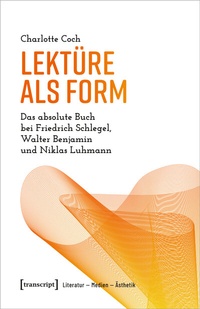
Lektüre als Form
Das absolute Buch bei Friedrich Schlegel, Walter Benjamin und Niklas Luhmann
1st Edition
Published on 12. January 2021
376 pages
978-3-8394-5579-1 (ISBN)
Description

Innerhalb der aktuellen Buchmaterialitätsforschung kommt die Betrachtung der Lektüre oft zu kurz. Dies verkennt die intrikate Verschlingung von Buch und Lektüre in der Entdeckung der Druckschrift um 1800. Charlotte Coch zeigt, wie sich das »absolute Buch« bei Friedrich Schlegel im Zeichen der Arabeske als spezifisches, symmetrisches Lektüreprogramm formiert. Sie verfolgt außerdem die Umcodierung dieses Lektüreprogramms bei Walter Benjamin und Niklas Luhmann: Parallel zu einer Prozessualisierung des Formbegriffs verwandelt sich das absolute Buch von der Arabeske in das Ornament - und wird signalförmig. Damit wird Literatur als Paratext und Theorie als Metatext lesbar.
Reviews / Votes
»Ein hochspannender Text.«More details
Series
Thesis
Doctoral thesis
2020
Universität zu Köln
Language
German
Place of publication
Bielefeld
Germany
Target group
Professional and scholarly
Illustrations
6
2 farbige Abbildungen, 4 s/w Abbildungen
4 SW-Abbildungen, 2 Farbabbildungen
File size
3,15 MB
ISBN-13
978-3-8394-5579-1 (9783839455791)
DOI
10.14361/9783839455791
Schweitzer Classification
Other editions
Additional editions
Charlotte Coch
Lektüre als Form
Das absolute Buch bei Friedrich Schlegel, Walter Benjamin und Niklas Luhmann
Book
01/2021
1st Edition
transcript
€49.00
Shipment within 5-7 days
Person
Content
- Cover
- Inhalt
- Danksagung
- Siglenverzeichnis
- 1. Einleitung: Absolute Bücher und ihre Lektüren
- 2. Lektüre als Form
- 2.1. Lektüre
- 2.2. Form
- 2.3. Arabeske und Ornament
- 3. »Lesewut und Bücherflut«: Drei Varianten
- 3.1. Bibliophilie
- 3.2. Bibliographie
- 3.3. Zettelkasten
- 4. Arabeske: Reden/Schweigen
- 4.1. Paratext
- 4.1.1. Kunst und Magie: Lektüre zwischen Öffnung und Schließung
- 4.1.2. »Helle und lebhafte Gegensätze«
- 4.1.3. Rede/Schrift: von der Symmetrie zur Asymmetrie
- 4.1.4. Organisation und Konstruktion
- 4.1.5. Grenze
- 4.1.6. Zwischenfazit I: Ironie
- 4.2. Buch
- 4.2.1. Konkretisierte Symmetrie: Die Arabeske
- 4.2.2. Konstruktion: Der Witz
- 4.2.3. Organisation: Die Liebe
- 4.2.4. Arabeske II: (Hand-)Schrift
- 4.2.5. Reden und Schweigen
- 4.3. Paratext/Metatext: Der Weg zum System
- 4.3.1. Von der Schwierigkeit des Anfangs
- 4.3.2. Streit
- 4.3.3. Enthusiasmus/Skepsis
- 4.3.4. Philosophie und Kritik
- 4.3.5. Die >cyklische Methode<
- 4.4. Die Prozessualisierung der Form
- 5. Reflexion: Form gegen Lektüre
- 5.1. Lektüre und Buch: Schlegel- und Goethetranskriptionen
- 5.2. Der »Doppelsinn« des Reflexionsmediums
- 5.2.1. Form/Medium - Die Transformation des Formbegriffs
- 5.2.2. Form als Widerstand von >Reflexion<
- 5.3. Paradigmenwechsel: Von der Arabeske zum Ornament
- 6. Ornament: Signal/Rauschen
- 6.1. Rauschen und Rauschen: Das Interview als Metatext
- 6.2. Prozessuale Begriffe
- 6.2.1. Sinn
- 6.2.2. Organisation und Konstruktion
- 6.2.3. Grenze
- 6.2.4. Zwischenfazit II: Ironie
- 6.3. Genealogien der Form
- 6.3.1. Form und Organisation
- 6.3.2. Form und System
- 6.3.3. Form/Medium
- 6.3.4. Form und Code
- 6.4. »Buch im Buch«: Soziale Systeme und Die Kunst der Gesellschaft
- 6.4.1. Der Anfang der Theorie
- 6.4.2. Signal und Rauschen
- 6.4.3. Ornament und Asymmetrie
- 6.5. Die reine Form - Dirk Baecker und die Haken
- 7. Fazit: Die Ornamentalisierung der Arabeske
- 8. Bibliographie
- 8.1. Quellen
- 8.2. Darstellungen
- 8.3. Sonstige Quellen
- Abbildungsverzeichnis
