

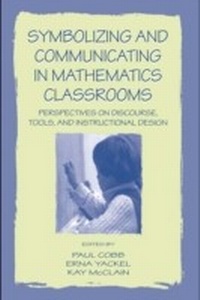
Symbolizing and Communicating in Mathematics Classrooms
Perspectives on Discourse, Tools, and Instructional Design
1st Edition
Published on 12. November 2012
412 pages
978-1-135-67783-1 (ISBN)
Description

This volume grew out of a symposium on discourse, tools, and instructional design at Vanderbilt University in 1995 that brought together a small international group to grapple with issues of communicating, symbolizing, modeling, and mathematizing, particularly as these issues relate to learning in the classroom. The participants invited to develop chapters for this book--all internationally recognized scholars in their respective fields--were selected to represent a wide range of theoretical perspectives including mathematics education, cognitive science, sociocultural theory, and discourse theory. The work is distinguished by the caliber of the contributors, the significance of the topics addressed in the current era of reform in mathematics education, and the diversity of perspectives taken to a common set of themes and issues.
The book is intended for those who are seeking to expand their understanding of the complexity of learning in order to enhance the learning experiences students have in schools, primarily researchers, instructional designers, and graduate students in mathematics education, as well as those in other fields including science education, instructional design in general, discourse theory, and semiotics.
The book is intended for those who are seeking to expand their understanding of the complexity of learning in order to enhance the learning experiences students have in schools, primarily researchers, instructional designers, and graduate students in mathematics education, as well as those in other fields including science education, instructional design in general, discourse theory, and semiotics.
Reviews / Votes
"All the articles taken together add up to a strong argument in favor of making symbolizing and communicating prominent features in mathematics classrooms. Arguments are well illustrated....A good resource for teacher educators and graduate students who are interested in the interrelationship between semiotic theories and mathematical understanding."-CHOICE
"...offers literacy educators another way to view mathematics....ways to think about literacy in mathematics classrooms....[and] provides literacy researchers insights into the kind of questions that are important to mathematics education researchers, which can be helpful as literacy educators work to consider problems and questions that cross educational domains....This book ultimately offers to literacy educators an insight into terms like symbolizing, modeling, mathematizing, and representation as used by mathematics educators. By understanding these terms and considering the implications for instructional design, literacy educators can begin building bridges between themselves and mathematics educators."
-Journal of Literacy Research
More details
Language
English
Place of publication
London
United Kingdom
Publishing group
Taylor & Francis Ltd
Target group
Professional and scholarly
File size
5,59 MB
ISBN-13
978-1-135-67783-1 (9781135677831)
Copyright in bibliographic data and cover images is held by Nielsen Book Services Limited or by the publishers or by their respective licensors: all rights reserved.
Schweitzer Classification
Other editions
Additional editions
Paul Cobb | Erna Yackel | Kay McClain
Symbolizing and Communicating in Mathematics Classrooms
Perspectives on Discourse, Tools, and Instructional Design
Book
01/2000
Routledge
€208.90
Shipment within 10-20 days
Paul Cobb | Erna Yackel | Kay McClain
Symbolizing and Communicating in Mathematics Classrooms
Perspectives on Discourse, Tools, and Instructional Design
Book
01/2000
Routledge
€89.80
Shipment within 10-20 days
Persons
Paul Cobb, Erna Yackel, Kay McClain
Content
Contents: E. Yackel, P. Cobb, K. McClain, Preface. E. Yackel, Introduction: Perspectives on Semiotics and Instructional Design. Part I:Theoretical Considerations.P. Cobb, From Representations to Symoblizing: Introductory Comments on Semiotics and Mathematical Learning. A. Sfard, Symbolizing Mathematical Reality Into Being--Or How Mathematical Discourse and Mathematical Objects Create Each Other. W. Doerfler, Means for Meaning. B. van Oers, The Appropriation of Mathematical Symbols: A Psychosemiotic Approach to Mathematics Learning. R. Nemirovsky, S. Monk, "If You Look at It the Other Way...": An Exploration Into the Nature of Symbolizing. Part II:Instructional Design Issues Related to Symbolizing, Communicating, and Mathematizing.K. Gravemeijer, P. Cobb, J. Bowers, J. Whitenack, Symbolizing, Modeling, and Instructional Design. J. Bransford, L. Zech, D. Schwarts, B. Barron, N. Vye, The Cognition and Technology Group at Vanderbilt, Designs for Environments That Invite and Sustain Mathematical Thinking. R. Lehrer, L. Schauble, S. Carpenter, D. Penner, The Innerrelated Development of Inscriptions and Conceptual Understanding. R. Lesh, H.M. Doerr, Symbolizing, Communicating, and Mathematizing: Key Components of Models and Modeling. J. Bowers, Postscript: Integrating Themes on Discourse and Design.
