

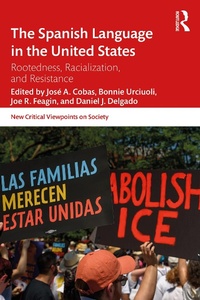
The Spanish Language in the United States
Rootedness, Racialization, and Resistance
1st Edition
Published on 24. February 2022
174 pages
978-1-000-53110-7 (ISBN)
Description

The Spanish Language in the United States addresses the rootedness of Spanish in the United States, its racialization, and Spanish speakers' resistance against racialization. This novel approach challenges the "foreigner" status of Spanish and shows that racialization victims do not take their oppression meekly. It traces the rootedness of Spanish since the 1500s, when the Spanish empire began the settlement of the new land, till today, when 39 million U.S. Latinos speak Spanish at home. Authors show how whites categorize Spanish speaking in ways that denigrate the non-standard language habits of Spanish speakers-including in schools-highlighting ways of overcoming racism.
More details
Series
Edition
1. Auflage
Language
English
Place of publication
London
United Kingdom
Publishing group
Taylor & Francis Ltd
Target group
College/higher education
Product notice
Reflowable
Illustrations
8 Tables, black and white; 2 Line drawings, black and white; 2 Illustrations, black and white
ISBN-13
978-1-000-53110-7 (9781000531107)
Copyright in bibliographic data and cover images is held by Nielsen Book Services Limited or by the publishers or by their respective licensors: all rights reserved.
Schweitzer Classification
Other editions
Additional editions
Jose Cobas | Bonnie Urciuoli | Joe Feagin
The Spanish Language in the United States
Rootedness, Racialization, and Resistance
Book
02/2022
1st Edition
Routledge
€205.90
Shipment within 10-20 days
Jose Cobas | Bonnie Urciuoli | Joe Feagin
The Spanish Language in the United States
Rootedness, Racialization, and Resistance
Book
02/2022
1st Edition
Routledge
€59.80
Shipment within 10-20 days
Persons
Jose A. Cobas is Professor Emeritus of Sociology at Arizona State University. Among his publications are (with Jorge Duany and Joe R. Feagin) How the United States Racializes Latinos: White Hegemony and Its Consequences (Paradigm 2009), (with Joe R. Feagin) Latinos Facing Racism: Discrimination, Resistance, and Endurance (Paradigm 2014), and (with Joe R. Feagin, Daniel J. Delgado, and Maria Chavez), Latino Peoples in the New America: Racialization and Resistance (Routledge 2019).
Bonnie Urciuoli is Professor Emerita of Anthropology at Hamilton College where she taught linguistic and semiotic anthropology. She has published on race/class ideologies of Spanish-English bilingualism in New York City, on the discursive production and marketing of "skills" in the United States, and on the construction and marketing of studenthood and diversity in U.S. higher education. Her books include Exposing Prejudice: Puerto Rican Experiences of Language, Race, and Class (1996), Neoliberalizing Diversity in Liberal Arts College Life (forthcoming), and an edited volume, The Experience of Neoliberal Education (2018).
Joe R. Feagin is Distinguished Professor of Sociology at Texas A&M University. He specializes in systemic racism studies. Among his books are Latinos Facing Racism (2014, with J. Cobas), Racist America (4th ed., Routledge 2019, with K. Ducey), Rethinking Diversity Frameworks in Higher Education (Routledge, 2020, with E. Chun), The White Racial Frame (3rd ed., Routledge 2020), and Revealing Systemic British Racism (Routledge 2021, with K. Ducey). He is the recipient of the American Association for Affirmative Action's Fletcher Lifetime Achievement Award and the American Sociological Association's W. E. B. Du Bois Career of Distinguished Scholarship Award, Cox-Johnson- Frazier Award, and Public Understanding of Sociology Award. He was the 1999-2000 president of the American Sociological Association.
Daniel J. Delgado is Associate Professor of Sociology or at Texas A&M University in San Antonio. His research is focused on three areas: a Latino/a student's experiences in higher education, middle-class Latinx experiences with processes of racialization, and understanding how race and space intersect in the Southwest. He has published in several edited volumes and journals and is co-editor (with Jose A. Cobas and Joe R. Feagin) of Latino Peoples in the New America: Racialization and Resistance (Routledge 2019). He lives in his hometown of San Antonio, Texas.
Bonnie Urciuoli is Professor Emerita of Anthropology at Hamilton College where she taught linguistic and semiotic anthropology. She has published on race/class ideologies of Spanish-English bilingualism in New York City, on the discursive production and marketing of "skills" in the United States, and on the construction and marketing of studenthood and diversity in U.S. higher education. Her books include Exposing Prejudice: Puerto Rican Experiences of Language, Race, and Class (1996), Neoliberalizing Diversity in Liberal Arts College Life (forthcoming), and an edited volume, The Experience of Neoliberal Education (2018).
Joe R. Feagin is Distinguished Professor of Sociology at Texas A&M University. He specializes in systemic racism studies. Among his books are Latinos Facing Racism (2014, with J. Cobas), Racist America (4th ed., Routledge 2019, with K. Ducey), Rethinking Diversity Frameworks in Higher Education (Routledge, 2020, with E. Chun), The White Racial Frame (3rd ed., Routledge 2020), and Revealing Systemic British Racism (Routledge 2021, with K. Ducey). He is the recipient of the American Association for Affirmative Action's Fletcher Lifetime Achievement Award and the American Sociological Association's W. E. B. Du Bois Career of Distinguished Scholarship Award, Cox-Johnson- Frazier Award, and Public Understanding of Sociology Award. He was the 1999-2000 president of the American Sociological Association.
Daniel J. Delgado is Associate Professor of Sociology or at Texas A&M University in San Antonio. His research is focused on three areas: a Latino/a student's experiences in higher education, middle-class Latinx experiences with processes of racialization, and understanding how race and space intersect in the Southwest. He has published in several edited volumes and journals and is co-editor (with Jose A. Cobas and Joe R. Feagin) of Latino Peoples in the New America: Racialization and Resistance (Routledge 2019). He lives in his hometown of San Antonio, Texas.
Content
Section One: Language, Race, and Power
Introduction: Language, Racialization, and Power.
Chapter 1: The Case of Middle-class Latinos in the United States
Section Two: Rootedness
Chapter 2: The Early Political History of Spanish in the United States
Chapter 3: The Demography and Socioeconomic Standing of Spanish-Language Latinos
Section Three: Racialization
Chapter 4: What Anti-Spanish Prejudice Tells Us about Whiteness
Chapter 5: A Language-elsewhere: A Friendlier Linguistic Terrorism
Chapter 6: "You Are Not Allowed to Speak Spanish! This Is an American Hospital!": Puerto Ricans' Experiences with Linguistic Discrimination and Otherness in Central Florida
Chapter 7: Black Spanish, White Leanings, Trigueno Mythologies in Puerto Rico
Section Four: Resistance
Chapter 8: The Enchantment of Language Resistance in Puerto Rico
Chapter 9: Subtracting Spanish and Forcing English: My Lived Experience in Texas Public Schools
Introduction: Language, Racialization, and Power.
Chapter 1: The Case of Middle-class Latinos in the United States
Section Two: Rootedness
Chapter 2: The Early Political History of Spanish in the United States
Chapter 3: The Demography and Socioeconomic Standing of Spanish-Language Latinos
Section Three: Racialization
Chapter 4: What Anti-Spanish Prejudice Tells Us about Whiteness
Chapter 5: A Language-elsewhere: A Friendlier Linguistic Terrorism
Chapter 6: "You Are Not Allowed to Speak Spanish! This Is an American Hospital!": Puerto Ricans' Experiences with Linguistic Discrimination and Otherness in Central Florida
Chapter 7: Black Spanish, White Leanings, Trigueno Mythologies in Puerto Rico
Section Four: Resistance
Chapter 8: The Enchantment of Language Resistance in Puerto Rico
Chapter 9: Subtracting Spanish and Forcing English: My Lived Experience in Texas Public Schools
