

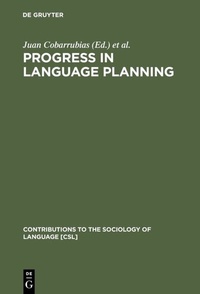
Progress in Language Planning
International Perspectives
1st Edition
Published on 25. October 2012
383 pages
978-3-11-082058-4 (ISBN)
Description

No detailed description available for "Progress in Language Planning".
More details
Series
Edition
Reprint 2012
Language
English
Place of publication
Berlin/Boston
Germany
Publishing group
de Gruyter Mouton
Target group
Professional and scholarly
US School Grade: College Graduate Student
Illustrations
4 Abbildungen, 6 s/w Tabellen
4 ill., 6 tbl.
File size
9,90 MB
ISBN-13
978-3-11-082058-4 (9783110820584)
Schweitzer Classification
Other editions
Additional editions
Book
01/1983
1st Edition
De Gruyter Mouton
€119.95
Shipment within 10-20 days
Book
01/1982
1st Edition
De Gruyter Mouton
€169.95
Article exhausted; check different version
Book
01/1982
1st Edition
De Gruyter
€29.95
Article exhausted; check different version
Content
- Intro
- INTRODUCTION
- Language Planning: The State of the Art
- PART ONE: DECISION MAKING IN LANGUAGE PLANNING
- Language Planning and Language Change
- Ethical Issues in Status Planning
- Language Status Decisions and the Law in the United States
- Modeling Rationales in Corpus Planning: Modernity and Tradition in Images of the Good Corpus
- PART TWO: CODIFICATION IN LANGUAGE PLANNING
- Contemporary Models of Standardized New World Spanish: Origin, Development, and Use
- Models of New Englishes
- PART THREE: LANGUAGE PLANNING IN NORTH AMERICA
- U.S. Language Status Policy and the Canadian Experience
- Corpus and Status Language Planning in Quebec: A Look at Linguistic Education
- The Modernization of Navajo
- What Can Language Planners Learn from the Hispanic Experience with Corpus Planning in the United States?
- PART FOUR: IMPLEMENTATION OF LANGUAGE PLANNING
- The Implementation of Corpus Planning: Theory and Practice
- The Implementation of Language Planning in China
- Implementation of Language Planning in the Soviet Union
- PART FIVE: EVALUATION OF LANGUAGE PLANNING
- Evaluation Status Planning: What Has the Past Decade Accomplished?
- Evaluation of Language Planning: What has the Last Decade Accomplished?
- CONCLUSION
- Progress in Language Planning: A Few Concluding Sentiments
