

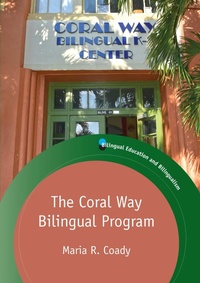
The Coral Way Bilingual Program
Published on 4. November 2019
168 pages
978-1-78892-459-7 (ISBN)
Description

This book introduces readers to the first publicly funded, two-way bilingual program in the United States, Coral Way Elementary School. It details the historical, social and political origins of the school; reviews the various discussions and conceptualization of the bilingual education program as a 50:50 model; and describes the training of the teachers and their work in designing curriculum for the bilingual students. Finally, it reviews whether the program was a success and outlines what lessons can be learned from the Coral Way Experiment for future bilingual programs. It is essential reading for all scholars of dual language education, for educational historians, for students of language policy and planning, and for teachers and educators who work in the context of dual language education in the US and worldwide.
Reviews / Votes
Maria Coady beautifully weaves together data to describe the beginnings of the legendary Coral Way Bilingual Program. The story she tells reminds us that the needs of students and families should always shape and reshape educational approaches. A must-read for bilingual educators to understand our history as we work toward an equitable future. * Tatyana Kleyn, The City College of New York, USA * Dual language education at Coral Way Elementary was the exemplar that paved the way to the Bilingual Education Act of 1968. In this book, Maria Coady captures the dreams of visionary educational leaders, teachers, parents, and community members whose activist work serves as inspiration for keeping the gift of bi/multilingualism alive for generations to come. * Maria E. Franquiz, University of Texas at Austin, USA * Coady's outstanding historical review of the Coral Way bilingual program is a needed resource and an answer to the gap in the literature of understanding our past to "move into the future". -- Daniel Garzon, University of Colorado Boulder, USA * Language Policy (2021) 20 * [This book] is tightly organized, well-written, and crafted with care. Throughout the text Coady shares both her deep respect for those involved in the experiment as well as her profound commitment to advancing bicultural and bilingual education. The book poignantly captures the dedication, creativity, and financial resources needed to embrace and work to advance a 'language as a resource' paradigm in the United States in the 1960s andperhaps even more so now. -- Kara D. Brown, University of South Carolina, USA * Sociolinguistic Studies, 2021 * I commend the author on what is an important contribution to the field. The book itself is well-written and it is easy to read [...] it explains the bases for building a bilingual program, it gives solutions to problems that may arise (e.g. period distribution and phases), and it shows the intricate relation with the socioeconomic context. Moreover, it is a reminder that bilingual education brings short and long-term formative outcomes for students. -- Marina Cuartero, University of Florida, USA * LINGUIST List 31.2517 * Coady's examination of the bilingual program at Coral Way serves as a reminder to those researching the field today to zoom out to situate their work within the bigger picture when examining DLBE and to root our understanding of where we are now, where we want to go, in where we first began. -- Jessica Mitchell-McCollough, University of Nebraska, Lincoln, USA * Spanish as a Heritage Language Vol. 1 No. 1, 2021 *
More details
Series
Language
English
Place of publication
Bristol
United Kingdom
Target group
College/higher education
Product notice
Reflowable
ISBN-13
978-1-78892-459-7 (9781788924597)
Copyright in bibliographic data and cover images is held by Nielsen Book Services Limited or by the publishers or by their respective licensors: all rights reserved.
Schweitzer Classification
Other editions
Additional editions
Maria R. Coady
The Coral Way Bilingual Program
Book
11/2019
Multilingual Matters
€41.70
Shipment within 3-4 weeks
Person
Maria R. Coady is Irving and Rose Fien Endowed Professor and Associate Professor of ESOL/Bilingual Education at the University of Florida, USA. Her research specialises in English Language Learners and multilingual students, especially those in rural settings. Her most recent publication is Connecting School and the Multilingual Home (Multilingual Matters, 2019).
Content
Lourdes Rovira: Foreword
Overview
Prologue
Chapter 1. Origin of the Experiment
Chapter 2. The 50:50 Model
Chapter 3. Cuban Educators: Aides, "The Marines", and Teachers
Chapter 4. The Miami Linguistic Readers and Curriculum Development
Chapter 5. Did it Work?: Findings from the Coral Way Experiment
Chapter 6. The Building a Bilingual Network
Epilogue
Overview
Prologue
Chapter 1. Origin of the Experiment
Chapter 2. The 50:50 Model
Chapter 3. Cuban Educators: Aides, "The Marines", and Teachers
Chapter 4. The Miami Linguistic Readers and Curriculum Development
Chapter 5. Did it Work?: Findings from the Coral Way Experiment
Chapter 6. The Building a Bilingual Network
Epilogue
