

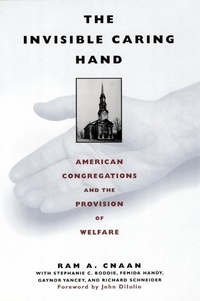
The Invisible Caring Hand
Description

Despite the assumption that congregations can help many needy people in our society, it remains to be seen how extensive they wish their involvement to be, or if they have the necessary tools to become significant providers in the social service arena. Moreover, how will such practices, which will move faith-based organizations towards professionalization, ultimately affect the spirit of volunteerism now prevalent in America's religious institutions?
We lack sufficient knowledge about congregational life and its ability to play a key role in social service provision. The Invisible Caring Hand attempts to fill that void. Based on in-depth interviews with clergy and lay leaders in 251 congregations nationwide, it reveals the many ways in which congregations are already working, beneath the radar, to care for people in need. This ground-breaking volume will provide much-sought empirical data to social scientists, religious studies scholars, and those involved in the debates over the role of faith-based organizations in faith-based services, as well as to clergy and congregation members themselves.
Reviews / Votes
"The first systematic and comprehensive social science description of social service contributions of diverse religious congregations. . . . Could not be more timely] or useful to academic and religious community audiences which now seek credible 'handles' for accessing and understanding this newly exposed but surprisingly extensive faith based contribution to human welfare in the United States." - Edward Newman,Temple University "Cnaan has reported an elegant story about religious congregations and their role in providing social welfare assistance. The book is emperically rich, narratively enhanced, and theoretically thick. It not only documents the role of congregations but also identifies their limitations as social welfare providers. The book is informative and catalyzes reflection on the issues. It is grounded in a large, national, multimethod research project spanning the United States, with a limited focus in Canada. The weaving together of these data is impressive. I particularly appreciate the use of case studies to explicate the array of congregational approaches to caring. For aficionados of case study method, of which I am one, these materials are rich, dense, and artfully constructed. The survey data are also well presented. Together, these data provide a story that resembles an artfully constructed mosaic." (Non Profit and Voluntary Sector Quarterly) "This book provides some much needed insight into the way congregations function in the povision of social services." (Journal of Religion and Spirituality in Social Work) "An important and timely contribution to our understanding. . . . Policy makers and church leaders alike will benefit from Cnaan's groundbreaking investigation of the facts." (The Social Policy Journal) "The Invisible Caring Hand represents an excellent addition to studies focused in understanding the role of local churches in their community." (Sociology of Religion)More details
Other editions
Additional editions
Persons
Content
I An Overview of Congregations
1 Congregations in Society
2 The Historical Development of American Congregations
II Congregations Involvement: Empirical Findings
3 The Congregations in Our Study
4 Congregational Involvement I: Areas of Involvement
5 Congregational Involvement II: Characteristics of Service and Financial Value
6 Which Congregations Tend to Get Involved
7 Comparing Neighbors: Canada and the U.S.A.
III Congregations for Society: Additional Studies
8 Small-Town Congregations: The Case of Council Grove, Kansas
9 Mediating Structures: The Greater New Orleans Federation of Churches
10 Social Ministry in the Community: The Case of St. Gabriel's Episcopal Church and Urban Bridges
IV Concluding Remarks
11 Volunteerism and Organized Religion
12 Why and How Congregations Get Involved in Service Delivery
13 The Congregational Norm of Community Involvement
14 The Broader Perspective: Congregations for Society and Beyond
