

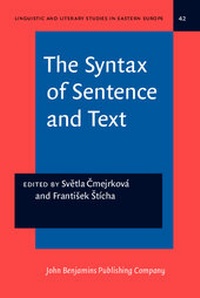
The Syntax of Sentence and Text
A Festschrift for Frantisek Danes
1st Edition
Published on 13. October 1994
398 pages
978-90-272-7662-9 (ISBN)
Description

This is a collection of papers inspired by the work of Frantisek Danes and is published in honour of his 75th birthday. Danes' international contribution to the development of Prague School functionalism, the theory of functional sentence perspective, discourse studies and semantics is reflected in the 27 papers collected in four thematic sections of this volume.
More details
Other editions
Additional editions
Svetla Cmejrkova | Frantisek Sticha
The Syntax of Sentence and Text
A Festschrift for Frantisek Danes
Book
10/1994
John Benjamins Publishing Co
€132.50
Shipment within 10-15 days
Content
- THE SYNTAX OF SENTENCE AND TEXT
- Editorial page
- Title page
- Copyright page
- Table of contents
- Acknowledgements
- Preface
- NOTE
- Selected Bibliography of the Publications of Professor Frantisek Danes, PhDr., DrSc.
- I. PRAGUE SCHOOL FUNCTIONALISM
- Functionalism versus Formalism in East and West
- A. The agenda of functionalism
- B. The advent of FSP
- C. Danes' three-level approach
- D. Conclusion
- NOTES
- REFERENCES
- Centre and Periphery, Delicacy and Fuzz
- 1. Discreteness, fuzz, centre, periphery
- 2. Centre, periphery, and markedness
- 3. Periphery and strategy
- 4. Variance and invariance
- 5. Milestones in fuzzy description
- 6. From naturalness to prototypes
- 7. The dynamic view: conflict and conspiracy
- 8. Literary preference semantics
- 9. Fuzzy sets
- 10. Variable rules
- 11. Definitions of concepts
- REFERENCES
- Karl Bühler's Field Theory in the Light of the Current Interest in Pragmatics
- NOTES
- REFERENCES
- Vilém Mathesius as One of the Forerunners of Modern Textological Research
- REFERENCES
- II. FUNCTIONAL SENTENCE PERSPECTIVE AND THEMATIC PROGRESSIONS
- I'm Sorry, I'll Read that Again": Information Structure in Writing
- REFERENCES
- Functional Sentence Perspective within a Model of Natural Textlinguistics
- 1. The general textual model
- 2. Dimensions of FSP most relevant for TL
- 2.1. Informativity
- 2.2. Cotextually or contextually known vs. unknown
- 2.3. Given vs. new in S's strategies (intentionality)
- 2.4. Linearisation
- 2.5. Base
- 3. Preference parameters (universal naturalness/markedness)
- 3.1. Preferred coincidences for T within a speech act
- 3.2. Preferred coincidences for R within n speech aca
- 3.3. Indexicality
- 3.4. lconicity
- 3.5. Preference for binary relations
- 3.6. Conflicts between speaker- and hearer-friendllness
- 3.7. Second-instance sentences as marked units
- 4. Conclusion
- NOTES
- REFERENCES
- On Thematic Configurations in Texts: Orientation and goals
- Why are thematic configurations needed
- Anticipating thematic configurations in texts
- Conclusion
- REFERENCES
- Substantiating Danes's View of Givensess as a Graded Phenomenon
- REFERENCES
- Is There Implicit Inclusion of Preceding Predicates in Anaphorics of Nominals or Pronominals?
- 1. Explicit inclusion of preceding predicates in subsequent anaphorics of nominals
- 2. Implicit inclusion and non-inclusion of preceding predicates in subsequent anaphorics of nominals or pronominals
- 2.1 Implicit inclusion and non-inclusion of predicates in subsequent anaphorics in two-sentence sentence sequences
- 2.2 Implicit inclusion and non-inclusion of predicates in subsequent anaphorics in longer sentence sequences
- 3. Implicit predicate-inclusion in expressions of the type 'such a + common noun'
- NOTES
- REFERENCES
- Discourse as Determinacy
- 0. Introduction
- 1. Determinacy grammar and text linguistics
- 2. Determinacy grammar and functional sentence perspective
- 3· Thematic progressions as determinacy progressions
- 4. Conclusion
- REFERENCES
- Some Aspects of the Syntactic and Semantic Text-Composition: The Topic - Comment Structure of Initial Text Sentences from a Semiotic Textological Point of View
- 1. Some general remarks on the textological research
- 2. The central aspects and factors of the semiotic textology
- 3. Aspects of the syntactic and semantic composition of initial text-sentences
- 4. Conclusions
- REFERENCES
- Functional Sentence Perspective in Modern and Old Javanese
- NOTES
- REFERENCES
- III. TEXT AND DISCOURSE
- Discontinuity in Texts
- O. Introduction
- 1. Discontinuity: a problem for textual coherence
- 2. Referential discontinuity
- 3. Inferential discontinuity
- NOTES
- REFERENCES
- Voices of Intention and Interpretation: On "The Czech Dreambook" by Ludvík Vaculík
- The text and the discourse
- Observation 1. Interaction
- Observation 2. Involvement
- Observation 3. Truth and Fiction
- Observation 4. Strategies
- Observation 5. Language
- Observation 6. Complexity
- Observation 7. Intertextual considerations
- Observation 8. Poetic gesture
- Observation 9. Preconditions and limits of interpretation
- Conclusions. The text and the feedback
- REFERENCES
- SOURCES
- On the Means of Expressing Vagueness and Uncertainty in CzechDiscourseNojá nevim asi tak nak...
- NOTES
- REFERENCES
- Repetition and Variation as Stylistic Principles of a Text Structure
- REFERENCES
- On Mutual Transformations between Spoken and Written Text
- NOTES
- REFERENCES
- 'Passive' Moves in Argumentation
- 1. Introduction
- 2. The inventory of passive roles
- 3. Passive moves
- 4. Moves including a passive component
- REFERENCES
- SOURCES
- E-mail as a New Subvariety of Medium and its Effects upon the Message
- NOTES
- REFERENCES
- From Syntax to Text: Problems in Producing Scientific Abstracts in L2
- 1. Introduction
- 2. The data
- 3. Text producer's point of view: publishers and authors
- 4. Syntactic analysis: Mean length of sentences
- 5. Textual analysis
- 6. The writer directing the reader's decoding process
- 7. Conclusion
- NOTES
- REFERENCES
- APPENDIX
- IV. GRAMMAR AND SEMANTICS
- Notes on the Functions of Grammatical Units in Language System and in Discourse
- 1. Potential and resultative aspects of function
- 2. Function and meaning
- 3. Function and the system-environment dichotomy
- 4. Functions of language units at the level of word forms and at the levels of utterance and text as a whole
- REFERENCES
- Sentential Complementation and Truth
- REFERENCES
- Simultaneous Encoding of Morpho-Syntactic and Textual Features in Oral Narrative Prose
- 1. Introduction
- 2. Plurifunctional encoding
- 3. Conclusion
- NOTES
- REFERENCES
- Acceptability and the Scope of Grammar
- NOTES
- REFERENCES
- On Relative Pronouns in Czech and German (jenz - který, der - welcher)
- Conclusion
- REFERENCES
- Constructions with Verbs and Abstract Nouns in Czech (Analytic Predicates)
- REFERENCES
- The Potential Valency Constituent in Diachronic Lexicology
- REFERENCES
- ABBREVIATIONS
- Subject Index
