

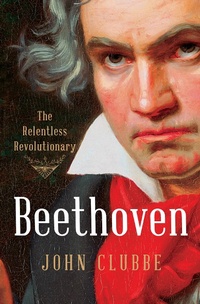
Beethoven
Description

A fascinating and in-depth exploration of how the Enlightenment, the French Revolution, and Napoleon shaped Beethoven's political ideals and inspired his groundbreaking compositions.
Beethoven imbibed Enlightenment and revolutionary ideas in his hometown of Bonn, where they were fervently discussed in cafés and at the university. Moving to Vienna at the age of twenty-one to study with Haydn, he gained renown as a brilliant pianist and innovative composer. In that conservative city, capital of the Hapsburg empire, authorities were ever watchful to curtail and punish overt displays of radical political views. Nevertheless, Beethoven avidly followed the meteoric rise of Napoleon.
As Napoleon had made strides to liberate Europe from aristocratic oppression, so Beethoven desired to liberate humankind through music. He went beyond the musical forms of Haydn and Mozart, notably in the Eroica Symphony and his opera Fidelio, both inspired by the French Revolution and Napoleon.
John Clubbe illuminates Beethoven as a lifelong revolutionary through his compositions, portraits, and writings, and by setting him alongside major cultural figures of the time—among them Schiller, Goethe, Byron, Chateaubriand, and Goya.
More details
Other editions
Additional editions
Person
Content
- Intro
- Title
- Contents
- Overture
- 1. Beethoven in Bonn
- 2. Key Influences: Schiller and Schneider
- 3. Two Cantatas
- 4. The French Revolution
- 5. Brutus and the Egyptian Mysteries
- 6. Hapsburg Vienna
- 7. Beethoven's Vienna
- 8. Beethoven as Traveler and Composer
- 9. The Rise of Napoleon
- 10. Parallel Lives, Beethoven and Napoleon
- 11. The Rise of Beethoven
- 12. The Eroica: Meaning and Dedication
- 13. The Eroica in Its Literary and Artistic Contexts: Seume's Walk to Syracuse and Mähler's Portrait of Beethoven
- 14. Toward Beethoven's 1808 Akademie
- 15. Napoleon in Vienna in 1809
- Beethoven Befriends Baron de Trémont
- 16. Composing Egmont
- 17. Bacchus Triumphant: The Seventh Symphony-the Eighth-Wellington's Victory
- 18. Fidelio
- 19. The Congress of Vienna and Its Aftermath
- 20. Beethoven Close Up, 1817-20
- 21. Napoleon's Death, Rossini's Rise
- 22. Beethoven and Grillparzer
- 23. The Missa solemnis and the Ninth Symphony
- 24. Music at the End
- Illustrations
- Acknowledgments
- Notes
- Index of Beethoven's Works
- General Index
- Also by John Clubbe
- Copyright
