

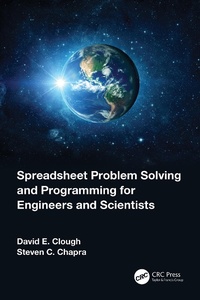
Spreadsheet Problem Solving and Programming for Engineers and Scientists
1st Edition
Published on 19. October 2023
452 pages
978-1-000-96630-5 (ISBN)
Description

Spreadsheet Problem Solving and Programming for Engineers and Scientists provides a comprehensive resource essential to a full understanding of modern spreadsheet skills needed for engineering and scientific computations.
Beginning with the basics of spreadsheets and programming, this book builds on the authors' decades of experience teaching spreadsheets and programming to both university students and professional engineers and scientists. Following on from this, it covers engineering economics, key numerical methods, and applied statistics. Finally, this book details the Visual Basic for Applications (VBA) programming system that accompanies Excel.
With each chapter including examples and a set of exercises, this book is an ideal companion for all engineering courses and also for self-study. Based on the latest version of Excel (Microsoft Excel for Microsoft 365), it is also compatible with earlier versions of Excel dating back to Version 2013. Including numerous case studies, this book will be of interest to students and professionals working in all areas of engineering and science.
Beginning with the basics of spreadsheets and programming, this book builds on the authors' decades of experience teaching spreadsheets and programming to both university students and professional engineers and scientists. Following on from this, it covers engineering economics, key numerical methods, and applied statistics. Finally, this book details the Visual Basic for Applications (VBA) programming system that accompanies Excel.
With each chapter including examples and a set of exercises, this book is an ideal companion for all engineering courses and also for self-study. Based on the latest version of Excel (Microsoft Excel for Microsoft 365), it is also compatible with earlier versions of Excel dating back to Version 2013. Including numerous case studies, this book will be of interest to students and professionals working in all areas of engineering and science.
More details
Edition
1. Auflage
Language
English
Place of publication
London
United Kingdom
Publishing group
Taylor & Francis Ltd
Target group
College/higher education
Product notice
Reflowable
Illustrations
47 Tables, black and white; 122 Line drawings, black and white; 360 Halftones, black and white; 482 Illustrations, black and white
ISBN-13
978-1-000-96630-5 (9781000966305)
Copyright in bibliographic data and cover images is held by Nielsen Book Services Limited or by the publishers or by their respective licensors: all rights reserved.
Schweitzer Classification
Other editions
Additional editions
David E. Clough | Steven C. Chapra
Spreadsheet Problem Solving and Programming for Engineers and Scientists
Book
10/2023
1st Edition
CRC Press
€147.10
Shipment within 10-20 days
Persons
David Clough joined the faculty of the Department of Chemical and Biological Engineering at the University of Colorado in 1975 after a brief career with DuPont in Wilmington, Delaware. He retired from Colorado in 2017 and holds the position of Professor Emeritus. He remains active at the university by assisting faculty and students in teaching and research. Notably, he teaches a series of workshops on process modeling and computer simulation as part of the senior design course sequence. In addition to this book, he has collaborated with Steve Chapra on two texts: Applied Numerical Methods with Python for Engineers and Scientists and Introduction to Engineering and Scientific Computing with Python.
Dr. Clough received degrees in chemical engineering from Case Western Reserve University and the University of Colorado. He has extensive experience in applied computing, process automation, and the modeling of various processes with emphasis on dynamic behavior, including polymerization, high-temperature catalytic reactors, fluidized beds, open-channel flow, biomedical instrumentation, and solar-thermal reactors.
Clough first learned to program in the original Fortran language while in high school in the early 1960s. Since then, he has experience in a wide array of programming languages and computing tools and has applied his expertise through his teaching, research, and industrial applications. In the 1980s, Clough and Steve Chapra originated the Introduction to Engineering Computing course for first-year students at the University of Colorado. The course is still taught and has included content on spreadsheets (originally Lotus 1-2-3, then Excel) and spreadsheet programming (VBA) for three decades.
Over his career, Clough has taught hundreds of in-person short courses to practicing professionals on applied computing and problem-solving. His courses on spreadsheet problem-solving, offered through the American Institute of Chemical Engineers, have been among the most popular offered by AIChE, spanning three decades. He also offers on-line versions of his spreadsheet courses via AIChE Academy.
Steve Chapra is Emeritus Professor and Louis Berger Chair in Civil and Environmental Engineering at Tufts University. His best-selling books include Surface Water-Quality Modeling, Numerical Methods for Engineers, 8th Ed., and Applied Numerical Methods with MATLAB for Engineers and Scientists, 5th Ed. He has also co-authored two texts with Prof. Clough on the Python language.
Dr. Chapra received engineering degrees from Manhattan College and the University of Michigan. Before joining Tufts, he worked for the U.S. Environmental Protection Agency and the National Oceanic and Atmospheric Administration, and taught at Texas A&M University, the University of Colorado, and Imperial College London. His general research interests focus on surface water-quality modeling and advanced computer applications in environmental engineering.
He is a Fellow and Distinguished Member of the American Society of Civil Engineering (ASCE) and has received several awards for his scholarly and academic contributions, including the Rudolph Hering Medal (ASCE), and the Meriam-Wiley Distinguished Author Award (American Society for Engineering Education). He has also been recognized as an outstanding teacher and advisor among the engineering faculties at Texas A&M University, the University of Colorado, and Tufts University. As a strong proponent of continuing education, he has taught over 90 workshops around the world introducing professionals to numerical methods, computer programming, and environmental modeling.
Dr. Clough received degrees in chemical engineering from Case Western Reserve University and the University of Colorado. He has extensive experience in applied computing, process automation, and the modeling of various processes with emphasis on dynamic behavior, including polymerization, high-temperature catalytic reactors, fluidized beds, open-channel flow, biomedical instrumentation, and solar-thermal reactors.
Clough first learned to program in the original Fortran language while in high school in the early 1960s. Since then, he has experience in a wide array of programming languages and computing tools and has applied his expertise through his teaching, research, and industrial applications. In the 1980s, Clough and Steve Chapra originated the Introduction to Engineering Computing course for first-year students at the University of Colorado. The course is still taught and has included content on spreadsheets (originally Lotus 1-2-3, then Excel) and spreadsheet programming (VBA) for three decades.
Over his career, Clough has taught hundreds of in-person short courses to practicing professionals on applied computing and problem-solving. His courses on spreadsheet problem-solving, offered through the American Institute of Chemical Engineers, have been among the most popular offered by AIChE, spanning three decades. He also offers on-line versions of his spreadsheet courses via AIChE Academy.
Steve Chapra is Emeritus Professor and Louis Berger Chair in Civil and Environmental Engineering at Tufts University. His best-selling books include Surface Water-Quality Modeling, Numerical Methods for Engineers, 8th Ed., and Applied Numerical Methods with MATLAB for Engineers and Scientists, 5th Ed. He has also co-authored two texts with Prof. Clough on the Python language.
Dr. Chapra received engineering degrees from Manhattan College and the University of Michigan. Before joining Tufts, he worked for the U.S. Environmental Protection Agency and the National Oceanic and Atmospheric Administration, and taught at Texas A&M University, the University of Colorado, and Imperial College London. His general research interests focus on surface water-quality modeling and advanced computer applications in environmental engineering.
He is a Fellow and Distinguished Member of the American Society of Civil Engineering (ASCE) and has received several awards for his scholarly and academic contributions, including the Rudolph Hering Medal (ASCE), and the Meriam-Wiley Distinguished Author Award (American Society for Engineering Education). He has also been recognized as an outstanding teacher and advisor among the engineering faculties at Texas A&M University, the University of Colorado, and Tufts University. As a strong proponent of continuing education, he has taught over 90 workshops around the world introducing professionals to numerical methods, computer programming, and environmental modeling.
Content
Chapter 1 Spreadsheet Basics
Chapter 2 Charts and Graphs
Chapter 3 Engineering and Scientific Formulas
Chapter 4 Table-based Calculations
Chapter 5 Case Studies and Targeting
Chapter 6 Financial Calculations
Chapter 7 Numerical Methods
Chapter 8 Applied Statistics
Chapter 9 Introduction to VBA and Macros
Chapter 10 User-defined Functions
Chapter 11 VBA Programming
Chapter 12 User Interfaces
Appendix A: Matrix Algebra Review
Appendix B: Shortcut Keys and Key Combinations
Chapter 2 Charts and Graphs
Chapter 3 Engineering and Scientific Formulas
Chapter 4 Table-based Calculations
Chapter 5 Case Studies and Targeting
Chapter 6 Financial Calculations
Chapter 7 Numerical Methods
Chapter 8 Applied Statistics
Chapter 9 Introduction to VBA and Macros
Chapter 10 User-defined Functions
Chapter 11 VBA Programming
Chapter 12 User Interfaces
Appendix A: Matrix Algebra Review
Appendix B: Shortcut Keys and Key Combinations
