

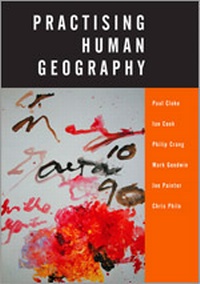
Practising Human Geography
1st Edition
Published on 21. April 2004
440 pages
978-1-84860-488-9 (ISBN)
Description

'Filling an enormous gap in the geographic literature, here is a terrific book that shows us how to think about and practice human geographic research' - Professor Jennifer Wolch, University of Southern California
`Practising Human Geography lucidly, comprehensively, and sometimes passionately shows why methodology matters, and why it is often so hard. To choose a method is to choose the kind of geographical values one wants to uphold. You need to get it right.These authors do' - Trevor Barnes, University of British Columbia
`Practising Human Geography is a godsend for students. Written in an accessible and engaging style, the book demystifies the study of geographical methodology, offering a wealth of practical advice from the authors' own research experience. This is not a manual of approved geographical techniques. It is a reflexive, critical and highly personal account, combining historical depth with up-to-the-minute examples of research in practice. Practising Human Geography is a comprehensive and theoretically informed introduction to the practices of fieldwork, data collection, interpretation and writing, enabling students to make sense of their own data and to develop a critical perspective on the existing literature. The book makes complicated ideas approachable through the effective use of case studies and a firm grasp of contemporary debates' - Peter Jackson, Professor of Human Geography, University of Sheffield
Practising Human Geography is a critical introduction to key issues in the practice of human geography, informed by the question 'how do geographers do research?' In examining those methods and practices that are essential to doing geography, the text presents a theoretically-informed discussion of the construction and interpretation of geographical data - including: the use of core research methodologies; using official and non-official sources; and the interpretative role of the researcher.
Framed by an overview of how ideas of practising human geography have changed, the twelve chapters offer a comprehensive and integrated overview of research methodologies. The text is illustrated throughout with text boxes, case studies, and definitions of key terms. Practising Human Geography will introduce geographers - from undergraduate to faculty - to the core issues that inform research design and practice.
`Practising Human Geography lucidly, comprehensively, and sometimes passionately shows why methodology matters, and why it is often so hard. To choose a method is to choose the kind of geographical values one wants to uphold. You need to get it right.These authors do' - Trevor Barnes, University of British Columbia
`Practising Human Geography is a godsend for students. Written in an accessible and engaging style, the book demystifies the study of geographical methodology, offering a wealth of practical advice from the authors' own research experience. This is not a manual of approved geographical techniques. It is a reflexive, critical and highly personal account, combining historical depth with up-to-the-minute examples of research in practice. Practising Human Geography is a comprehensive and theoretically informed introduction to the practices of fieldwork, data collection, interpretation and writing, enabling students to make sense of their own data and to develop a critical perspective on the existing literature. The book makes complicated ideas approachable through the effective use of case studies and a firm grasp of contemporary debates' - Peter Jackson, Professor of Human Geography, University of Sheffield
Practising Human Geography is a critical introduction to key issues in the practice of human geography, informed by the question 'how do geographers do research?' In examining those methods and practices that are essential to doing geography, the text presents a theoretically-informed discussion of the construction and interpretation of geographical data - including: the use of core research methodologies; using official and non-official sources; and the interpretative role of the researcher.
Framed by an overview of how ideas of practising human geography have changed, the twelve chapters offer a comprehensive and integrated overview of research methodologies. The text is illustrated throughout with text boxes, case studies, and definitions of key terms. Practising Human Geography will introduce geographers - from undergraduate to faculty - to the core issues that inform research design and practice.
Reviews / Votes
`Practising Human Geography is a god-send for students. Written in an accessible and engaging style, the book demystifies the study of geographical methodology, offering a wealth of practical advice from the authors' own research experience. This is not a manual of approved geographical techniques. It is a reflexive, critical and highly personal account, combining historical depth with up-to-the-minute examples of research in practice. Practising Human Geography is a comprehensive and theoretically informed introduction to the practices of fieldwork, data collection, interpretation and writing, enabling students to make sense of their own data and to develop a critical perspective on the existing literature. The book makes complicated ideas approachable through the effective use of case studies and a firm grasp of contemporary debates' - Peter Jackson, Professor of Human Geography, University of SheffieldAll prices
More details
Edition
First Edition
Language
English
Place of publication
London
United Kingdom
Target group
College/higher education
ISBN-13
978-1-84860-488-9 (9781848604889)
Copyright in bibliographic data and cover images is held by Nielsen Book Services Limited or by the publishers or by their respective licensors: all rights reserved.
Schweitzer Classification
Other editions
Additional editions
Paul J. Cloke | Ian Cook et al | Philip Crang
Practising Human Geography
Book
04/2004
1st Edition
SAGE Publications Inc
€250.30
Shipment within 15-20 days
Paul J. Cloke | Ian Cook et al | Philip Crang
Practising Human Geography
Book
04/2004
1st Edition
SAGE Publications Inc
€123.50
Shipment within 15-20 days
Persons
Ian Cook et al is Professor of Cultural Geography at the University of Exeter in the UK. As an undergraduate student at University College London in the 1980s, he stumbled across the tiny tradition of experiential geography in a module taught by Jacqui Burgess and Peter Jackson and went to the University of Kentucky as a master's student to learn how this was done from its main advocate Graham Rowles. Returning to the UK in the early 1990s to undertake a multisited ethnographic "follow the thing" PhD at the University of Bristol, he and fellow PhD student Mike Crang wrote a "how to" "Doing ethnographies" (1995) booklet for the Institute of British Geographers' Concepts and Techniques in Modern Geography (CATMOG) series. Scanned and posted online, a scribbled-on version was read and referred to in a surprising variety of publications as geography took its cultural (and ethnographic) turn. After SAGE bought the CATMOG series in the early 2000s, Mike and Ian were able to finish and publish it as a book in 2007.
Professor Joe Painter focuses mainly on the prosaic geographies of the state.
Chris Philo is a professor of geography at the University of Glasgow. His specialist interest is the historical geography of "spaces reserved for insanity," meaning people with mental health problems, across many centuries in Britain. He is fascinated by the history and theory of geography, as both academic subject and wider way of engaging with the world. He has undertaken critical-scholarly research on the geographies of "outsider" human groupings, including children and people with learning disabilities, as well as on the geographies of human-animal relations, rural geographies, and a range of health geographies. He has long been concerned with what psychoanalytic and psychological approaches can bring to geographical studies.
Professor Joe Painter focuses mainly on the prosaic geographies of the state.
Chris Philo is a professor of geography at the University of Glasgow. His specialist interest is the historical geography of "spaces reserved for insanity," meaning people with mental health problems, across many centuries in Britain. He is fascinated by the history and theory of geography, as both academic subject and wider way of engaging with the world. He has undertaken critical-scholarly research on the geographies of "outsider" human groupings, including children and people with learning disabilities, as well as on the geographies of human-animal relations, rural geographies, and a range of health geographies. He has long been concerned with what psychoanalytic and psychological approaches can bring to geographical studies.
Content
Changing Practices of Human Geography
An Introduction
PART ONE: CONSTRUCTING GEOGRAPHICAL DATA
Official Sources
Non-official Sources
Imaginative Sources
Talking to People
Observing, Participating and Ethnographies
PART TWO: CONSTRUCTING GEOGRAPHICAL INTERPRETATIONS
Sifting and Sorting
Enumerating
Explaining
Understanding
Representing Human Geographies
The Politics of Practising Human Geography
An Introduction
PART ONE: CONSTRUCTING GEOGRAPHICAL DATA
Official Sources
Non-official Sources
Imaginative Sources
Talking to People
Observing, Participating and Ethnographies
PART TWO: CONSTRUCTING GEOGRAPHICAL INTERPRETATIONS
Sifting and Sorting
Enumerating
Explaining
Understanding
Representing Human Geographies
The Politics of Practising Human Geography
