

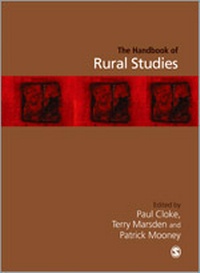
Handbook of Rural Studies
1st Edition
Published on 5. January 2006
528 pages
978-1-4462-0694-2 (ISBN)
Description

`This book raises the theoretical level of rural studies to new heights...the Handbook of Rural Studies will likely become a key resource on the bookshelves of the next generation of graduate students...' - Gary Paul Green, University of Wisconsin-Madison
`This Handbook powerfully demonstrates that rural spaces, rural societies and rural natures are at the very forefront of critical social science endeavour. Read this book, become a rural social scientist' - Henry Buller, University of Exeter
`An outstandingly comprehensive review of theory, research and the study of rural questions...an essential reference for students, scholars, politicians, developers and rural activists' - Imre Kovach, Institute for Political Sciences, Budapest
`This collection is an essential addition to any rural scholar's library and will be a critical resource for both established rural scholars and rising graduate students interested in rural research topics' - Peter B Nelson, Middlebury College
`The Handbook of Rural Studies is a tour de force on changing rural people and places in a rapidly urbanizing global economy -- the most comprehensive interdisciplinary treatment of "rural" available anywhere. This is absolutely must reading for social scientists concerned about finding a prominent place for "rural" in scholarly discourse, institutional analysis, and public policy debates on the political economy of space' - Daniel T Lichter, Policy Analysis and Management, Cornell University
The Handbook represents the vitality and theoretical innovation at work in rural studies. It shows how political economy and the 'cultural turn' have led to very significant new thinking in the cultural representations of: rurality; nature; sustainability; new economies; power and rurality; new consumerism; and exclusion and rurality.
It is organized in three sections: approaches to rural studies; rural research: key theoretical co-ordinates and new rural relations.
In a rich and textured discussion, the Handbook of Rural Studies explains the key moments in which the theorization of culture, nature, politics, agency, and space in rural contexts have transmitted ideas back into wider social science.
`This Handbook powerfully demonstrates that rural spaces, rural societies and rural natures are at the very forefront of critical social science endeavour. Read this book, become a rural social scientist' - Henry Buller, University of Exeter
`An outstandingly comprehensive review of theory, research and the study of rural questions...an essential reference for students, scholars, politicians, developers and rural activists' - Imre Kovach, Institute for Political Sciences, Budapest
`This collection is an essential addition to any rural scholar's library and will be a critical resource for both established rural scholars and rising graduate students interested in rural research topics' - Peter B Nelson, Middlebury College
`The Handbook of Rural Studies is a tour de force on changing rural people and places in a rapidly urbanizing global economy -- the most comprehensive interdisciplinary treatment of "rural" available anywhere. This is absolutely must reading for social scientists concerned about finding a prominent place for "rural" in scholarly discourse, institutional analysis, and public policy debates on the political economy of space' - Daniel T Lichter, Policy Analysis and Management, Cornell University
The Handbook represents the vitality and theoretical innovation at work in rural studies. It shows how political economy and the 'cultural turn' have led to very significant new thinking in the cultural representations of: rurality; nature; sustainability; new economies; power and rurality; new consumerism; and exclusion and rurality.
It is organized in three sections: approaches to rural studies; rural research: key theoretical co-ordinates and new rural relations.
In a rich and textured discussion, the Handbook of Rural Studies explains the key moments in which the theorization of culture, nature, politics, agency, and space in rural contexts have transmitted ideas back into wider social science.
Reviews / Votes
"This book captures the vitality and theoretical innovation at work in the field. It explains new 'theorizations' of rural life, landscape, and work and leisure over the last 10 years. The three main sections are devoted to: key approaches to the sociology of rural knowledge, spatial, social, economic, resources, planning, key theoretical coordinates in survey of the state of the area, and 'new ruralities,' new formulations of rural citizenship and social movements." -- APADE "TheHandbook of Rural Studies attempts to
address that question by bringing together scholars from both sides of the Atlantic to consider key approaches, theoretical
developments, and contemporary conditions in rural communities. The editors contend
there is revival afoot, and their aim is to convey what they see as new
intellectual excitement and heightened relevance of rural studies. The 35
diverse essays include work by scholars trained in sociology, geography,
planning, economics, psychology, tourism management, and development. One of
the clear strengths of the book is its broad, even eclectic, approach. The
stronger chapters include well-written, thoughtful introductory road maps to
their argument, review the relevant literature to date, and assess what it adds
up to for the field or a particular subfield. These authors bring a rural lens
to key contemporary concerns about issues such as racial, gender, and class
inequality, politics, environmental degradation, and new community and regional
development efforts." -- Chris R. Colocousis and Cynthia M. Duncan * Journal of Regional Science * "SAGE Handbooks set a standard amongst compendia for fields within the social sciences...The book is well produced and includes an excellent index..one that will prove useful to graduate students..." -- Paul B. Thompson * Agriculture and Human Values *
All prices
More details
Language
English
Place of publication
London
United Kingdom
Target group
Professional and scholarly
ISBN-13
978-1-4462-0694-2 (9781446206942)
Copyright in bibliographic data and cover images is held by Nielsen Book Services Limited or by the publishers or by their respective licensors: all rights reserved.
Schweitzer Classification
Other editions
Additional editions
Paul J. Cloke | Terry Marsden | Patrick Mooney
Handbook of Rural Studies
Book
01/2006
1st Edition
SAGE Publications Inc
€201.00
Shipment within 15-20 days
Persons
Content
PART ONE: APPROACHES TO RURAL STUDIES
Pathways in the Sociology of Rural Knowledge - Terry Marsden
Conceptualizing Rurality - Paul Cloke
Reconfiguring Rural Resource Governance - Stewart Lockie, Geoffrey Lawrence and Lynda Cheshire
The Legacy of Neo-Liberalism in Australia
Rural Space - Keith Halfacree
Constructing a Three-Fold Architecture
Rural Society - Ruth Panelli
Rural Economies - Matteo B Marini and Patrick H Mooney
Rural Policy and Planning - Mark B Lapping
PART TWO: RURAL RESEARCH: KEY THEORETICAL COORDINATES
A Cultural Representation
Landscapes of Desires? - E Melanie DuPuis
Idyllic Ruralities - Brian Short
Variations on the Rural Idyll - David Bell
Constructing Rural Natures - 03S NatureNoel Castree and Bruce Braun
Networking Rurality - Jonathan Murdoch
Emergent Complexity in the Countryside
Non-Human Rural Studies - Owain Jones
Sustainability
The Road Towards Sustainable Rural Development - Terry Marsden
Issues of Theory, Policy and Practice in a European Context
Sustaining the Unsustainable - Frederick H Buttel
Agro-Food Systems and Environment in the Modern World
Social Forestry - Paul Milbourne, Lawrence Kitchen and Kieron Stanley
Exploring the Social Contexts of Forests and Forestry in Rural Areas
New Economies
Commodification - Harvey C Perkins
Re-Resourcing Rural Areas
Agricultural Production in Crisis - Jan Douwe van der Ploeg
Neo-Endogenous Rural Development in the EU - Christopher Ray
Power
Global Capital and the Transformation of Rural Communities - Thomas A Lyson
Regulating Rurality? Rural Studies and the Regulation Approach - Mark Goodwin
The State and Rural Polity - Alessandro Bonanno
New Consumerism
The Rural Household as a Consumption Site - Sonya Salamon
Consumption Culture - Mara Miele
The Case of Food
Tourism, Consumption and Rurality - David Crouch
Identity
Gender and Sexuality in Rural Communities - Jo Little
Rurality and Racialized Others - Paul Cloke
Out of Place in the Countryside
Rural Change and the Production of Otherness - A I (Lex) Chalmers and Alun E Joseph
The Elderly in New Zealand
Exclusion
Inclusions/Exclusions in Rural Space - David Sibley
Rural Poverty - Ann R Tickamyer
Rural Housing and Homelessness - Paul Milbourne
PART THREE: NEW RURAL RELATIONS
Rurality and Otherness - Paul Cloke
Political Articulation - Michael Woods
The Modalities of New Critical Politics of Rural Citizenship
New Rural Social Movements and Agroecology - Eduardo Sevilla Guzman and Joan Martinez-Alier
Performing Rurality - Tim Edensor
Pathways in the Sociology of Rural Knowledge - Terry Marsden
Conceptualizing Rurality - Paul Cloke
Reconfiguring Rural Resource Governance - Stewart Lockie, Geoffrey Lawrence and Lynda Cheshire
The Legacy of Neo-Liberalism in Australia
Rural Space - Keith Halfacree
Constructing a Three-Fold Architecture
Rural Society - Ruth Panelli
Rural Economies - Matteo B Marini and Patrick H Mooney
Rural Policy and Planning - Mark B Lapping
PART TWO: RURAL RESEARCH: KEY THEORETICAL COORDINATES
A Cultural Representation
Landscapes of Desires? - E Melanie DuPuis
Idyllic Ruralities - Brian Short
Variations on the Rural Idyll - David Bell
Constructing Rural Natures - 03S NatureNoel Castree and Bruce Braun
Networking Rurality - Jonathan Murdoch
Emergent Complexity in the Countryside
Non-Human Rural Studies - Owain Jones
Sustainability
The Road Towards Sustainable Rural Development - Terry Marsden
Issues of Theory, Policy and Practice in a European Context
Sustaining the Unsustainable - Frederick H Buttel
Agro-Food Systems and Environment in the Modern World
Social Forestry - Paul Milbourne, Lawrence Kitchen and Kieron Stanley
Exploring the Social Contexts of Forests and Forestry in Rural Areas
New Economies
Commodification - Harvey C Perkins
Re-Resourcing Rural Areas
Agricultural Production in Crisis - Jan Douwe van der Ploeg
Neo-Endogenous Rural Development in the EU - Christopher Ray
Power
Global Capital and the Transformation of Rural Communities - Thomas A Lyson
Regulating Rurality? Rural Studies and the Regulation Approach - Mark Goodwin
The State and Rural Polity - Alessandro Bonanno
New Consumerism
The Rural Household as a Consumption Site - Sonya Salamon
Consumption Culture - Mara Miele
The Case of Food
Tourism, Consumption and Rurality - David Crouch
Identity
Gender and Sexuality in Rural Communities - Jo Little
Rurality and Racialized Others - Paul Cloke
Out of Place in the Countryside
Rural Change and the Production of Otherness - A I (Lex) Chalmers and Alun E Joseph
The Elderly in New Zealand
Exclusion
Inclusions/Exclusions in Rural Space - David Sibley
Rural Poverty - Ann R Tickamyer
Rural Housing and Homelessness - Paul Milbourne
PART THREE: NEW RURAL RELATIONS
Rurality and Otherness - Paul Cloke
Political Articulation - Michael Woods
The Modalities of New Critical Politics of Rural Citizenship
New Rural Social Movements and Agroecology - Eduardo Sevilla Guzman and Joan Martinez-Alier
Performing Rurality - Tim Edensor
