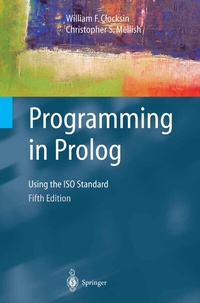
Programming in Prolog
Description

Originally published in 1981, this was the first textbook on programming in the Prolog language and is still the definitive introductory text on Prolog. Though many Prolog textbooks have been published since, this one has withstood the test of time because of its comprehensiveness, tutorial approach, and emphasis on general programming applications.
Prolog has continued to attract a great deal of interest in the computer science community, and has turned out to be a basis for an important new generation of programming languages and systems for Artificial Intelligence. Since the previous edition of Programming in Prolog, the language has been standardised by the International Organization for Standardization (ISO) and this book has been updated accordingly. The authors have also introduced some new material, clarified some explanations, corrected a number of minor errors, and removed appendices about Prolog systems that are now obsolete.
Reviews / Votes
From the reviews of the fifth edition:
"This is the fifth and the most recent edition of a legendary book . . It was probably the first introductory Prolog book and it is still the most gentle introduction to Prolog for everyone, including non-computer scientists. . the book is as great as ever as an introductory text for Prolog. When a newbie asks for an introduction to Prolog, the best advice is still Clocksin & Mellish." (Bart Demoen, TLP-Theory and Practice of Logic Programming, Vol. 5 (3), 2005)
More details
Other editions
Additional editions