

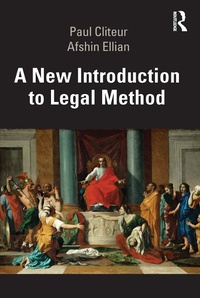
A New Introduction to Legal Method
1st Edition
Published on 4. April 2022
238 pages
978-1-000-57871-3 (ISBN)
Description

A New Introduction to Legal Method provides a comprehensive overview of legal science and the scientific character of legal knowledge.
In five chapters, the book analyses and explores: (i) legal methodology in general, the main features of different schools of thought, and the nature of science in general; (ii) American realism, which offers an ideal starting point for law students to reflect on the material they are about to study critically; (iii) rationalism, empiricism, and logical positivism, in particular the work of Karl Popper; (iv) criticisms of essentialism; (v) the ideological and philosophical background of contemporary liberal interpretation. The inclusion of Dutch, French, and German literature sources makes this law title differ from previous writings on legal science.
This textbook is ideal for students of legal method, and will be of great interest to those studying legal science, jurisprudence, legal research,and legal skills.
In five chapters, the book analyses and explores: (i) legal methodology in general, the main features of different schools of thought, and the nature of science in general; (ii) American realism, which offers an ideal starting point for law students to reflect on the material they are about to study critically; (iii) rationalism, empiricism, and logical positivism, in particular the work of Karl Popper; (iv) criticisms of essentialism; (v) the ideological and philosophical background of contemporary liberal interpretation. The inclusion of Dutch, French, and German literature sources makes this law title differ from previous writings on legal science.
This textbook is ideal for students of legal method, and will be of great interest to those studying legal science, jurisprudence, legal research,and legal skills.
Reviews / Votes
"The content of the book addresses core issues. The book is extensively researched and the content reflects the depth of research." Olayinka Lewis, University of Essex"This introduction to legal method by Professors Cliteur and Ellian is unique. Its refreshing and rare historical and philosophical scope, its lucidity and rigour, and the sheer stimulating power of its open-ended questions and engaging style make this book the ideal text for any legal methods course." Mark Somos, Max Planck Institute for Comparative Public Law and International Law
"This is one of the best introductions to legal method. It is written in an accessible style, has a clear point of view and is therefore well recommended." Rumy Hasan, University of Sussex Business School
More details
Edition
1. Auflage
Language
English
Place of publication
London
United Kingdom
Publishing group
Taylor & Francis Ltd
Target group
College/higher education
ISBN-13
978-1-000-57871-3 (9781000578713)
Copyright in bibliographic data and cover images is held by Nielsen Book Services Limited or by the publishers or by their respective licensors: all rights reserved.
Schweitzer Classification
Other editions
Additional editions
Paul Cliteur | Afshin Ellian
A New Introduction to Legal Method
Book
04/2022
1st Edition
Routledge
€60.20
Shipment within 10-20 days
Paul Cliteur | Afshin Ellian
A New Introduction to Legal Method
Book
04/2022
1st Edition
Routledge
€205.60
Shipment within 10-20 days
Persons
Paul Cliteur is Professor of Jurisprudence at Leiden University, the Netherlands. He is the author of The Secular Outlook (2010), Populist and Islamist Challenges for International Law (2019, together with Amos N. Guiora), and Theoterrorism v. Freedom of Speech (2019).
Afshin Ellian is Professor of Jurisprudence at Leiden University, the Netherlands. He edited The State of Exception and Militant Democracy in a Time of Terror (2012) and Counterterrorism after the IS-Caliphate (2020), and The Open Society and Its Closed Communities (2021, together with Paul Cliteur).
Afshin Ellian is Professor of Jurisprudence at Leiden University, the Netherlands. He edited The State of Exception and Militant Democracy in a Time of Terror (2012) and Counterterrorism after the IS-Caliphate (2020), and The Open Society and Its Closed Communities (2021, together with Paul Cliteur).
Content
Introduction 1 Is legal science a real science? 2 American Realism 3 Rationalism, empiricism, and logical positivism 4 Popper's Critique of Essentialism and the Scientific Outlook 5 Three types of legal interpretation
