

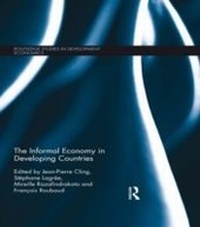
The Informal Economy in Developing Countries
1st Edition
Published on 21. August 2014
366 pages
978-1-317-91223-1 (ISBN)
Description

Informality is ubiquitous in most developing countries. Understanding the informal economy is therefore of utmost importance from a political, economic and social point of view. Paradoxically, despite its economic importance, knowledge is extremely limited regarding the informal economy. It remains largely unrecognized by researchers, is neglected by politicians, and is even negatively perceived as it is meant to disappear with development.
This book aims to amend this situation by presenting recent high level research which studies the informal sector and informal employment. Fresh research into this subject is presented through empirical analysis which covers Asia, Africa and Latin America. Each chapter relies on data and a detailed knowledge of the context of the countries studied in order to question the dominant schools of thought on the origins and causes of informality. The results provide interesting insights into the constraints faced by informal workers, the dynamics of the informal economy and its link with poverty issues. On the basis of the evidences provided by results adequate policies could be defined to address informality issues.
The principal characteristics of the informal sector testify to some profound similarities between developing countries: low qualifications and the precariousness of jobs, mediocre incomes and working conditions, atomization of production units and lack of articulation with the formal economy, etc. This general statement does not contradict the observation that there is a high level of heterogeneity in the sector and in informal employment within each country, confirmed by several chapters in this work. In the absence of a sufficient number of job creations, the informal sector essentially constitutes a refuge for workers seeking and is here to stay in the short and medium term, even in emerging countries.
This book aims to amend this situation by presenting recent high level research which studies the informal sector and informal employment. Fresh research into this subject is presented through empirical analysis which covers Asia, Africa and Latin America. Each chapter relies on data and a detailed knowledge of the context of the countries studied in order to question the dominant schools of thought on the origins and causes of informality. The results provide interesting insights into the constraints faced by informal workers, the dynamics of the informal economy and its link with poverty issues. On the basis of the evidences provided by results adequate policies could be defined to address informality issues.
The principal characteristics of the informal sector testify to some profound similarities between developing countries: low qualifications and the precariousness of jobs, mediocre incomes and working conditions, atomization of production units and lack of articulation with the formal economy, etc. This general statement does not contradict the observation that there is a high level of heterogeneity in the sector and in informal employment within each country, confirmed by several chapters in this work. In the absence of a sufficient number of job creations, the informal sector essentially constitutes a refuge for workers seeking and is here to stay in the short and medium term, even in emerging countries.
More details
Series
Language
English
Place of publication
London
United Kingdom
Publishing group
Taylor & Francis Ltd
Target group
College/higher education
Illustrations
37 s/w Abbildungen, 72 s/w Tabellen, 37 s/w Zeichnungen
72 Tables, black and white; 37 Line drawings, black and white; 37 Illustrations, black and white
File size
3,30 MB
ISBN-13
978-1-317-91223-1 (9781317912231)
Copyright in bibliographic data and cover images is held by Nielsen Book Services Limited or by the publishers or by their respective licensors: all rights reserved.
Schweitzer Classification
Other editions
Additional editions
Jean-Pierre Cling | Stephane Lagree | Mireille Razafindrakoto
The Informal Economy in Developing Countries
Book
12/2018
1st Edition
Routledge
€72.30
Shipment within 15-20 days
Jean-Pierre Cling | Stephane Lagree | Mireille Razafindrakoto
The Informal Economy in Developing Countries
Book
06/2014
1st Edition
Routledge
€244.20
Shipment within 15-20 days
Persons
Jean-Pierre Cling, economist, Ministry of Foreign affairs, Paris, and associate member of DIAL (mixed research unit IRD/University Paris Dauphine), Paris, France.
Stephane Lagree, coordinator of the bureau for francophone cooperation, Vietnam Academy of Social Science, Hanoi, Vietnam.
Mireille Razafindrakoto, senior researchfellow at the Institut de Recherche pour le Developpement (IRD) and a member of DIAL (mixed research unit IRD/ University of Paris Dauphine), Paris, France.
Francois Roubaud, senior research fellow at the IRD and a member of DIAL, Paris, France.
Stephane Lagree, coordinator of the bureau for francophone cooperation, Vietnam Academy of Social Science, Hanoi, Vietnam.
Mireille Razafindrakoto, senior researchfellow at the Institut de Recherche pour le Developpement (IRD) and a member of DIAL (mixed research unit IRD/ University of Paris Dauphine), Paris, France.
Francois Roubaud, senior research fellow at the IRD and a member of DIAL, Paris, France.
Content
Part 1. 1. Labor Informality and Poverty in Latin America. The Case of Argentina, Brazil, Chile and Peru 2. Working in the Informal Sector: A Free Choice or an Obligation? An Analysis of Job Satisfaction in Vietnam 3. Intergenerational Transmission of Self-Employed Atatus in the Informal Sector: A Constrained Choice or better Income Prospects? Evidence from Seven West-African Countries 4. Integration of Formal and Informal Sectors in Craft Villages of the Red River Delta (Vietnam) 5. Social Insurance and Informal Economy in Vietnam: The Challenge of an Universal Coverage Part 2. 6. Efficiency of Informal Production Units and its Determinants: Applying the Quantile Regression Method in the Case of Antananarivo 7. Estimating the Returns to Education in the Informal Sector : The Case of Cameroon 8. Does Corruption Matter for Informal Sector Economic Performance? Microdata Evidence from Sub-Saharan Africa 9. Does forced Solidarity Hamper Entrepreneurial Activity? Evidence from Seven West-African Countries 10. The Political Economy of Micro Entrepreneurship: Why Does Microcredit Fail to Promote Self-Employment in Rural South-India? Part 3. 11. Informal versus Formal: A Panel Data Analysis of Earnings Gaps in Madagascar 12. Do limits exist to informality growth in South America? A preliminary exploration 13. Long term dynamic of the Labour market in Thailand: Transitions between the Formal and Informal Sectors 14. Dynamics of Informal Microenterprises and Poverty in Peru: A Panel Approach 15. Informality, Crisis and Public Policies in Vietnam
