

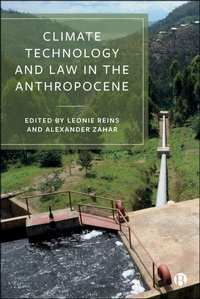
Climate Technology and Law in the Anthropocene
Bristol University Press
1st Edition
Published on 8. July 2025
538 pages
978-1-5292-3290-5 (ISBN)
Description

Available open access digitally under CC-BY-NC-ND licence. As climate change accelerates, our window for action is closing. To stay within the "Anthropocene" - an epoch in which humankind as the dominant force shaping the planet retains a degree of control over the destructive processes it has unleashed - global warming must be kept below 2 degrees Celsius.
This book explores the unprecedented technological and legal changes required to achieve this. Featuring contributions from leading experts, the essays examine the intersection of technology, law, and environmental values, offering diverse viewpoints on navigating the Anthropocene.
Revealing the controversies of rapid technological adoption and legal reform, this is a crucial analysis of a complex future whose many dangers for our society are barely understood.
This book explores the unprecedented technological and legal changes required to achieve this. Featuring contributions from leading experts, the essays examine the intersection of technology, law, and environmental values, offering diverse viewpoints on navigating the Anthropocene.
Revealing the controversies of rapid technological adoption and legal reform, this is a crucial analysis of a complex future whose many dangers for our society are barely understood.
More details
Edition
First Edition
Language
English
Place of publication
Bristol
United Kingdom
Target group
Professional and scholarly
Illustrations
Not illustrated
File size
1,33 MB
ISBN-13
978-1-5292-3290-5 (9781529232905)
Copyright in bibliographic data and cover images is held by Nielsen Book Services Limited or by the publishers or by their respective licensors: all rights reserved.
Schweitzer Classification
Other editions
Additional editions
Book
approx. 12/2030
1st Edition
Bristol University Press
€222.83
The article will not be published
Book
07/2025
1st Edition
Bristol University Press
€246.50
Shipment within 3-4 weeks
Persons
Alexander Zahar is a lawyer specializing in environmental litigation at Ashurst Australia. He is also a Lead Reviewer of greenhouse gas inventories, national communications, and biennial reports, as well as a Technical Expert of biennial update reports submitted by developing countries. He is the founder and editor of the journal Climate Law. His publications include Debating Climate Law (Cambridge University Press, 2021), co-edited with Benoit Mayer.
Leonie Reins is Professor for Public Law and Sustainability at Erasmus School of Law. Prior to joining ESL she worked as an Assistant Professor at the Tilburg Institute for Law, Technology and Society (TILT) at Tilburg University. She obtained her FWO-financed PhD from KU Leuven, where she subsequently also worked as a Post-Doctoral Researcher. In addition Leonie worked as Legal Advisor at a Brussels-based environmental law and policy consultancy, where she was involved in projects on environmental, energy and climate change law and policy.
Leonie Reins is Professor for Public Law and Sustainability at Erasmus School of Law. Prior to joining ESL she worked as an Assistant Professor at the Tilburg Institute for Law, Technology and Society (TILT) at Tilburg University. She obtained her FWO-financed PhD from KU Leuven, where she subsequently also worked as a Post-Doctoral Researcher. In addition Leonie worked as Legal Advisor at a Brussels-based environmental law and policy consultancy, where she was involved in projects on environmental, energy and climate change law and policy.
Content
1. Introduction - Alexander Zahar and Leonie Reins
Part A: Climate Technologies
2. Are Renewable Energy Technologies Compatible With Biodiversity Conservation? The Energy-Conservation Legal Nexus - Floor Fleurke and Phillip Paiement
3. Ambition in Nationally Determined Contributions: The Case of Hydropower - Alexander Zahar
4. An Essential Zero-Carbon Solution or a Perilous Energy Technology? Exploring the Nuclear Debate in EU Law - Kaisa Huhta
5. Critical Raw Materials in the Anthropocene: Regulatory Perspectives on Their Promise and Pitfalls - Seita Vesa
6. Hydrogen: What Does Its Deployment at Speed and Scale Mean for Legal Systems? - Ruven Fleming and and Kelsey Pailman
7. Genetically Modified Organisms: Is the Proof in the Pudding or the Process? - Mirta Alessandrini and Josephine Van Zeben
8. Cultured Meat and Dairy as a Game-Changing Technology in the Agricultural and Food Transition in the EU: What Role for Law? - Jonathan Verschuuren
9. Regulating Geoengineering - Gareth Davies
10. Solar Radiation Management Technologies: Research and Development Are Essential and Risks Can Be Governed - Manon Simon, Kerryn Brent, Jeffrey McGee, and Jan McDonald
11. Whither Law and Regulation on Carbon Capture, Utilisation and Storage Technology? A Comparative Analysis - Hao Zhang
12. Evidence Based Climate Law? The Case of Carbon Capture, Use and Storage - Bettina Lange
13. Nature-Based Climate Solutions and the Rights of Nature: A Conundrum of Values - Felicity Deane and Justine Bell-James
14. Ban on Coal: Rationale and Legality for Restrictions on Coal Production, Sale, and Use - Daria Shapovalova
Part B: The Broader Normative Context
15. Should Owners of a Carbon-Intensive Assets Be Compensated if Required To Cease Operation Due to the Energy Transition? - Gunnar S. Eskeland and Ignacio Herrera Anchustegui
16. Rising Tides, Rising Justice: Navigating the Intersection of Climate Mitigation and Energy Justice - Laura Kaschny
17. Promethean Dreams: Intellectual Property and Climate Change in the Anthropocene - Matthew Rimmer
18. The Interface of Climate Technologies and International Trade Law: Tensions and Opportunities - Kateryna Holzer and Yulia Yamineva
19. Debating the Architecture of the International Climate Regime and Its Potential for the Regulation of Technology - Alberto Quintavalla and Leonie Reins
20. Thinking Technology Transfer Beyond Development - Morag Goodwin
Part A: Climate Technologies
2. Are Renewable Energy Technologies Compatible With Biodiversity Conservation? The Energy-Conservation Legal Nexus - Floor Fleurke and Phillip Paiement
3. Ambition in Nationally Determined Contributions: The Case of Hydropower - Alexander Zahar
4. An Essential Zero-Carbon Solution or a Perilous Energy Technology? Exploring the Nuclear Debate in EU Law - Kaisa Huhta
5. Critical Raw Materials in the Anthropocene: Regulatory Perspectives on Their Promise and Pitfalls - Seita Vesa
6. Hydrogen: What Does Its Deployment at Speed and Scale Mean for Legal Systems? - Ruven Fleming and and Kelsey Pailman
7. Genetically Modified Organisms: Is the Proof in the Pudding or the Process? - Mirta Alessandrini and Josephine Van Zeben
8. Cultured Meat and Dairy as a Game-Changing Technology in the Agricultural and Food Transition in the EU: What Role for Law? - Jonathan Verschuuren
9. Regulating Geoengineering - Gareth Davies
10. Solar Radiation Management Technologies: Research and Development Are Essential and Risks Can Be Governed - Manon Simon, Kerryn Brent, Jeffrey McGee, and Jan McDonald
11. Whither Law and Regulation on Carbon Capture, Utilisation and Storage Technology? A Comparative Analysis - Hao Zhang
12. Evidence Based Climate Law? The Case of Carbon Capture, Use and Storage - Bettina Lange
13. Nature-Based Climate Solutions and the Rights of Nature: A Conundrum of Values - Felicity Deane and Justine Bell-James
14. Ban on Coal: Rationale and Legality for Restrictions on Coal Production, Sale, and Use - Daria Shapovalova
Part B: The Broader Normative Context
15. Should Owners of a Carbon-Intensive Assets Be Compensated if Required To Cease Operation Due to the Energy Transition? - Gunnar S. Eskeland and Ignacio Herrera Anchustegui
16. Rising Tides, Rising Justice: Navigating the Intersection of Climate Mitigation and Energy Justice - Laura Kaschny
17. Promethean Dreams: Intellectual Property and Climate Change in the Anthropocene - Matthew Rimmer
18. The Interface of Climate Technologies and International Trade Law: Tensions and Opportunities - Kateryna Holzer and Yulia Yamineva
19. Debating the Architecture of the International Climate Regime and Its Potential for the Regulation of Technology - Alberto Quintavalla and Leonie Reins
20. Thinking Technology Transfer Beyond Development - Morag Goodwin
