

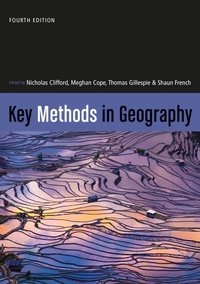
Key Methods in Geography
4th Edition
Published on 13. April 2023
784 pages
978-1-5296-1379-7 (ISBN)
Description

Key Methods in Geography is the perfect introductory companion, providing an overview of qualitative and quantitative methods for human and physical geography. The fourth edition of this essential and accessible primer covers the breadth of the discipline and offer critical and contextual perspectives on research methods. New coverage takes account of newer technologies and practice, and 9 new chapters bring greater diversity of positionality and perspective to the volume, including decolonial methods, predicting, visualizing and modelling climate and environmental change, and writing up research. Case study examples, summaries and exercises have been included in each chapter to enable learning.
This is vital reading for any student undertaking a Geography Methods module as well as a valuable resource for any student embarking on independent research as part of their degree.
This is vital reading for any student undertaking a Geography Methods module as well as a valuable resource for any student embarking on independent research as part of their degree.
Reviews / Votes
An in-depth inquisition of the complex dynamic landscape associated with human and physical geography and their interactions, expertly articulated and packaged by an ecosystem of experts, key methods in geography is an ideal reference book for novice and experienced researchers.Faith Njoki Karanja - Geoinformation Expert -- Dr Faith Njoki Karanja
More details
Edition
Fourth Edition
Language
English
Place of publication
London
United Kingdom
Publishing group
Sage Publications Ltd (Digital)
Target group
College/higher education
Product notice
Reflowable
File size
20,27 MB
ISBN-13
978-1-5296-1379-7 (9781529613797)
Copyright in bibliographic data and cover images is held by Nielsen Book Services Limited or by the publishers or by their respective licensors: all rights reserved.
Schweitzer Classification
Other editions
Additional editions
Nicholas Clifford | Meghan Cope | Thomas W. Gillespie
Key Methods in Geography
Book
04/2023
4th Edition
SAGE Publications Ltd
€210.10
Shipment within 15-20 days
Nicholas Clifford | Meghan Cope | Thomas W. Gillespie
Key Methods in Geography
Book
04/2023
4th Edition
SAGE Publications Ltd
€106.50
Shipment within 15-20 days
Persons
Nick Clifford is Professor and Head of Department at King's College London. Dr. Meghan Cope is an urban social geographer. She is mainly interested in the ways that social, economic, political, and environmental processes influence cities and communities, as well as the ways that people's everyday lives create meaningful spaces and places within, or even against, the larger-scale processes operating on them. Her focus has always been on social/spatial processes of marginalization and disempowerment, for example, through gender, race/ethnicity, class, youth, etc. She is especially motivated by issues such as employment, households and neighborhoods, welfare, public space, poverty, discrimination, and identity. She is also a qualitative researcher who uses ethnography and other methods to learn about the geographic meanings and processes that matter to marginalized groups. Over the past 10 years she has developed an associated interest in critical perspectives on Geographic Information Systems (GIS) and have explored methods of combining qualitative research with GIS (Cope & Elwood, 2009). Thomas Gillespie teaches geography at UCLA.
Content
Starting Points And Perspectives
Getting Started In Geographical Research: How This Book Can Help
Health, Safety And Risk In The Field
On Being Ethical In Geographical Research
Identifying And Reviewing The Key Literature For Your Assignment
Effective Research Communication
Fundamentals Of Mapping And GIS
Decolonial Methods
Exploring Human And More-Than-Human Geographies
Historical And Archival Research
Conducting Questionnaire Surveys
Semi-Structured Interviews And Focus Groups
Respondent Diaries
Participant Observation
Researching Affect And Emotion
More-Than-Human Research Methodologies
Textual Analysis
Interpreting The Visual
Using Digital Social Data In Geographic Research
GeoHumanities And Creative Research Methods
Critical GIS
Quantitative Modelling In Human Geography
Exploring The Physical Environment
Making Observations And Measurements In The Field
Uncrewed Aircraft Systems (UAS) For Predicting, Visualizing, And Modelling Environmental Change
Getting Information From The Past: Palaeoecological Studies Of Terrestrial Ecosystems
Numerical Modelling: Understanding Explanation and Prediction in Physical Geography
Simulation And Reduced Complexity Models
Remote Sensing And Satellite Earth Observation
Digital Terrain Analysis
Environmental GIS
Models And Data In Biogeography And Landscape Ecology
Environment And Sustainability: Environmental Auditing, Impact Assessment And Valuation Revised
Geographical Analysis: Interpreting, Visualising, And Representing Geographical Data
Making Use Of Secondary Data
Using Statistics To Describe And Explore Spatial Data
Exploring And Presenting Quantitative Data
Case Study Methodology
Making Sense Of Qualitative Data: Coding, Organizing, And Analyzing
Video, Audio And Technology-Based Applications
Writing: An Embodied Spatial Practice of Scholarly Sharing
Perspectives On Research In Practice
Encountering The Digital In Human Geography Research
Doing Engaged Scholarship: Why Methods Matter
Getting Started In Geographical Research: How This Book Can Help
Health, Safety And Risk In The Field
On Being Ethical In Geographical Research
Identifying And Reviewing The Key Literature For Your Assignment
Effective Research Communication
Fundamentals Of Mapping And GIS
Decolonial Methods
Exploring Human And More-Than-Human Geographies
Historical And Archival Research
Conducting Questionnaire Surveys
Semi-Structured Interviews And Focus Groups
Respondent Diaries
Participant Observation
Researching Affect And Emotion
More-Than-Human Research Methodologies
Textual Analysis
Interpreting The Visual
Using Digital Social Data In Geographic Research
GeoHumanities And Creative Research Methods
Critical GIS
Quantitative Modelling In Human Geography
Exploring The Physical Environment
Making Observations And Measurements In The Field
Uncrewed Aircraft Systems (UAS) For Predicting, Visualizing, And Modelling Environmental Change
Getting Information From The Past: Palaeoecological Studies Of Terrestrial Ecosystems
Numerical Modelling: Understanding Explanation and Prediction in Physical Geography
Simulation And Reduced Complexity Models
Remote Sensing And Satellite Earth Observation
Digital Terrain Analysis
Environmental GIS
Models And Data In Biogeography And Landscape Ecology
Environment And Sustainability: Environmental Auditing, Impact Assessment And Valuation Revised
Geographical Analysis: Interpreting, Visualising, And Representing Geographical Data
Making Use Of Secondary Data
Using Statistics To Describe And Explore Spatial Data
Exploring And Presenting Quantitative Data
Case Study Methodology
Making Sense Of Qualitative Data: Coding, Organizing, And Analyzing
Video, Audio And Technology-Based Applications
Writing: An Embodied Spatial Practice of Scholarly Sharing
Perspectives On Research In Practice
Encountering The Digital In Human Geography Research
Doing Engaged Scholarship: Why Methods Matter
