

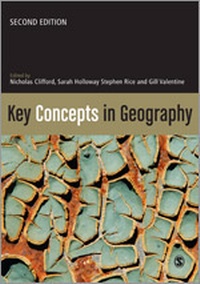
Key Concepts in Geography
2nd Edition
Published on 12. December 2008
480 pages
978-1-4462-0665-2 (ISBN)
Description

"This book clearly outlines key concepts that all geographers should readily be able to explain. It does so in a highly accessible way. It is likely to be a text that my students will return to throughout their degree."
- Dr Karen Parkhill, Bangor University
"The editors have done a fantastic job. This second edition is really accessible to the student and provides the key literature in the key geographical terms of scale, space, time, place and landscape."
- Dr Elias Symeonakis, Manchester Metropolitan University
"An excellent introductory text for accessible overviews of key concepts across human and physical geography."
- Professor Patrick Devine-Wright, Exeter University
Including ten new chapters on nature, globalization, development and risk, and a new section on practicing geography, this is a completely revised and updated edition of the best-selling, standard student resource.
Key Concepts in Geography explains the key terms - space, time, place, scale, landscape - that define the language of geography. It is unique in the reference literature as it provides in one volume concepts from both human geography and physical geography.
Four introductory chapters on different intellectual traditions in geography situate and introduce the entries on the key concepts. Each entry then comprises a short definition, a summary of the principal arguments, a substantive 5,000-word discussion, the use of real-life examples, and annotated notes for further reading.
Written in an accessible way by established figures in the discipline, the definitions provide thorough explanations of all the core concepts that undergraduates of geography must understand to complete their degree.
- Dr Karen Parkhill, Bangor University
"The editors have done a fantastic job. This second edition is really accessible to the student and provides the key literature in the key geographical terms of scale, space, time, place and landscape."
- Dr Elias Symeonakis, Manchester Metropolitan University
"An excellent introductory text for accessible overviews of key concepts across human and physical geography."
- Professor Patrick Devine-Wright, Exeter University
Including ten new chapters on nature, globalization, development and risk, and a new section on practicing geography, this is a completely revised and updated edition of the best-selling, standard student resource.
Key Concepts in Geography explains the key terms - space, time, place, scale, landscape - that define the language of geography. It is unique in the reference literature as it provides in one volume concepts from both human geography and physical geography.
Four introductory chapters on different intellectual traditions in geography situate and introduce the entries on the key concepts. Each entry then comprises a short definition, a summary of the principal arguments, a substantive 5,000-word discussion, the use of real-life examples, and annotated notes for further reading.
Written in an accessible way by established figures in the discipline, the definitions provide thorough explanations of all the core concepts that undergraduates of geography must understand to complete their degree.
More details
Edition
Second Edition
Language
English
Place of publication
London
United Kingdom
Target group
College/higher education
ISBN-13
978-1-4462-0665-2 (9781446206652)
Copyright in bibliographic data and cover images is held by Nielsen Book Services Limited or by the publishers or by their respective licensors: all rights reserved.
Schweitzer Classification
Other editions
Additional editions
Nicholas Clifford | Sarah L. Holloway | Stephen P. Rice
Key Concepts in Geography
Book
12/2008
2nd Edition
SAGE Publications Inc
€122.00
Shipment within 10-20 days
Nicholas Clifford | Sarah L. Holloway | Stephen P. Rice
Key Concepts in Geography
Book
12/2008
2nd Edition
SAGE Publications Inc
€267.41
Shipment within 10-20 days
Persons
Nick Clifford is Professor and Head of Department at King's College London. Professor Valentine has held prestigious international visiting fellowships at the Universities of Sydney, Australia and Otago, New Zealand and has visited and given keynote addresses at a range of prestigious international conferences. She was co-founder and co-editor of the international journal Social and Cultural Geography, and co-edited Gender, Place and Culture. She has undertaken international research in Europe, Africa and the USA and is committed to developing the University of Sheffield's international strategy within the Faculty of Social Sciences.
Content
THE NATURE OF GEOGRAPHY
Histories of Geography - Mike Heffernan
Geography and the Physical Science Tradition - Keith Richards
Geography and the Social Science Tradition - Ron Johnston
Geography and the Humanities Tradition - Alison Blunt
KEY CONCEPTS
Space: The Fundamental Stuff of Geography - Nigel Thrift
Space: Making Room for Space in Physical Geography - Martin Kent
Time: Change and Stability in Environmental Systems - John Thornes
Time: From Hegemonic Change to Everyday Life - Peter Taylor
Place: Connections and Boundaries in an Interdependent World - Noel Castree
Place: The Management of Sustainable Physical Environments - Ken Gregory
Scale: Resolution, Analysis and Synthesis in Physical Geography - Tim Burt
Scale: The Local and the Global - Andy Herod
Social Formations: Thinking about Society, Identity, Power and Resistance - Cindi Katz
Physical Systems: Systems in Physical Geography - Stephan Harrison
Landscape and Environment: The Physical Layer - Murray Gray
Landscape and Environment: Representing and Interpreting the World - Karen Morin
Nature: A Contested Concept - Franklin Ginn and David Demeritt
Nature: Reclamation, Rehabilitation and Restoration - Roy Haines-Young
Globalisation: Interconnected Worlds - James Faulconbridge & Jonathan Beaverstock
Globalisation: Earth System Science - Physical Diversity and Global Heterogeneity - Nick Clifford
Development: Critical Approaches in Human Geography - Kate Willis
Development: The Sustainability Industry - Robert Inkpen
Risk - Shaun French
Risk: Geophysical Processes in Natural Hazards - Graham Tobin & Burrell Montz
Conclusion: Practising Geography
Relevance: Human Geography, Public Policy and Public Geographies - David Bell
Relevance: The Application of Physical Geographical Knowledge - Mike Church
Histories of Geography - Mike Heffernan
Geography and the Physical Science Tradition - Keith Richards
Geography and the Social Science Tradition - Ron Johnston
Geography and the Humanities Tradition - Alison Blunt
KEY CONCEPTS
Space: The Fundamental Stuff of Geography - Nigel Thrift
Space: Making Room for Space in Physical Geography - Martin Kent
Time: Change and Stability in Environmental Systems - John Thornes
Time: From Hegemonic Change to Everyday Life - Peter Taylor
Place: Connections and Boundaries in an Interdependent World - Noel Castree
Place: The Management of Sustainable Physical Environments - Ken Gregory
Scale: Resolution, Analysis and Synthesis in Physical Geography - Tim Burt
Scale: The Local and the Global - Andy Herod
Social Formations: Thinking about Society, Identity, Power and Resistance - Cindi Katz
Physical Systems: Systems in Physical Geography - Stephan Harrison
Landscape and Environment: The Physical Layer - Murray Gray
Landscape and Environment: Representing and Interpreting the World - Karen Morin
Nature: A Contested Concept - Franklin Ginn and David Demeritt
Nature: Reclamation, Rehabilitation and Restoration - Roy Haines-Young
Globalisation: Interconnected Worlds - James Faulconbridge & Jonathan Beaverstock
Globalisation: Earth System Science - Physical Diversity and Global Heterogeneity - Nick Clifford
Development: Critical Approaches in Human Geography - Kate Willis
Development: The Sustainability Industry - Robert Inkpen
Risk - Shaun French
Risk: Geophysical Processes in Natural Hazards - Graham Tobin & Burrell Montz
Conclusion: Practising Geography
Relevance: Human Geography, Public Policy and Public Geographies - David Bell
Relevance: The Application of Physical Geographical Knowledge - Mike Church
