

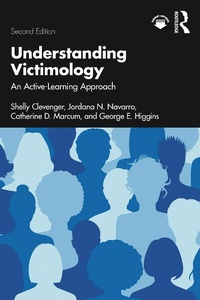
Understanding Victimology
An Active-Learning Approach
2nd Edition
Published on 29. March 2024
264 pages
978-1-003-84811-0 (ISBN)
Description

Understanding Victimology: An Active Learning Approach is the only textbook with extensive discussion of both online and offline victimization reinforced by group and individual learning activities. Our textbook offers instructors a variety of active learning exercises - in the book itself and in the authors' ancillaries - that engage students in the material and shed light on the experiences of marginalized social groups. Through these activities, students become engaged with the material at a higher level of learning. They learn how victimization happens and the challenges people who experience crime face in acquiring assistance from the criminal-legal system at a more intimate level instead of simply reading about it. Students also build their abilities to work with others in a collaborative learning environment, encouraging professional socialization for the future.
The chapters in this second edition address gaps in information typically presented in victimology that ignore prevention or intervention, even though these topics are currently at the forefront of the national conversation going on about sexual violence in higher education. New to this edition are added coverage of immigrants and minorities and a new chapter on the media and victimization. Instructor resources are available online.
Suitable for undergraduate courses in victimology, this book also serves the needs of sociology and women's studies courses and can be taught university-wide as part of diversity and inclusion initiatives.
The chapters in this second edition address gaps in information typically presented in victimology that ignore prevention or intervention, even though these topics are currently at the forefront of the national conversation going on about sexual violence in higher education. New to this edition are added coverage of immigrants and minorities and a new chapter on the media and victimization. Instructor resources are available online.
Suitable for undergraduate courses in victimology, this book also serves the needs of sociology and women's studies courses and can be taught university-wide as part of diversity and inclusion initiatives.
More details
Edition
2nd edition
Language
English
Place of publication
London
United Kingdom
Publishing group
Taylor & Francis Ebooks
Target group
College/higher education
Illustrations
6 Tables, black and white; 1 Line drawings, black and white; 4 Halftones, black and white; 5 Illustrations, black and white
ISBN-13
978-1-003-84811-0 (9781003848110)
Copyright in bibliographic data and cover images is held by Nielsen Book Services Limited or by the publishers or by their respective licensors: all rights reserved.
Schweitzer Classification
Other editions
Additional editions
Shelly Clevenger | Jordana N. Navarro | Catherine D. Marcum
Understanding Victimology
An Active-Learning Approach
Book
03/2024
2nd Edition
Routledge
€206.30
Shipment within 10-20 days
Shelly Clevenger | Jordana N. Navarro | Catherine D. Marcum
Understanding Victimology
An Active-Learning Approach
Book
03/2024
2nd Edition
Routledge
€63.50
Shipment within 10-20 days
Persons
Shelly Clevenger is chair of the Department of Victim Studies at Sam Houston State University, which is the first and only department of its kind in the nation. She received her PhD, MA, and BA in criminology from Indiana University of Pennsylvania. Clevenger received the Stan and Sandy Rives Excellence in Undergraduate Education Award from Illinois State University in 2020 and Book of the Year Award for Understanding Victimology: An Active Learning Approach from the American Society of Criminology, Division of Victimology in 2019. Her research area of focus is victimization, both in person and online, and has been published in journals such as Policing: An International Journal of Police Strategies and Management, American Journal of Criminal Justice, and Crime & Delinquency.
Jordana N. Navarro is an associate professor in the Department of Criminal Justice at The Citadel in Charleston, South Carolina. She graduated with her PhD in sociology from the University of Central Florida in 2013. Her research interests are cybercrime, intimate partner abuse, victimology, and sexual abuse. She also has teaching interests in homicide and mapping analysis. She has published on these topics in a variety of journals, and her most recent work focuses on men who are victimized by sexual assaults. Additionally, she has authored books on criminological theory and how domestic abuse manifests in virtual environments.
Catherine D. Marcum is the chair of the Department of Government and Justice Studies at Appalachian State University, as well as a professor of justice studies. She earned a PhD in criminology from Indiana University of Pennsylvania and was named the 2022 IUP Distinguished Alumni of the Year. Her areas of teaching and research focus on correctional issues, cybercrime, and victimization, and she very much enjoys working with students on research. She has published over 60 peer-reviewed journal articles and 20 books in her fields. Marcum serves as the editor for the Journal of Criminal Justice Education. She is an active volunteer for the Girl Scouts of America, Hardin Park School, and other community organizations.
George E. Higgins is a full professor with tenure of criminal justice in the University of Louisville's Department of Criminal Justice. His research focuses on testing criminological theories and organizational theories applied to criminal justice using advanced quantitative methods. Substantively, Higgins examines substance use, cybercrime, race and ethnicity differences, criminal justice organizational issues (i.e., leadership, administration, and profiling), and suicide issues. He is the author of more than 200 peer-reviewed scholarly journal articles and 10 books. He is the recipient of numerous awards, including the 2022 Academy of Criminal Justice Sciences (ACJS) Fellow Award and 2018 Academy of Criminal Justice Science's (ACJS) Founder's Award. In 2015, Higgins was ranked 24th of the top 100 influential criminologists (Walters, G. D. [2015]. Measuring the quantity and quality of scholarly productivity in criminology and criminal justice. Scientometrics, 102, 2011-2022).
Jordana N. Navarro is an associate professor in the Department of Criminal Justice at The Citadel in Charleston, South Carolina. She graduated with her PhD in sociology from the University of Central Florida in 2013. Her research interests are cybercrime, intimate partner abuse, victimology, and sexual abuse. She also has teaching interests in homicide and mapping analysis. She has published on these topics in a variety of journals, and her most recent work focuses on men who are victimized by sexual assaults. Additionally, she has authored books on criminological theory and how domestic abuse manifests in virtual environments.
Catherine D. Marcum is the chair of the Department of Government and Justice Studies at Appalachian State University, as well as a professor of justice studies. She earned a PhD in criminology from Indiana University of Pennsylvania and was named the 2022 IUP Distinguished Alumni of the Year. Her areas of teaching and research focus on correctional issues, cybercrime, and victimization, and she very much enjoys working with students on research. She has published over 60 peer-reviewed journal articles and 20 books in her fields. Marcum serves as the editor for the Journal of Criminal Justice Education. She is an active volunteer for the Girl Scouts of America, Hardin Park School, and other community organizations.
George E. Higgins is a full professor with tenure of criminal justice in the University of Louisville's Department of Criminal Justice. His research focuses on testing criminological theories and organizational theories applied to criminal justice using advanced quantitative methods. Substantively, Higgins examines substance use, cybercrime, race and ethnicity differences, criminal justice organizational issues (i.e., leadership, administration, and profiling), and suicide issues. He is the author of more than 200 peer-reviewed scholarly journal articles and 10 books. He is the recipient of numerous awards, including the 2022 Academy of Criminal Justice Sciences (ACJS) Fellow Award and 2018 Academy of Criminal Justice Science's (ACJS) Founder's Award. In 2015, Higgins was ranked 24th of the top 100 influential criminologists (Walters, G. D. [2015]. Measuring the quantity and quality of scholarly productivity in criminology and criminal justice. Scientometrics, 102, 2011-2022).
Content
Preface
1. Introduction to Victimology
2. Theories of Victimization
3. Rights and Remedies of Those Harmed by Crime
4. Hybrid and Online Victimization
5. Personal and Property Victimization
6. Rape, Sexual Assault, and Kidnapping
7. Intimate Partner Abuse
8. School and Work Victimization
9. Victimization of Special Populations
10. Hate Crimes and Terrorism
11. People Harmed and the Media
Index
1. Introduction to Victimology
2. Theories of Victimization
3. Rights and Remedies of Those Harmed by Crime
4. Hybrid and Online Victimization
5. Personal and Property Victimization
6. Rape, Sexual Assault, and Kidnapping
7. Intimate Partner Abuse
8. School and Work Victimization
9. Victimization of Special Populations
10. Hate Crimes and Terrorism
11. People Harmed and the Media
Index
