

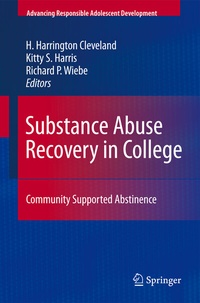
Substance Abuse Recovery in College
Description

Reviews / Votes
From the reviews:"One might expect to see a text book entitled Substance Abuse in College, not Substance Abuse Recovery in College which feels like an oxymoron. While most college campuses are challenged with providing effective prevention and education resources for students using and abusing substances, very few colleges focus on the recovery population. That is why th text is worth reading. Unique in its contribution to not only the field of adolescent development and addiction recovery, the text offers Higher Education another avenue for approaching and developing a comprehensive alcohol and other drug strategy: on campus recovery support. Additionally, it offers students in recovery hope, while demonstrating to all students that college life is not synonymous with substance abuse. ... This text is an important read for clinicians, higher education policy makers, health and human services and related professionals in human development."Teresa Wren Johnston, MA, LPC, July 2010"For many, the term 'recovery' conjures up images of worn out middle-aged former addicts or alcoholics. Severely dependent individuals often use drugs and/or drink for two decades or longer before seeking treatment or some other form of help (e.g., 12-step fellowships such as Alcoholics and/or Narcotics Anonymous). Most of what we know about the recovery experience and the type of environment and strategies that support recovery comes from studies conducted among individuals enrolled in treatment programs, individuals in their late 30's or older. However, substance use typically starts in adolescence. The main contribution of Substance Abuse Recovery in College: Community Supported Abstinence, edited by H. Harrington Cleveland, Kitty S. Harris, and Richard P. Wiebe, is a message of hope: it demonstrates that alcohol and drug problems need not inexorably progress unchecked for years, even decades, shattering lives and dreams along the way,before the individual seeks recovery. Rather, the book demonstrates how youths with substance use problems can simultaneous nurture their recovery and achieve, even thrive, academically.The book describes the Collegiate Recovery Communities at Texas Tech University (TTU), a youth oriented recovery community designed to support a substance-free life and to promote addiction recovery in the context of institutions of higher education that are too often 'abstinence-hostile.' Young people in the process of overcoming substance use problems often forego pursuing a higher education, arguably among the most important assets to a achieving 'a good life' but one that is too often denied or delayed by chronic addiction because of the rampant alcohol and drug use on college campuses and the peer-pressure to drink and/or do drug to 'fit in.' While 12-step fellowships are an important part of a successful collegiate recovery community, by themselves they may not be sufficient to support abstinence and recovery on a college campus where socializing often revolves around drinking and partying. Collegiate Recovery Communities (CRC) provide a supportive environment of peers in the academic setting, with three goals: (a) to lay a foundation for long-term and sustained recovery, (b) to provide a context where community members can safely pursue their education, and (c) to instill character in students to help them function in society. The program is guided and supported by professionals but relies most on peer-to-peer support, the basis of mutual aid groups, that provides not only abstinence and other forms of support but also role models, shared strategies to handle stress and resist temptations to use drugs or drink, acceptance, identification and a substance-free social network.Written equally well for the scientist and the lay reader, the book reviews the need for college-based recovery communities and the theoretical Ericksonian foundations of theprogram; it then presents a series of studies describing the CRC students, their substance use and academic outcomes - a remarkably low rate of return to substance use and impressive grade point averages, and the strategies they use to maintain their recovery; using an innovative technique, daily diary data collection using palm pilots, the authors provide insights into students' experiences being part of CRC, especially the social support network that promotes abstinence from drugs and alcohol use.Not surprisingly, the TTU program has become a model for other colleges and universities to build their own collegiate recovery communities with the support of several federal agencies. The book finishes with a 'lessons learnt' chapter that puts the CRC model into the context of related efforts such as recovery schools, discusses the logistics of implementing and evaluating a recovery support program and presents examples of pilot efforts to export the model to other campuses. The book is a must read for educators, addiction scientists, and school and college counselors as well as for young people with substance use problems who are considering college, and for their parents."-Alexandre B. Laudet, Ph.D., October 9, 2009"Describes the implementation of a collegiate recovery community (CRC) . . this book may appeal to professionals working directly with adolescents and young adults with substance use disorders, as well as to researchers who study continuing care models or alcohol and drug use among college-age individuals. . The main value of this book, edited by H. Harrington Cleveland, Kitty S. Harris, and Richard P. Wiebe, is that it thoroughly introduces this novel continuing care model for college students recovering from addictions." (Douglas C. Smith, PsycCRITIQUES, Vol. 55 (42), October, 2010)More details
Other editions
Additional editions
Persons
H. Harrington Cleveland received his J.D. at Boston College in 1991 and his Ph.D. in Family Studies and Human Development from the University of Arizona in 1998. Following his Ph.D., he spent 2 years as a National Institute of Child Health and Human Development (NICHD) Post-Doctoral Fellow at the Carolina Population Center at the University of North Carolina-Chapel Hill. While at the University of North Carolina, he worked exclusively on analyzing data from the National Longitudinal Study of Adolescent Health under the supervision of J. R. Udry. He has published extensively on the influences of genes and environments on both risk behaviors, such as alcohol and drug use, and the social experiences, such as associating with substance using peers, which can encourage these risk behaviors. The last few years, Dr. Cleveland has worked extensively with a community of college students in long-term recovery to understand how they construct their lives of abstinence.
Kitty Harris, Ph.D., is the Director of the Center for the Study of Addiction & Recovery at Texas Tech University. She is also Co-Director of the Texas Tech University Center for Child and Adolescent Development and Resiliency. Dr. Harris received her Master's Degree in Speech Communication from University of North Texas in 1974 and her Ph.D. in Human Development and Family Studies from Texas Tech University in 1983. Dr. Harris currently holds LCDC and LMFT licenses. She has been on the faculty of Texas Tech University since 1988. In addition, she serves as the Program Director for Supportive Adolescent Services and Pre-Adolescent Supportive Services, a mentoring program in the Lubbock Independent School District designed to help teens with their everyday lives.
As Director of the Center for the Study of Addiction and Recovery, Dr. Harris coordinates two federal grants. One grant is a federal earmark in its second year of funding to replicate the Collegiate Recovery Community atuniversities nationwide. As a nationally recognized expert in recovery and recovery support, Dr. Harris was a member of the 2005 National Summit on Recovery sponsored by the Substance Abuse and Mental Health Services Administration and Center for Substance Abuse Treatment.
Content
Richard P. Wiebe, H. Harrington Cleveland, and Lukas R. Dean
As the previous chapter notes, the Collegiate Recovery Community (CRC) at Texas Tech University maintains an impressive relapse rate of only 4.4% per semester, which means that more than 95% of the community members continue their successful recovery each semester. Although one of bedrock beliefs of the Center for Study of Addiction and Recovery is that young men and women who are part of the Collegiate Recovery Community that the center supports should be striving for a “recovery” that goes far beyond day-to-day sobriety, it is important to recognize that in the midst of building a higher level of recovery, members must sometimes draw upon various strategies, ranging from the psychological to the physical to make it through their day, and their hard-won states of sobriety have to be defended against temptations that differ from member to member.
The purpose of this chapter is to closely examine the strategies that they are using to maintain their sobriety and the situations that challenge this sobriety. In addition, we consider “where” members’ recoveries are in the context of a well-known framework of addictive change, the Prochaska and DiClemente (1982) “stages-of-change” model. Whereas Chapter 4 explained who the members of the CRC are in terms of basic demographics and members’ past addictive and treatment histories, this chapters tells the story of what members struggle with, the tools that they use for their struggles, and how they think of their struggles, as something in the past that they have to revisit from time to time or as a daily challenge that defines their present.
One of the theoretical underpinnings of recovery is the notion that it is not a task that once achieved can be taken for granted. Rather, it is an ongoing process. According to this perspective, adhered to most notably by AA and other 12-step programs, an individual is said to be “in recovery,” not “cured” or “recovered” (see Humphreys, 2004). Maintaining recovery is a day-to-day challenge, and recovering addicts use specific tactics to counter the urge to relapse, matching tactics to situations. For CRC members, recovery will continue to present challenges after college. Therefore, members must develop the ability to sustain their recoveries while not surrounded by the protective bubble of the CRC. Thus, it is important not only to understand which aspects of their daily lives present the greatest threats to abstinence and recovery, but to examine the defenses they have developed to deal with these threats.
In creating their defenses, CRC members are to a great extent self-directed. In this way, they differ from patients or clients of an orthodox treatment program, in which specific treatment protocols must be followed. Instead of obediently obeying doctors’ orders, CRC members craft their recovery using elements derived from four main sources: abstinence-specific social support from peers and others; “selfhelp” groups such as AA and NA; clinical and other professionals such as CSAR staff; and intrapersonal will and action.
In this way, recovery may differ essentially from clinical intervention or treatment, in that an intervention might be said to have succeeded or failed, while recovery never ends. Alternatively, recovery might map easily onto treatment, in that each is a process through which individuals progress in stages. Under this view, CRC members, who have been in recovery before entering college and who exhibit low relapse rates, should be at an advanced stage of change."
