

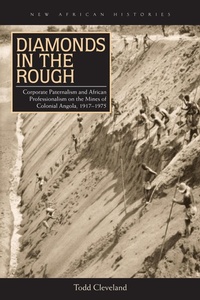
Diamonds in the Rough
Corporate Paternalism and African Professionalism on the Mines of Colonial Angola, 1917-1975
1st Edition
Published on 15. July 2015
277 pages
978-0-8214-4521-1 (ISBN)
Description

Diamonds in the Rough explores the lives of African laborers on Angola's diamond mines from the commencement of operations in 1917 to the colony's independence from Portugal in 1975. The mines were owned and operated by the Diamond Company of Angola, or Diamang, which enjoyed exclusive mining and labor concessions granted by the colonial government. Through these monopolies, the company became the most profitable enterprise in Portugal's African empire. After a tumultuous initial period, the company's mines and mining encampments experienced a remarkable degree of stability, in striking contrast to the labor unrest and ethnic conflicts that flared in other regions. Even during the Angolan war for independence (1961-75), Diamang's zone of influence remained comparatively untroubled.
Todd Cleveland explains that this unparalleled level of quietude was a product of three factors: African workers' high levels of social and occupational commitment, or "professionalism"; the extreme isolation of the mining installations; and efforts by Diamang to attract and retain scarce laborers through a calculated paternalism. The company's offer of decent accommodations and recreational activities, as well as the presence of women and children, induced reciprocal behavior on the part of the miners, a professionalism that pervaded both the social and the workplace environments. This disparity between the harshness of the colonial labor regime elsewhere and the relatively agreeable conditions and attendant professionalism of employees at Diamang opens up new ways of thinking about how Africans in colonial contexts engaged with forced labor, mining capital, and ultimately, each other.
Todd Cleveland explains that this unparalleled level of quietude was a product of three factors: African workers' high levels of social and occupational commitment, or "professionalism"; the extreme isolation of the mining installations; and efforts by Diamang to attract and retain scarce laborers through a calculated paternalism. The company's offer of decent accommodations and recreational activities, as well as the presence of women and children, induced reciprocal behavior on the part of the miners, a professionalism that pervaded both the social and the workplace environments. This disparity between the harshness of the colonial labor regime elsewhere and the relatively agreeable conditions and attendant professionalism of employees at Diamang opens up new ways of thinking about how Africans in colonial contexts engaged with forced labor, mining capital, and ultimately, each other.
Reviews / Votes
"This meticulous study is a must read for scholars and graduate students interested in African labor history and Portuguese colonialism. Those with an interest in (diamond) mining will take away as much as those reading for information on forced labor or on the interplay between the Portuguese colonial state and concessional companies. However, those keen to learn about the rich texture of workers' experiences, both on and o the mine, stand to gain the most." (H-Net) "Diamonds in the Rough is a significant contribution to Angolan historiography and to the literature on mining on the continent. Cleveland persuasively argues that laborers on Angolan mines were active participants in shaping the stable conditions that made Diamang profitable, and, ironically, helped further the Portuguese regime in Angola." "[Cleveland] is particularly strong on African workers' experiences and perceptions of the mines and its Janus-faced character: getting well paid while being exploited. ... [Diamonds in the Rough] is balanced, showing that there are no facile answers and the Appendix, entitled "Digging Deeper," contains useful discussion questions and suggestions for further reading, all of which enhances its quality for the educated layperson and its obvious audience, students." (International Journal of African Historical Studies) "[Cleveland] appropriately and generously acknowledges the many people who shepherded him through these challenge, but, in the end, his own patience and determination were crucial for the appearance of this remarkable work." (Journal of Interdisciplinary History) "This book is relevant, rich, and interesting for people who are interested in the histories of mining in colonial settings, the relationship between the colonial state and companies, the role of companies in the pacification of native peoples, and the emergence and reflections of the working class in the colonies." (Canadian Journal of History)More details
Series
Edition
1. Auflage
Language
English
Place of publication
Athens
United States
Target group
Professional and scholarly
File size
4,26 MB
ISBN-13
978-0-8214-4521-1 (9780821445211)
Copyright in bibliographic data and cover images is held by Nielsen Book Services Limited or by the publishers or by their respective licensors: all rights reserved.
Schweitzer Classification
Other editions
Additional editions
Todd Cleveland
Diamonds in the Rough
Corporate Paternalism and African Professionalism on the Mines of Colonial Angola, 1917-1975
Book
07/2015
Ohio University Press
€99.23
Shipment within 10-20 days
Todd Cleveland
Diamonds in the Rough
Corporate Paternalism and African Professionalism on the Mines of Colonial Angola, 1917-1975
Book
07/2015
Ohio University Press
€38.00
Shipment within 10-20 days
Person
Todd Cleveland is a distinguished professor of history at the University of Arkansas. His books include these Ohio University Press titles: Sports in Africa, Past and Present (2020), Following the Ball: The Migration of African Soccer Players across the Portuguese Colonial Empire, 1949-1975 (2017), Diamonds in the Rough: Corporate Paternalism and African Professionalism on the Mines of Colonial Angola, 1917-1975 (2015), and Stones of Contention: A History of Africa's Diamonds (2014).
Content
- List of Illustrations
- Acknowledgments
- Chapter 1: An Introduction to Angola's Diamond Past
Paternalism, Professionalism, and Place - Chapter 2: A Bountiful Place
The Political Economy of Lunda, 1870-1975 - Chapter 3: The Recruitment Process, 1921-75
- Chapter 4: A Group Effort
The Collaborative Process of Diamond Extraction, 1917-75 - Chapter 5: Negotiating Stability
Laborers' Work-Site Strategies, 1922-75 - Chapter 6: Eventful Evenings
Life after the Whistle Blew, 1925-75 - Chapter 7: To Stay or to Leave
The End of the Labor Contract, 1921-75 - Epilogue
- Notes
- Bibliography
- Index
