

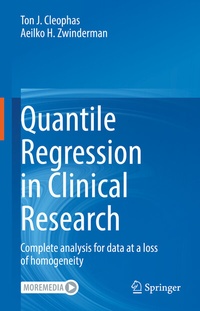
Quantile Regression in Clinical Research
Description

Quantile regression is an approach to data at a loss of homogeneity, for example (1) data with outliers, (2) skewed data like corona - deaths data, (3) data with inconstant variability, (4) big data. In clinical research many examples can be given like circadian phenomena, and diseases where spreading may be dependent on subsets with frailty, low weight, low hygiene, and many forms of lack of healthiness. Stratified analyses is the laborious and rather explorative way of analysis, but quantile analysis is a more fruitful, faster and completer alternative for the purpose. Considering all of this, we are on the verge of a revolution in data analysis. The current edition is the first textbook and tutorial of quantile regressions for medical and healthcare students as well as recollection/update bench, and help desk for professionals. Each chapter can be studied as a standalone and covers one of the many fields in the fast growing world of quantile regressions. Step by step analyses of over 20 data files stored at extras.springer.com are included for self-assessment. We should add that the authors are well qualified in their field. Professor Zwinderman is past-president of the International Society of Biostatistics (2012-2015) and Professor Cleophas is past-president of the American College of Angiology(2000-2002). From their expertise they should be able to make adequate selections of modern quantile regression methods for the benefit of physicians, students, and investigators.
More details
Other editions
Additional editions
Persons
Aeilko H Zwinderman is professor of Statistics and Chair of the Department of Biostatistics and Epidemiology at the University of Amsterdam the Netherlands. His current work focuses on development and validation of multivariable models, particularly in genetic research, and he is a major developer of penalized canonical analysis.
