

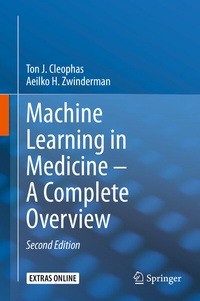
Machine Learning in Medicine - A Complete Overview
Description

Adequate health and health care is no longer possible without proper data supervision from modern machine learning methodologies like cluster models, neural networks, and other data mining methodologies. The current book is the first publication of a complete overview of machine learning methodologies for the medical and health sector, and it was written as a training companion, and as a must-read, not only for physicians and students, but also for any one involved in the process and progress of health and health care.
In this second edition the authors have removed the textual errors from the first edition. Also, the improved tables from the first edition, have been replaced with the original tables from the software programs as applied. This is, because, unlike the former, the latter were without error, and readers were better familiar with them.
The main purpose of the first edition was, to provide stepwise analyses of the novel methods from data examples, but background information and clinical relevance information may have been somewhat lacking. Therefore, each chapter now contains a section entitled "Background Information".
Machine learning may be more informative, and may provide better sensitivity of testing than traditional analytic methods may do. In the second edition a place has been given for the use of machine learning not only to the analysis of observational clinical data, but also to that of controlled clinical trials.
Unlike the first edition, the second edition has drawings in full color providing a helpful extra dimension to the data analysis.
Several machine learning methodologies not yet covered in the first edition, but increasingly important today, have been included in this updated edition, for example, negative binomial and Poisson regressions, sparse canonical analysis, Firth's bias adjusted logistic analysis, omics research, eigenvalues and eigenvectors.
More details
Other editions
Additional editions
Previous edition
Persons
Professor Zwinderman is one of the Principle Investigators of the Academic Medical Center Amsterdam, and his research is concerned with developing statistical methods for new research designs in biomedical science, particularly integrating omics data, like genomics, proteomics, metabolomics, and analysis tools based on parallel computing and the use of cluster computers and grid computing.
Professor Cleophas is a member of the Academic Committee of the European College of Pharmaceutical Medicine, that provides, on behalf of 22 European Universities, the Master-ship trainings "Pharmaceutical Medicine" and "Medicines Development".
From their expertise theyshould be able to make adequate selections of modern methods for clinical data analysis for the benefit of physicians, students, and investigators. The authors have been working and publishing together for 18 years, and their research can be characterized as a continued effort to demonstrate that clinical data analysis is not mathematics but rather a discipline at the interface of biology and mathematics.
The authors as professors and teachers in statistics at universities in The Netherlands and France for the most part of their lives, are concerned, that their students find regression-analyses harder than any other methodology in statistics. This is serious, because almost all of the novel methodologies in current data mining and data analysis include elements of regression-analysis, and they do hope that the current production "Regression Analysis for Starters and 2nd Levelers" will be a helpful companion for the purpose. Five textbookscomplementary to the current production and written by the same authors are
Statistics applied to clinical studies 5th edition, 2012, Machine learning in medicine a complete overview, 2015, SPSS for starters and 2nd levelers 2nd edition, 2015, Clinical data analysis on a pocket calculator 2nd edition, 2016, Modern Meta-analysis, 2017Regression Analysis in Medical Research, 2018 all of them published by Springer
