

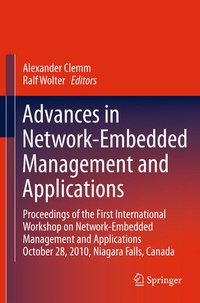
Advances in Network-Embedded Management and Applications
Description

The general trend of modern network devices towards greater intelligence and programmability is accelerating the development of systems that are increasingly autonomous and to a certain degree self-managing. Examples range from router scripting environments to fully programmable server blades. This has opened up a new field of computer science research, reflected in this new volume.
This selection of contributions to the first ever international workshop on network-embedded management applications (NEMA) features six papers selected from submissions to the workshop, held in October 2010 at Niagara Falls, Canada. They represent a wide cross-section of the current work in this vital field of inquiry. Covering a diversity of perspectives, the volume's dual structure first of all examines the 'enablers' for NEMAs-the platforms, frameworks, and development environments which facilitate the evolution of network-embedded management and applications.
The second section of the book covers network-embedded applications that might both empower and benefit from such enabling platforms. These papers cover topics ranging from deciding where to best place management control functions inside a network to a discussion of how multi-core hardware processors can be leveraged for traffic filtering applications. The section concludes with an analysis of a delay-tolerant network application in the context of the 'One Laptop per Child' program.
There is a growing recognition that it is vital to make network operation and administration as easy as possible to contain operational expenses and cope with ever shorter control cycles. This volume provides researchers in the field with the very latest in current thinking.
More details
Other editions
Additional editions
Content
2 - Table of Contents [Seite 8]
3 - Contributors [Seite 9]
4 - Reviewers and NEMA Program Committee Members [Seite 10]
5 - Chapter 1:Challenges and Experiences in Transitioning Management Instrumentation from Command-Oriented to Model-Driven [Seite 12]
5.1 - 1 Introduction [Seite 12]
5.2 - 2 Background [Seite 14]
5.3 - 3 Design Considerations [Seite 15]
5.3.1 - 3.1 Defining the Instrumentation Model [Seite 17]
5.3.1.1 - Derivation from Source Code [Seite 17]
5.3.1.2 - Designing from Domain Knowledge [Seite 17]
5.3.2 - 3.2 Model Inheritance [Seite 18]
5.3.3 - 3.3 Dynamic versus Static Models [Seite 18]
5.3.4 - 3.4 Model Versioning [Seite 18]
5.4 - 4 Implementation Experiences [Seite 19]
5.4.1 - An API Implementation Example [Seite 21]
5.5 - 5 Related Work [Seite 23]
5.6 - 6 Conclusions [Seite 25]
5.6.1 - Further Work [Seite 26]
5.7 - References [Seite 27]
6 - Chapter 2:A Low Power, Programmable Networking Platform and Development Environment [Seite 29]
6.1 - 1 Introduction [Seite 30]
6.2 - 2 Related Work [Seite 31]
6.3 - 3 The SCALOPES C-board [Seite 32]
6.3.2 - 3.2 Internal Structure [Seite 33]
6.3.3 - 3.3 Low Power Design [Seite 35]
6.4 - 4 The Development Environment [Seite 36]
6.4.1 - 4.1 GUI based development [Seite 38]
6.4.2 - 4.2 Custom module development [Seite 39]
6.4.3 - 4.3 Hardware accelerator development [Seite 39]
6.5 - 5 Case Studies [Seite 41]
6.5.1 - 5.1 A Network Monitoring System with DPI Capabilities [Seite 41]
6.5.2 - 5.2 Generic Switch/Router architecture [Seite 43]
6.6 - 6 Summary [Seite 44]
6.7 - References [Seite 45]
7 - Chapter 3:Application Framework for Programmable Network Control [Seite 47]
7.1 - 1 Introduction [Seite 47]
7.2 - 2 Related Work [Seite 48]
7.3 - 3 Application Framework for Network Control [Seite 50]
7.4 - 4 Functional Components [Seite 52]
7.5 - 5 Implementation and Test Bed [Seite 54]
7.5.1 - 5.1 Hardware [Seite 54]
7.6 - 6 Network Control Programs [Seite 57]
7.7 - 7 Conclusion and Future Work [Seite 59]
7.8 - Acknowledgments [Seite 60]
7.9 - References [Seite 60]
8 - Chapter 4:Facilitating Adaptive Placement of Management and Control Functions in Converged ICT Systems [Seite 63]
8.1 - 1 Introduction [Seite 63]
8.2 - 2 Related Work [Seite 65]
8.3 - 3 Adaptive Placement of Management and Control Functions [Seite 67]
8.3.1 - 3.1 Management/Control Capabilities [Seite 68]
8.3.1.2 - Internal Structure of Management Capabilities [Seite 70]
8.3.2 - 3.2 Management and Control Structures [Seite 70]
8.3.3 - 3.4 Realization Options [Seite 71]
8.4 - 4 Scenario: OpenFlow Control and In-Network Management [Seite 72]
8.4.2 - 4.2 Scenario Description [Seite 73]
8.4.3 - 4.3 Discussion of Scenario [Seite 74]
8.5 - 5 Conclusion [Seite 76]
8.6 - References [Seite 77]
9 - Chapter 5:Wire-Speed Hardware-Assisted Traffic Filtering with Mainstream Network Adapters [Seite 81]
9.1 - 1 Introduction [Seite 81]
9.2 - 2 Motivation and Scope of Work [Seite 83]
9.3 - 3 Related Work [Seite 85]
9.4 - 4 Framework Design [Seite 86]
9.5 - 5 Use Cases and Validation [Seite 90]
9.5.1 - 5.1 Realtime Multimedia Traffic Monitoring [Seite 91]
9.5.2 - 5.2 Network Troubleshooting [Seite 92]
9.5.3 - 5.3 Traffic Classification and Balancing [Seite 92]
9.5.5 - 5.5 Firewalling at 10 Gbit [Seite 93]
9.6 - 6 Open Issues and Future Work [Seite 93]
9.7 - 7 Conclusions [Seite 94]
9.8 - References [Seite 94]
10 - Chapter 6:Embedded Rule-based Management for Content-based DTNs [Seite 97]
10.1 - 1 Introduction [Seite 97]
10.2 - 2 An Opportunistic Content-based Routing Protocol [Seite 99]
10.2.1 - 2.1 RON Protocol [Seite 100]
10.3 - 3 Managing a Delay Tolerant Protocol [Seite 101]
10.4 - 4 System Overview [Seite 102]
10.4.1 - 4.1 Common Node Architecture [Seite 103]
10.5 - 5 Implementation [Seite 104]
10.5.2 - 5.2 PDP [Seite 105]
10.5.3 - 5.3 Rmoon [Seite 106]
10.5.4 - 5.4 RON [Seite 106]
10.6 - 6 Management Footprint [Seite 107]
10.7 - 7 Conclusions and Future Work [Seite 109]
10.9 - References [Seite 110]
