

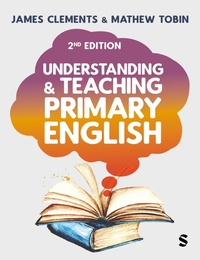
Understanding and Teaching Primary English
Theory Into Practice
2nd Edition
Published on 28. March 2026
352 pages
978-1-0362-0337-5 (ISBN)
Description

Covering all major aspects of primary English, from reading and writing, to grammar, vocabulary and oracy, and following the foundations set in the early years, this book will support you through your teacher training and early career in the classroom while also offering fresh insights for experienced teachers.
Each topic moves from robust theory and the latest research to practical classroom application, offering nuanced teaching guidance grounded in experience.
Hands-on strategies, classroom case studies and opportunities to reflect on your learning combine to support high-quality literacy teaching, and effective planning and assessment.
This second edition has been fully updated to:
Apply insight from recent policy to teaching, including the DfE's 2023 Reading Framework and the policy intentions of the 2024 Labour government.
Offer guidance on teaching children for whom English is an additional language (EAL).
Expand the discussion of reading for pleasure, utilising recent research on this topic.
Each topic moves from robust theory and the latest research to practical classroom application, offering nuanced teaching guidance grounded in experience.
Hands-on strategies, classroom case studies and opportunities to reflect on your learning combine to support high-quality literacy teaching, and effective planning and assessment.
This second edition has been fully updated to:
Apply insight from recent policy to teaching, including the DfE's 2023 Reading Framework and the policy intentions of the 2024 Labour government.
Offer guidance on teaching children for whom English is an additional language (EAL).
Expand the discussion of reading for pleasure, utilising recent research on this topic.
More details
Edition
Second Edition
Language
English
Place of publication
London
United Kingdom
Publishing group
SAGE Publishing (Digital)
Target group
College/higher education
File size
3,64 MB
ISBN-13
978-1-0362-0337-5 (9781036203375)
Copyright in bibliographic data and cover images is held by Nielsen Book Services Limited or by the publishers or by their respective licensors: all rights reserved.
Schweitzer Classification
Other editions
Additional editions
Book
approx. 04/2026
2nd Edition
SAGE Publications Ltd
€179.40
Not yet published
Book
03/2026
2nd Edition
SAGE Publications Ltd
€135.50
Shipment within 3-4 weeks
Persons
James Clements is an experienced teacher, researcher, and education writer. He has worked with groups of schools, education organisations and governments in the UK and across the world. James' principal areas of interest are children's development of language and language comprehension, how schools create rich reading cultures, and authentic ways of supporting children's written communication. Prior to this, James was a primary teacher and school leader in central London. He is the author of Teaching English by the Book.
Mathew Tobin was a primary teacher and school leader for many years before becoming a senior lecturer in Primary English and Children's Literature. He continues to work closely with school practitioners and pupils particularly with a particular focus on raising standards in English. He is passionate about raising the profile of Reading Teachers and the Reflecting Realities agenda and teaches these areas at both Undergraduate and Postgraduate level. Mathew is often invited to chair discussions around Children's Literature, deliver keynotes and is involved in various judging panels. His own research interests include exploring the relationships between children's literature and the landscapes and the pedagogical potential and benefits of a locality-based curriculum.
Mathew Tobin was a primary teacher and school leader for many years before becoming a senior lecturer in Primary English and Children's Literature. He continues to work closely with school practitioners and pupils particularly with a particular focus on raising standards in English. He is passionate about raising the profile of Reading Teachers and the Reflecting Realities agenda and teaches these areas at both Undergraduate and Postgraduate level. Mathew is often invited to chair discussions around Children's Literature, deliver keynotes and is involved in various judging panels. His own research interests include exploring the relationships between children's literature and the landscapes and the pedagogical potential and benefits of a locality-based curriculum.
Content
Part 1: English in the Early Years
Ch1 Reading in the Early Years: Theory
Ch2 Reading in the Early Years: Practice
Ch3 Writing in the Early Years: Theory
Ch4 Writing in the Early Years: Practice
Part 2: Oracy and Spoken Language
Ch5 Talk, Oracy and Spoken Language: Theory
Ch6 Talk, Oracy and Spoken Language: Practice
Part 3: Reading
Ch7 The Simple View of Reading: Theory
Ch8 The Simple View of Reading: Practice
Ch9 Becoming a Reader: Theory and Practice in Reading for Pleasure
Ch10 Teachers as Readers - Understanding the Importance of Children's Literature: Theory and Practice
Part 4: Writing
Ch11 The Teaching and Learning of Writing: Theory
Ch12 The Teaching and Learning of Writing: Practice
Ch13 Teaching Grammar and Punctuation in Context: Theory and Practice
Part 5: Vocabulary and Word Knowledge
Ch14 Building Vocabulary and Word Knowledge: Theory and Practice
Part 6: Curriculum, Planning and Assessment
Ch15 Curriculum and Planning in Primary English: Theory
Ch16 Curriculum and Planning in Primary English: Practice
Ch17 Assessment in English: Theory
Ch18 Assessment in English: Practice
Ch1 Reading in the Early Years: Theory
Ch2 Reading in the Early Years: Practice
Ch3 Writing in the Early Years: Theory
Ch4 Writing in the Early Years: Practice
Part 2: Oracy and Spoken Language
Ch5 Talk, Oracy and Spoken Language: Theory
Ch6 Talk, Oracy and Spoken Language: Practice
Part 3: Reading
Ch7 The Simple View of Reading: Theory
Ch8 The Simple View of Reading: Practice
Ch9 Becoming a Reader: Theory and Practice in Reading for Pleasure
Ch10 Teachers as Readers - Understanding the Importance of Children's Literature: Theory and Practice
Part 4: Writing
Ch11 The Teaching and Learning of Writing: Theory
Ch12 The Teaching and Learning of Writing: Practice
Ch13 Teaching Grammar and Punctuation in Context: Theory and Practice
Part 5: Vocabulary and Word Knowledge
Ch14 Building Vocabulary and Word Knowledge: Theory and Practice
Part 6: Curriculum, Planning and Assessment
Ch15 Curriculum and Planning in Primary English: Theory
Ch16 Curriculum and Planning in Primary English: Practice
Ch17 Assessment in English: Theory
Ch18 Assessment in English: Practice
