

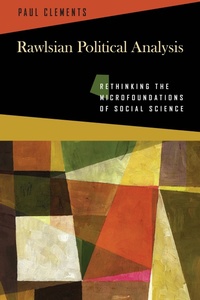
Rawlsian Political Analysis
Rethinking the Microfoundations of Social Science
1st Edition
Published on 30. June 2012
277 pages
978-0-268-07696-2 (ISBN)
Description

In Rawlsian Political Analysis: Rethinking the Microfoundations of Social Science, Paul Clements develops a new, morally grounded model of political and social analysis as a critique of and improvement on both neoclassical economics and rational choice theory. What if practical reason is based not only on interests and ideas of the good, as these theories have it, but also on principles and sentiments of right? The answer, Clements argues, requires a radical reorientation of social science from the idea of interests to the idea of social justice.
According to Clements, systematic weaknesses in neoclassical economics and rational choice theory are due to their limited model of choice. According to such theories in the utilitarian tradition, all our practical decisions aim to maximize the satisfaction of our interests. These neo-utilitarian approaches focus on how we promote our interests, but Clements argues, our ideas of right, cognitively represented in principles, contribute independently and no less fundamentally to our practical decisions.
The most significant challenge to utilitarianism in the last half century is found in John Rawls's Theory of Justice and Political Liberalism, in which Rawls builds on Kant's concept of practical reason. Clements extends Rawls's moral theory and his critique of utilitarianism by arguing for social analysis based on the Kantian and Rawlsian model of choice. To illustrate the explanatory power of his model, he presents three detailed case studies: a program analysis of the Grameen Bank of Bangladesh, a political economy analysis of the causes of poverty in the Indian state of Bihar, and a problem-based analysis of the ethics and politics of climate change. He concludes by exploring the broad implications of social analysis grounded in a concept of social justice.
According to Clements, systematic weaknesses in neoclassical economics and rational choice theory are due to their limited model of choice. According to such theories in the utilitarian tradition, all our practical decisions aim to maximize the satisfaction of our interests. These neo-utilitarian approaches focus on how we promote our interests, but Clements argues, our ideas of right, cognitively represented in principles, contribute independently and no less fundamentally to our practical decisions.
The most significant challenge to utilitarianism in the last half century is found in John Rawls's Theory of Justice and Political Liberalism, in which Rawls builds on Kant's concept of practical reason. Clements extends Rawls's moral theory and his critique of utilitarianism by arguing for social analysis based on the Kantian and Rawlsian model of choice. To illustrate the explanatory power of his model, he presents three detailed case studies: a program analysis of the Grameen Bank of Bangladesh, a political economy analysis of the causes of poverty in the Indian state of Bihar, and a problem-based analysis of the ethics and politics of climate change. He concludes by exploring the broad implications of social analysis grounded in a concept of social justice.
Reviews / Votes
"This is an ambitious book; it offers a strong and powerful critique of theories that try to explain social reality merely in terms of interests. In place of such interest-based analyses it highlights the value of Rawlsian political analysis as it acknowledges the role played by principles in the construction and explanation of our social world-institutions as well as individual action-and allows us to bring in concerns of justice and human freedom." -Gurpreet Mahajan, Jawaharlal Nehru University"Economists claim that people act out of self-interest. Sociologists claim that people act according to norms and principles. Both sides recognize that they do not have the whole story, yet few efforts have been made at synthesizing the two. That situation is changing now, as social scientists endeavor, not to discard the utility-maximizing model of rational action, but to enhance it. Paul Clements' new book brings philosophy, political science, and development economics to bear on this task. The result is an important and interesting contribution to an exciting new area of research." -Peter Stone, Trinity College Dublin
"There have been few applications of Rawls in the real world, yet Clements admirably exemplifies his methodological claim in three chapters discussing the Grameen bank in Bangladesh, the (sorry) state of Bihar in India and the politics of climate change. . . . Clements' book is a welcome and thoughtful addition to the debate on how to analyse social agency . . . this thought-provoking book will undoubtedly spark lively discussions in postgraduate poitics seminars." -Political Studies Review
"Clements has done a very valuable service in clearly articulating and demonstrating the importance of ensuring that socio-political analysis embrace a Rawlsian perspective. Clements presents not only a thoughtful and persuasive theoretical argument, but, importantly, he supports that argument with c"oncrete evidence." -The Review of Politics
"John Rawls's writings on justice, political liberalism, and international justice have had an enormous influence on contemporary political theory and law. Clements has now appropriated Rawls to serve as the micro-foundation of the social sciences generally." -Choice
"Presents a new framework for political analysis based on the work of Immanuel Kant and John Rawls." -Journal of Economic Literature
"Paul Clements's Rawlsian Political Analysis mounts an important intervention into the philosophy of the social sciences, challenging the tired fact/value, empirical/normative binaries that continue to impoverish social analysis. His insistence that social analysis must engage both facts and norms, the empirical and the normative, the good and the right, interest and principle-and that empirical social scientists must engage constructively on questions of autonomy and social justice-is noble and ultimately essential if social science is to justify its place in the years to come." -Fonna Forman-Barzilai, University of California, San Diego
More details
Other editions
Additional editions
Book
06/2012
University of Notre Dame Press
€34.50
Article not available at the moment
Person
Paul Clements is professor of political science at Western Michigan University.
Content
- Cover
- Half title
- Title page
- Copyright
- Dedication
- Contents
- Acknowledgments
- Chapter One: Introduction
- Chapter Two: The Cognition of Principles and the Role of Rawlsian Political Analysis
- Chapter Three: The Analytic Limits of Rational Choice Theory
- Chapter Four: Program Analysis of the Grameen Bank
- Chapter Five: Political Analysis of Problems in Bihar
- Chapter Six: The Ethics and the Politics of Climate Change
- Chapter Seven: Kantian Ontology of Practical Reason and Social Science
- Notes
- Works Cited
- Index
