

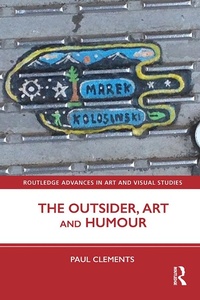
The Outsider, Art and Humour
1st Edition
Published on 7. May 2020
226 pages
978-1-000-05758-4 (ISBN)
Description

This cross-disciplinary book, situated on the periphery of culture, employs humour to better comprehend the arts, the outsider and exclusion, illuminating the ever-changing social landscape, the vagaries of taste and limits of political correctness.
Each chapter deals with specific themes and approaches - from the construct of outsider and complexity of humour, to Outsider Art and spaces - using various theoretical and analytical methods. Paul Clements draws on humour, especially from visual arts and culture (and to a lesser extent literature, film, music and performance), as a tool of ridicule, amongst other discourses, employed by the powerful but also as a weapon to satirize them. These ambiguous representations vary depending on context, often assimilated then reinterpreted in a game of authenticity that is poignant in a world of facsimile and 'fake news'. The humour styles of a range of artists are highlighted to reveal the fluidity and diversity of meaning which challenges expectations and at its best offers resistance and, crucially, a voice for the marginal.
This book will be of particular interest to scholars in art history, cultural studies, fine art, humour studies and visual culture.
Each chapter deals with specific themes and approaches - from the construct of outsider and complexity of humour, to Outsider Art and spaces - using various theoretical and analytical methods. Paul Clements draws on humour, especially from visual arts and culture (and to a lesser extent literature, film, music and performance), as a tool of ridicule, amongst other discourses, employed by the powerful but also as a weapon to satirize them. These ambiguous representations vary depending on context, often assimilated then reinterpreted in a game of authenticity that is poignant in a world of facsimile and 'fake news'. The humour styles of a range of artists are highlighted to reveal the fluidity and diversity of meaning which challenges expectations and at its best offers resistance and, crucially, a voice for the marginal.
This book will be of particular interest to scholars in art history, cultural studies, fine art, humour studies and visual culture.
Reviews / Votes
"Clements shows us why humor and joking in art, and in particular 'outsider art,' should matter to us. His book is funny, and he explains the jokes, yet it is serious because humor can heal or abuse and we ought to care whether it makes people's lives better or worse. ... Clements' book is a great primer for scholars, jokers, and artists who seek justice in a crazy world."--Rhizomes: Cultural Studies in Emerging Knowledge
More details
Series
Edition
1. Auflage
Language
English
Place of publication
London
United Kingdom
Publishing group
Taylor & Francis Ltd
Target group
College/higher education
Illustrations
25 Illustrations, black and white
ISBN-13
978-1-000-05758-4 (9781000057584)
Copyright in bibliographic data and cover images is held by Nielsen Book Services Limited or by the publishers or by their respective licensors: all rights reserved.
Schweitzer Classification
Other editions
Additional editions
Paul Clements
The Outsider, Art and Humour
Book
06/2020
Routledge
Unfortunately, price unknown
Available (delivery time upon request)
Paul Clements
The Outsider, Art and Humour
Book
05/2020
1st Edition
Routledge
€167.13
Shipment within 15-20 days
Person
Paul Clements is Lecturer at Goldsmiths College, University of London. He is the author of The Creative Underground: Art, Politics and Everyday Life (Routledge, 2017) and Charles Bukowski, Outsider Literature, and the Beat Movement (Routledge, 2013).
Content
Introduction
Approaches to humour and laughter
The construct of outsider: media labelling, 'othering' and excluded minds
The construct of outsider: identity, the body and representation
Humorous representations of the outsider: hybridity, utility and carnivalesque
Representations of humour by marginal artists
Creative outsider spaces and dark heterotopias
Transgression, spectacle and political correctness
Afterthoughts
Approaches to humour and laughter
The construct of outsider: media labelling, 'othering' and excluded minds
The construct of outsider: identity, the body and representation
Humorous representations of the outsider: hybridity, utility and carnivalesque
Representations of humour by marginal artists
Creative outsider spaces and dark heterotopias
Transgression, spectacle and political correctness
Afterthoughts
