

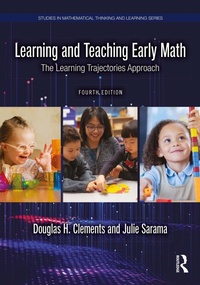
Learning and Teaching Early Math
The Learning Trajectories Approach
4th Edition
Will be published approx. on 18. June 2026
540 pages
978-1-040-66396-7 (ISBN)
Description

This definitive fourth edition synthesizes the research and wisdom of expert teachers on how young children learn mathematics and how effective teachers support their development with learning trajectories. The learning trajectories approach builds on what children know and can do, using activities tailored to develop the next level of thinking. By focusing on the inherent delight and curiosity behind young children's mathematical reasoning, learning trajectories make teaching more joyful. Through helping teachers understand the varying levels of children's thinking and learning, this approach allows teachers to better meet the learning needs of all children. This thoroughly revised edition builds on the comprehensive research base of past volumes while drawing on numerous new research studies, expanded international examples, and updated illustrations. Chapters are also more closely linked with Learning and Teaching with Learning Trajectories [LT] (2)-an open-access, web-based tool that includes videos, interactive games, and practical classroom resources to help early childhood educators understand how children think and learn about mathematics. Ideal as a curriculum planning resource for mathematics administrators and leaders, as a professional development resource for early math teachers, and as a resource for math methods courses, this book brings the authors' nationally recognized learning trajectories approach directly into your classroom.
More details
Series
Edition
4th edition
Language
English
Place of publication
London
United Kingdom
Publishing group
Taylor & Francis Ltd
Target group
College/higher education
Professional and scholarly
Product notice
Reflowable
Illustrations
37 Tables, black and white; 178 Line drawings, black and white; 153 Halftones, black and white; 331 Illustrations, black and white
File size
17,16 MB
ISBN-13
978-1-040-66396-7 (9781040663967)
Copyright in bibliographic data and cover images is held by Nielsen Book Services Limited or by the publishers or by their respective licensors: all rights reserved.
Schweitzer Classification
Other editions
Additional editions
Douglas H. Clements | Julie Sarama
Learning and Teaching Early Math
The Learning Trajectories Approach
Book
approx. 06/2026
4th Edition
Routledge
€179.50
Not yet published
Douglas H. Clements | Julie Sarama
Learning and Teaching Early Math
The Learning Trajectories Approach
Book
approx. 06/2026
4th Edition
Routledge
€68.50
Not yet published
Persons
Douglas H. Clements is a Distinguished University Professor, the Kennedy Endowed Chair in Early Childhood Learning, and the Co-Executive Director of the Marsico Institute of Early Learning, University of Denver, USA.
Julie Sarama is a Distinguished University Professor, the Kennedy Endowed Chair in Innovative Technology, and the Co-Executive Director of the Marsico Institute of Early Learning, University of Denver, USA.
Julie Sarama is a Distinguished University Professor, the Kennedy Endowed Chair in Innovative Technology, and the Co-Executive Director of the Marsico Institute of Early Learning, University of Denver, USA.
Content
1. Young Children and Mathematics Learning 2. Quantity, Number, and Subitizing 3. Verbal and Object Counting 4. Comparing, Ordering, and Estimating 5. Arithmetic: Early Addition and Subtraction and Counting Strategies 6. Arithmetic: Composition of Number, Place Value, Multidigit Addition and Subtraction, Multiplication and Division, and Fractions 7. Spatial Thinking 8. Shape 9. Composition and Decomposition of Shapes 10. Geometric Measurement: Length 11. Geometric Measurement: Area, Volume, and Angle 12. Other Content Domains: Patterns, Structure, and Algebraic Thinking; Classi?cation and Data 13. Mathematical Processes and Practices 14. Cognition and Affect 15. Early Childhood Mathematics Education for All: Contexts, Curricula, and Cultures 16. Instructional Practices and Pedagogical Issues
