

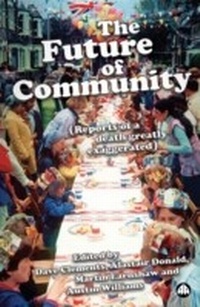
The Future of Community
Reports of a Death Greatly Exaggerated
1st Edition
Published on 20. October 2008
208 pages
978-1-84964-408-2 (ISBN)
Description

We are constantly being told that communities are under threat, that we are losing a 'sense of community'. This book finds that the notion of community in Britain is actually threatened by the very thing intended to protect it; relentless government and third party interventions bent on imposing their own forms of social cohesion on the population.
There is no doubt that modern societies, underpinned by a ruthlessly competitive and individualistic economic system, have undermined ties of family, solidarity and commonality. However, when an idea of community is articulated it is almost invariably along conservative and reactionary lines - with unelected spokespersons unquestionably accepted as 'community leaders', and with formal contractual relationships taking the place of 'traditional' social order. The short, punchy articles in this book criticise attempts by the state and other agencies to correct the so-called collapse of communities.
This book is for students and citizens looking to get beyond the hysterical rhetoric of the government and media to find out about the real communities of the 21st century.
There is no doubt that modern societies, underpinned by a ruthlessly competitive and individualistic economic system, have undermined ties of family, solidarity and commonality. However, when an idea of community is articulated it is almost invariably along conservative and reactionary lines - with unelected spokespersons unquestionably accepted as 'community leaders', and with formal contractual relationships taking the place of 'traditional' social order. The short, punchy articles in this book criticise attempts by the state and other agencies to correct the so-called collapse of communities.
This book is for students and citizens looking to get beyond the hysterical rhetoric of the government and media to find out about the real communities of the 21st century.
Reviews / Votes
'A much-needed challenge to the complacent orthodoxies currently dominating the debate. It asks all the right questions: What are communities? What's so great about them? How do they really thrive? This book will lift the communities debate to another level' -- Julian Baggini, author of Welcome to Everytown: A Journey into the English Mind 'This powerful book is an alternative to the tradition of swansongs to lost communities' -- Professor Dennis Hayes, Oxford Brookes University, co-author of Basildon: The Mood of the NationMore details
Edition
1. Auflage
Language
English
Place of publication
London
United Kingdom
File size
0,84 MB
ISBN-13
978-1-84964-408-2 (9781849644082)
Copyright in bibliographic data and cover images is held by Nielsen Book Services Limited or by the publishers or by their respective licensors: all rights reserved.
Schweitzer Classification
Other editions
Additional editions
Dave Clements | Alastair Donald | Martin Earnshaw
The Future of Community
Reports of a Death Greatly Exaggerated
Book
10/2008
Pluto Press
€126.28
Article exhausted; check different version
Dave Clements | Alastair Donald | Martin Earnshaw
The Future of Community
Reports of a Death Greatly Exaggerated
Book
10/2008
Pluto Press
€48.46
Article exhausted; check different version
Persons
Dave Clements works as a policy adviser in children's social care. He has written widely for publications including the Guardian, spiked-online and Community Care Magazine. He is the co-editor of The Future of Community (Pluto, 2008).
Alastair Donald is researching Urban Systems and Metropolitan Design at the Martin Centre for Architectural and Urban Studies, University of Cambridge. He is co-editor of The Future of Community (Pluto, 2009) and The Lure of the City (Pluto, 2011).
Martin Earnshaw was a convenor of the 2006 Future of Community conference, held at Central St Martins. He is co-editor of The Future of Community (Pluto, 2008).
Austin Williams is author of The Enemies of Progress (Societas, 2008) and co-editor of The Future of Community (Pluto, 2009) and The Lure of the City (Pluto, 2008). He is the founder of ManTownHuman, director of the Future Cities Project and convenor of the infamous 'Bookshop Barnies' book discussions.
Alastair Donald is researching Urban Systems and Metropolitan Design at the Martin Centre for Architectural and Urban Studies, University of Cambridge. He is co-editor of The Future of Community (Pluto, 2009) and The Lure of the City (Pluto, 2011).
Martin Earnshaw was a convenor of the 2006 Future of Community conference, held at Central St Martins. He is co-editor of The Future of Community (Pluto, 2008).
Austin Williams is author of The Enemies of Progress (Societas, 2008) and co-editor of The Future of Community (Pluto, 2009) and The Lure of the City (Pluto, 2008). He is the founder of ManTownHuman, director of the Future Cities Project and convenor of the infamous 'Bookshop Barnies' book discussions.
Content
Acknowledgements
Introduction: Who needs Community Anyway? - Austin Williams
Part I: In Search of Community
1. Faking Civil Society - Dave Clements
2. A Green Unpleasant Land - Alastair Donald
3. Public Space: Designing-in Community' - Richard Williams
Part II: Constructing Communities
4. New New Urbanism - Austin Williams
5. Density Versus Sprawl - Karl Sharro
6. Salvation by Brick? The Life and Death of British Communities - by Penny Lewis
Part III: Communities in Flux
7. Strictly Personal: The Working Class confined to Community - Andrew Calcutt
8. Virtual Communities versus Political Realities - Martyn Perks
9. Minorities, Multiculturalism and the Metropolitan Experience - Neil Davenport
10. From Little Italy to Big America - Elizabetta Gasparoni -Abraham
11. Rio on Galway: Immigration on Ireland - Suzy Dean
Part IV: Undermining Communities
12. Communities on the Couch - Martin Earnshaw
13. Youthful Misbehaviour or Adult Traumas? - Stuart Waiton
14. Parish Pump Politics - Dave Clements
Conclusion: A Death Greatly Exaggerated - Alastair Donald
Notes on Contributors
Index
Introduction: Who needs Community Anyway? - Austin Williams
Part I: In Search of Community
1. Faking Civil Society - Dave Clements
2. A Green Unpleasant Land - Alastair Donald
3. Public Space: Designing-in Community' - Richard Williams
Part II: Constructing Communities
4. New New Urbanism - Austin Williams
5. Density Versus Sprawl - Karl Sharro
6. Salvation by Brick? The Life and Death of British Communities - by Penny Lewis
Part III: Communities in Flux
7. Strictly Personal: The Working Class confined to Community - Andrew Calcutt
8. Virtual Communities versus Political Realities - Martyn Perks
9. Minorities, Multiculturalism and the Metropolitan Experience - Neil Davenport
10. From Little Italy to Big America - Elizabetta Gasparoni -Abraham
11. Rio on Galway: Immigration on Ireland - Suzy Dean
Part IV: Undermining Communities
12. Communities on the Couch - Martin Earnshaw
13. Youthful Misbehaviour or Adult Traumas? - Stuart Waiton
14. Parish Pump Politics - Dave Clements
Conclusion: A Death Greatly Exaggerated - Alastair Donald
Notes on Contributors
Index
